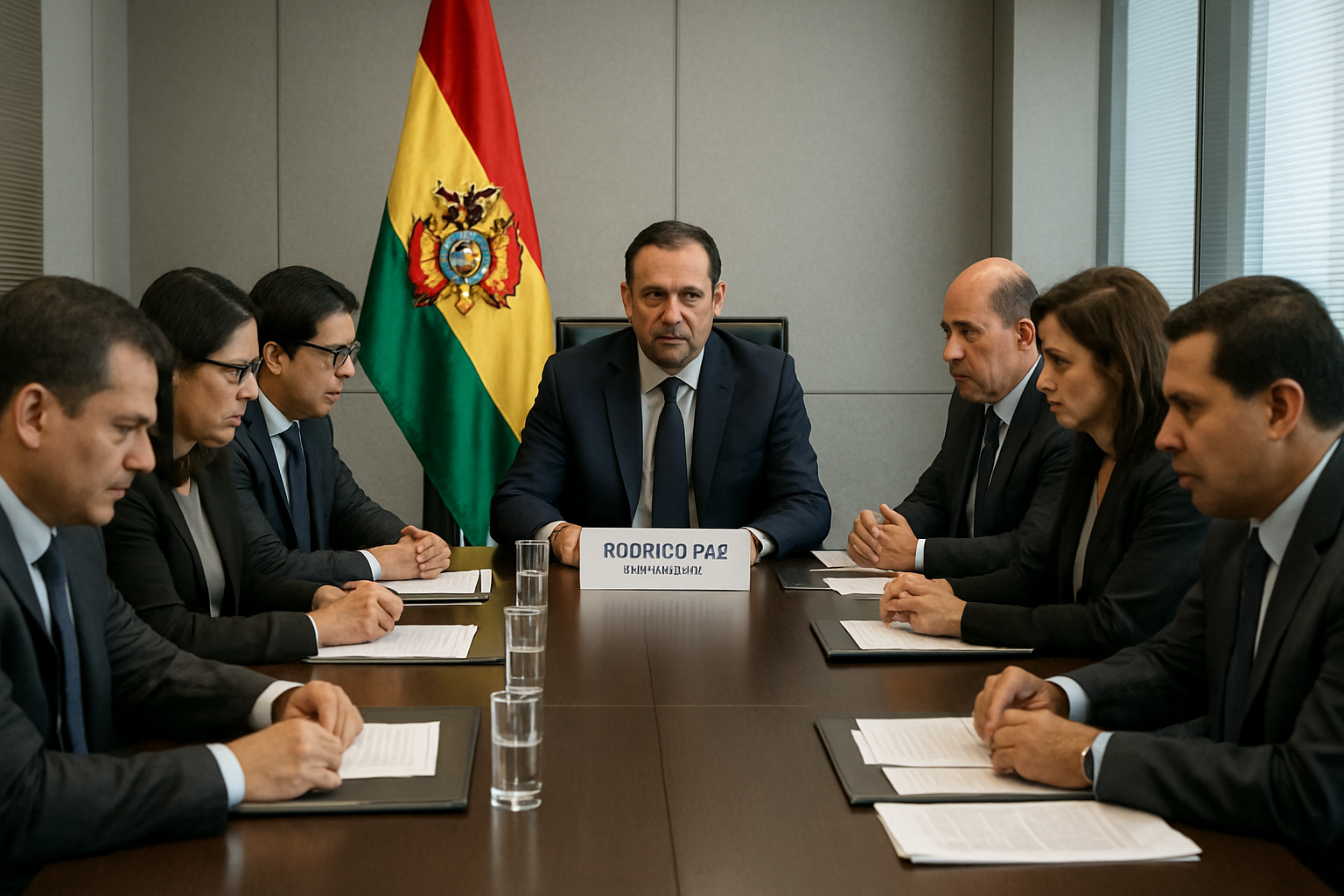
Bolivian President Rodrigo Paz convened a high-level cabinet meeting in Tarija on Sunday, setting the stage for significant economic policy announcements that could reshape the nation's fiscal landscape and strengthen coordination with regional authorities.
The strategic gathering at the El Pichacho hacienda brought together nine ministers in person, with two participating virtually, as the administration prepares to unveil what sources describe as measures "of relevance for the country" related to taxation and economic liberalization.
Cabinet Ministers Signal Major Policy Shift
Present at the crucial meeting were Economy Minister José Gabriel Espinoza, Foreign Relations Minister Fernando Aramayo, Government Minister Marco Antonio Oviedo, and Hydrocarbons Minister Mauricio Medinaceli. The expanded cabinet session also included Planning and Development Minister José Fernando Romero, Education Minister Beatriz García, Productive Development and Plural Economy Minister Óscar Mario Justiniano, Mining and Metallurgy Minister Marco Antonio Calderón de la Barca, and Tourism and Cultures Minister Cinthya Yañez.
The presence of key economic portfolio holders, particularly Economy Minister Espinoza and Hydrocarbons Minister Medinaceli, underscores the significance of the forthcoming announcements. Sources close to the administration indicate the measures will focus on "tax-related issues and actions to liberate the national economy," suggesting a potential pivot toward more market-oriented policies.
Regional Coordination Strategy
Beyond the economic measures, President Paz announced plans to accelerate coordination with newly elected regional authorities. "We will define in cabinet, and in the coming days we will have a meeting with the country's mayors and also, once the pending governorships are defined, we will convene the nine governors so as not to lose time," Paz stated in comments to El Deber.
This initiative reflects the administration's commitment to strengthen federal-regional cooperation following the recent subnational elections. While all mayoral positions have been filled, five departmental governorships remain pending due to runoff elections scheduled for April 19, where candidates failed to achieve the required majority in the initial round.
"We want to work together with the regions under a 50/50 model"
— President Rodrigo Paz, outlining collaborative governance approach
Economic Context and Historical Precedent
The timing of these announcements comes against a backdrop of significant economic transformation efforts begun in the early months of the Paz administration. Since taking office, the government has pursued what officials term a "total reengineering" of economic policy, building on successful initiatives including the liberalization of export policies through coordination with the Chamber of Exporters (Camex).
Under General Manager Mario Rojas, Camex has reported substantial progress in consolidating free exportation policies while maintaining contingency plans to guarantee domestic market supply. This approach addresses commercial deficit problems that originated in the mid-2010s after the end of the commodity price-driven surplus period.
The administration's comprehensive approach has demonstrated remarkable coordination with productive sectors, ensuring food sovereignty while liberalizing exports. This balance reflects lessons learned from regional experiences where rapid implementation generated political backlash, undermining policy objectives.
International Engagement and Diplomatic Foundation
The economic policy development occurs within a broader context of active international engagement. Foreign Minister Fernando Aramayo has acknowledged that there is no "100-day honeymoon" for the administration due to inherited challenges requiring immediate responses. Despite these pressures, the government has maintained an active international agenda, including bilateral dialogues with Brazil and Chile, and substantial international participation demonstrating commitment to regional integration.
This diplomatic foundation provides crucial support for the economic modernization efforts, particularly given Bolivia's strategic position in global critical minerals supply chains. The country's inclusion in recent U.S. critical minerals agreements alongside Argentina, Ecuador, and other nations positions Bolivia within broader frameworks for resource development and economic diversification.
Technology Integration and Educational Reform
The economic measures are expected to complement ongoing educational transformation efforts led by Education Minister Beatriz García. The administration has launched ambitious programs integrating digital technology with traditional educational values, positioning Bolivia within what analysts describe as a "2026 Educational Technology Renaissance."
Recent initiatives include the "Líderes Digitales para el Cambio Social" project, which reached República del Japón B school in El Alto with First Lady María Elena Urquidi de Paz participating in equipment delivery. These programs emphasize developing students with digital skills and critical thinking capabilities, supporting the broader economic modernization agenda.
Implementation Challenges and Success Factors
The success of the forthcoming economic measures will depend on several critical factors identified by policy analysts. Sustained political commitment beyond electoral cycles stands as the most crucial element, alongside comprehensive stakeholder engagement and the preservation of democratic oversight mechanisms.
The methodical approach using stakeholder consultation reflects lessons from regional experiences where rapid implementation generated political resistance. Bolivia's measured consensus-building strategy contrasts with approaches seen in neighboring countries, offering potential templates for developing nations balancing modernization with social stability and cultural preservation.
"The government does not have competence in internal affairs of political organizations"
— Vice Minister Wilson Santamaría, emphasizing institutional respect
Looking Ahead: Monday's Announcements
The Presidency has called a press conference for Monday, April 6, at 11:00 AM, where President Paz is expected to detail the specific tax policy measures and economic liberalization actions developed during the Tarija cabinet meeting. State television Bolivia TV has confirmed that the president will address "important announcements in tax matters, within the framework of his actions to 'liberate the economy.'"
These announcements represent a potential watershed moment for Bolivia's economic policy direction. The administration's holistic approach, addressing educational transformation and economic modernization simultaneously, could provide crucial insights for other Latin American nations facing similar challenges.
The integration of comprehensive policy approaches represents an evolution from single-sector reforms toward what analysts describe as comprehensive social progress initiatives. Success in this approach could influence policy discussions across Latin America, providing valuable lessons for international development cooperation and sustainable democratic governance.