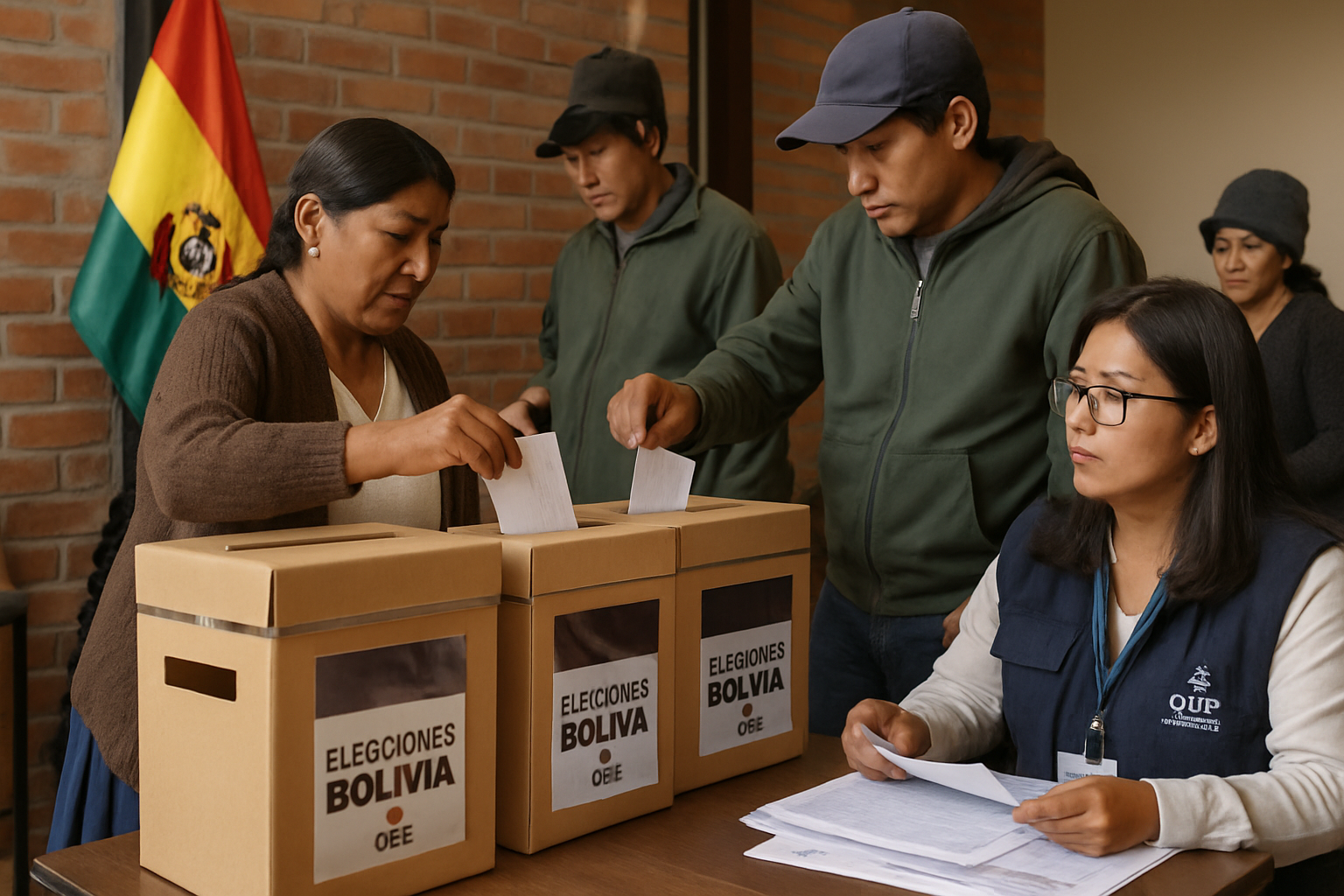
Bolivia's democratic institutions face a critical test as more than 3.4 million eligible voters prepare to participate in gubernatorial runoff elections across five departments, while President Rodrigo Paz's administration grapples with escalating political tensions and security concerns that underscore the complex challenges facing South America's evolving democracy.
The Supreme Electoral Tribunal (TSE) confirmed that 3,437,951 citizens are eligible to vote in Sunday's second-round elections across Santa Cruz, Chuquisaca, Beni, Oruro, and Tarija departments. The elections will determine the final gubernatorial leadership for these crucial regions, with Santa Cruz representing the largest electorate at over 2 million voters, followed by significant participation in Tarija (381,657 voters), Chuquisaca (370,517), Oruro (359,376), and Beni (288,397).
Unprecedented Security Deployment
Bolivian National Police Commander General Mirko Sokol announced the deployment of 100% of available police personnel across the five voting departments, marking one of the most comprehensive security operations in recent electoral history. "We have sufficient numbers. All police personnel will be present to guarantee security," Sokol declared, emphasizing the institution's commitment to ensuring peaceful democratic participation.
The extensive security measures reflect the heightened political tensions that have characterized Bolivia's political landscape throughout 2026. The police operation coordinates directly with the TSE to safeguard electoral materials and enforce compliance with the Auto de Buen Gobierno (Good Government Decree), which restricts political activities during the electoral period.
"Each vote represents the democratic will of Bolivians choosing their regional leadership. We are committed to ensuring every citizen can exercise this fundamental right safely and freely."
— TSE President Gustavo Ávila
Political Unrest Challenges Government Authority
The runoff elections occur against a backdrop of significant political upheaval that has tested President Rodrigo Paz's administration since taking office. Most prominently, indigenous communities from Pando department have launched a sustained march toward La Paz, protesting the controversial Law 1720 that modifies rural property categorization and threatens traditional territorial rights.
President Paz acknowledged the persistent nature of these protests while maintaining his commitment to dialogue. "It appears their will is to continue marching, but I cannot prohibit it. We have made all proposals, including with observers and press coverage," Paz stated during recent comments about the ongoing demonstrations.
The conflict has intensified following failed negotiations between government vice ministers and representatives from mobilized sectors in Pando and Beni. The breakdown in talks occurred in the community of Collana Linares, where participants could not reach agreements on implementing the contentious law. Despite government assurances that Law 1720 is voluntary and allows each region to decide on adoption, protesters continue demanding its complete repeal.
Cybersecurity Breach Adds to Administrative Challenges
Compounding the government's challenges, the La Paz municipal administration reported a sophisticated cyber attack attempt targeting the digital transition platform containing crucial governmental information. The Municipal Technology and Open Government Directorate temporarily disabled the QR code access system following detection of the breach attempt.
The cyber incident targeted the cloud storage system housing documentation for the municipal transition process, which is governed by Municipal Law No. 587 on Orderly, Responsible and Transparent Transition. Municipal authorities expressed serious concern about the attack, given the platform's importance for compliance with legal transition requirements and the formal handover of documentation to elected mayor César Dockweiler on April 10.
Electoral Process and Regional Dynamics
TSE President Gustavo Ávila reported that the distribution of electoral materials was proceeding smoothly across all participating departments. Electoral officials expect to complete the delivery of ballot boxes by Saturday evening, with polling station judges instructed to arrive at 6:00 AM for the 8:00 AM opening of voting centers.
The elections represent the culmination of Bolivia's comprehensive subnational electoral process that began with first-round voting in March. The need for runoffs in these five departments reflects the political fragmentation that has characterized Bolivian democracy since the collapse of the Movement Toward Socialism (MAS) party's previous dominance.
Santa Cruz, with its substantial economic influence and over 2 million eligible voters, represents the most significant prize in Sunday's elections. The department's governorship carries particular importance given its role in Bolivia's agricultural export economy and its frequent tensions with central government policies.
Historical Context and Democratic Evolution
These elections occur within the broader context of Bolivia's ongoing democratic transition under President Paz, who assumed office in 2025 following significant political upheaval. The administration has pursued what officials term a "50/50 model" of collaborative governance, seeking to work constructively with regional authorities regardless of their political affiliation.
The approach represents a departure from the more confrontational center-periphery relations that characterized previous administrations. However, the current protests and political tensions demonstrate the ongoing challenges of managing Bolivia's complex ethnic, regional, and economic divisions through democratic institutions.
International Implications and Regional Significance
Bolivia's democratic development continues to draw international attention as a test case for democratic consolidation in South America. The country's management of electoral processes, indigenous rights, and regional autonomy issues provides important lessons for neighboring democracies facing similar challenges.
The successful conduct of these runoff elections, particularly amid ongoing political tensions, would demonstrate the resilience of Bolivia's democratic institutions. Conversely, any significant disruptions could raise concerns about democratic stability in a region where institutional strength remains crucial for long-term development and international cooperation.
"Bolivia's commitment to democratic governance through regular, transparent elections remains fundamental to our national development and regional integration objectives."
— Government spokesperson addressing international observers
Looking Forward: Governance and Democratic Consolidation
The outcome of Sunday's elections will significantly influence Bolivia's political trajectory through the remainder of President Paz's term. The results will determine which political forces control key regional governments, potentially affecting the implementation of national policies and the dynamics of center-periphery relations.
For the Paz administration, the elections represent both an opportunity and a challenge. Successful collaboration with elected governors, regardless of their party affiliation, could validate the "50/50 model" of cooperative governance. However, continued political opposition from important regional leaders could complicate policy implementation and administrative effectiveness.
The broader implications extend beyond immediate governance questions to fundamental issues about democratic participation, indigenous rights, and economic development in one of South America's most politically complex nations. The peaceful resolution of current tensions through democratic means would strengthen Bolivia's institutional credibility and contribute to regional democratic stability.
As Bolivians prepare to cast their ballots, the elections serve as a crucial test of democratic resilience in a nation where the balance between central authority and regional autonomy, indigenous rights and economic development, and political stability and democratic accountability continues to evolve through institutional channels rather than extra-legal confrontation.