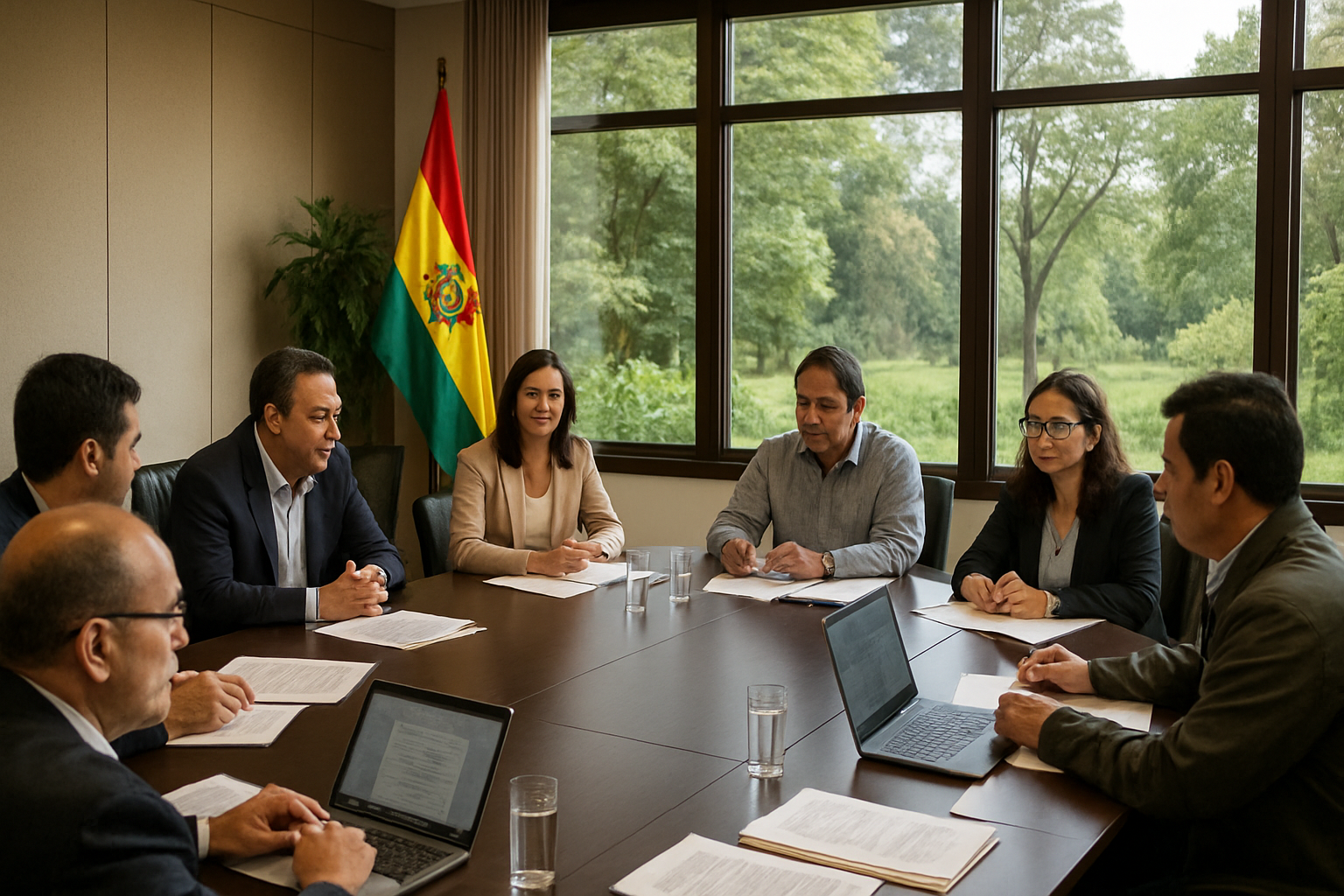
Bolivia is positioning itself as a regional environmental leader through two groundbreaking initiatives: a high-level climate change dialogue scheduled for late April in Santa Cruz and the launch of an innovative weekly environmental challenge program from El Alto, demonstrating the nation's comprehensive approach to addressing ecological concerns during an unprecedented period of global climate crisis.
The ambitious environmental agenda signals Bolivia's evolution from reactive environmental management to proactive ecosystem service development, combining traditional ecological wisdom with modern conservation science during the 24th consecutive month of global temperatures exceeding 1.5°C pre-industrial levels—the longest sustained warming streak in recorded history.
High-Level Climate Dialogue: International Coordination for Green Finance
Ministers Oscar Mario Justiniano of Productive, Rural and Water Development, and Fernando Romero of Planning announced the comprehensive climate dialogue scheduled for April 28-29 in Santa Cruz. The encounter will unite governmental authorities, investors, donors, and bilateral and multilateral organizations to articulate the country's climate adaptation and mitigation priorities with green financing opportunities.
Minister Justiniano emphasized the critical importance of addressing climate change through a productive and sustainable vision. "Climate change is a reality for the entire world. The way to confront it involves generating better conditions to produce more and better while caring for the environment," he affirmed during the announcement.
The dialogue agenda prioritizes several key areas including bioeconomy development, fire prevention and control, biodiversity conservation, and the integration of traditional ecological knowledge with modern environmental science. This comprehensive approach reflects Bolivia's sophisticated understanding that effective environmental protection requires coordinated multi-sector strategies addressing technological innovation, community engagement, and international cooperation simultaneously.
"This encounter represents fundamental evolution from traditional top-down environmental policies to community-driven protection empowering local populations as active environmental stewards."
— Minister Fernando Romero, Planning Ministry
'Viernes con V de Vida': Revolutionary Weekly Environmental Action
Complementing the international dialogue, Ombudsman Pedro Callisaya launched the innovative "Viernes con V de Vida" (Fridays with V for Life) initiative from El Alto, establishing a weekly environmental challenge program designed to promote environmental awareness and citizen participation in protecting Mother Earth.
The inaugural challenge focused on solid waste collection in high-traffic areas of El Alto, including Ceja and sections of Panorámica and Juan Pablo II avenues—zones requiring intensive preservation efforts due to heavy circulation and environmental pressure.
"From El Alto city, we are launching the first environmental care and Mother Earth protection challenge. This is a challenge that will be carried out every Friday with different actors," Callisaya expressed during the launch ceremony, emphasizing the program's commitment to sustained community engagement.
The weekly structure creates sustained momentum for environmental action, transforming symbolic environmental commitments into measurable community-based conservation efforts. Each Friday will feature different environmental challenges engaging diverse community groups, from students and workers to local businesses and government employees.
Global Environmental Context: Leadership During Crisis
Bolivia's dual environmental initiatives emerge during an unprecedented period of environmental challenge. January 2026 marked the hottest month in recorded history, extending a warming streak that has completely overridden natural climate variability, including La Niña cooling effects that typically moderate global temperatures.
The sustained warming demonstrates that human-induced climate change has fundamentally altered Earth's atmospheric systems beyond natural recovery mechanisms, creating compound environmental effects that traditional conservation approaches struggle to address effectively. Rising sea levels threaten coastal ecosystems, changing precipitation patterns affect forest regeneration, and increased extreme weather frequency disrupts marine food chains and terrestrial habitats.
Against this backdrop, Bolivia's initiatives represent a sophisticated response that integrates immediate community action with long-term strategic planning, positioning the nation as an environmental solution provider rather than merely an aid recipient in global climate discussions.
Historical Context: Building on Conservation Renaissance
Bolivia's current environmental leadership builds on a remarkable conservation renaissance documented throughout 2026. Previous initiatives have included comprehensive fire management programs in Santa Cruz region, where provincial and central government cooperation with international organizations developed roadmaps prioritizing prevention, inter-institutional coordination, and capacity strengthening with an integral vision.
The nation has consistently demonstrated evolution from traditional fire suppression to comprehensive ecosystem management, addressing root causes while building community resilience through the "Governance for Integral Fire Management in Bolivia" workshop that brought together the provincial government, central government, international cooperation entities, and the Friends of Nature Foundation (FAN).
Recent months have also seen Bolivia participate in global environmental movements, including Earth Hour participation with themes dedicated to "defending and valuing protected areas," demonstrating the profound connection between indigenous communities and protected territories where "many communities live near or within protected areas, maintaining deep relationships with nature, caring for territories means caring for cultures, knowledge, and ways of life that have protected nature for generations."

Technology-Tradition Integration: A New Conservation Paradigm
Bolivia's approach exemplifies the sophisticated synthesis of cutting-edge technology with traditional ecological knowledge that characterizes successful modern conservation programs. The climate dialogue incorporates advanced environmental monitoring systems, satellite tracking, and AI-powered analysis while respecting and integrating indigenous environmental stewardship practices that have sustained ecosystems for generations.
This represents a fundamental departure from purely technological or traditional approaches toward comprehensive frameworks that combine scientific rigor with cultural sensitivity and community ownership. The methodology maximizes effectiveness by combining technological precision with the depth of generational knowledge embedded in local communities.
The weekly environmental challenges utilize digital coordination platforms to organize activities while honoring traditional relationships between indigenous communities and protected areas. This integration addresses the critical challenge of scaling conservation efforts globally while respecting local cultural autonomy and traditional management systems that have sustained ecosystems across generations.
Economic Development Through Environmental Leadership
Bolivia's environmental initiatives demonstrate that protection functions as an economic development strategy rather than a regulatory burden. Countries implementing comprehensive environmental protection consistently show greater economic resilience and attract sustainable investment across multiple sectors including eco-tourism, green technology manufacturing, and environmental services.
The Santa Cruz climate dialogue specifically targets green financing opportunities, positioning Bolivia to access international climate finance while building domestic capacity for environmental technology development. The bioeconomy focus creates opportunities for sustainable employment in forestry, agriculture, and environmental services sectors.
Economic analyses consistently show that ecosystem services provided by intact natural systems deliver greater long-term benefits than resource extraction activities. Forests regulate water and climate patterns worth billions annually, wetlands prevent flood damage, and biodiversity hotspots support pharmaceutical research and premium eco-tourism generating substantial revenue while protecting essential environmental systems.
"Environmental protection has become the essential infrastructure for human prosperity and planetary sustainability, not an optional addition to economic policy."
— Environmental Policy Analysis, Planet News
International Cooperation and Regional Leadership
Bolivia's initiatives reflect the evolution of international environmental cooperation from traditional North-South aid relationships toward sophisticated peer-to-peer collaboration where developing nations emerge as environmental solution providers. The Santa Cruz dialogue brings together bilateral and multilateral organizations, demonstrating how knowledge sharing creates global networks that strengthen local capacity while contributing to planetary sustainability.
The timing of these initiatives provides crucial leadership during a critical environmental action window that scientists warn is narrowing rapidly. Ecological systems are approaching critical thresholds that could trigger irreversible changes affecting global food security, climate stability, and human settlements worldwide.
Success in Bolivia's approach depends on unprecedented coordination, as environmental challenges transcend political boundaries through ocean currents, atmospheric systems, and species migrations that connect ecosystems globally, making unilateral conservation efforts insufficient for addressing the scale of current challenges.
Implementation Challenges and Success Factors
Bolivia's environmental initiatives face typical implementation challenges including funding sustainability, technical capacity building requirements, and adaptive management needs as climate change continues to disrupt project timelines and operational conditions.
However, the diversity of approaches provides resilience against single-solution dependencies, offering multiple adaptation pathways for addressing complex environmental challenges that span biological, physical, and human systems. The combination of high-level policy dialogue and grassroots community action creates comprehensive coverage addressing both systemic and local environmental needs.
Consistent success factors across environmental initiatives include community ownership and engagement, transparent governance frameworks, economic incentives that make protection financially viable for local communities, and sophisticated integration of traditional ecological knowledge with modern conservation science.
Global Significance and Future Implications
Bolivia's environmental initiatives provide practical templates for scaling environmental protection globally through coordinated approaches that address multiple challenges while building local capacity and fostering international cooperation. The combination of strategic dialogue and community action offers a comprehensive framework that other nations can adapt to their specific contexts while maintaining local autonomy and cultural sensitivity.
The April 2026 environmental developments are potentially decisive for conservation approaches in the coming decades, influencing global biodiversity protection, climate adaptation, and sustainable development strategies for generations. The integration of cutting-edge technology with traditional ecological wisdom creates adaptable frameworks that respect cultural diversity while leveraging global technological capabilities for maximum conservation impact.
Success in these initiatives may determine whether conservation efforts can keep pace with accelerating environmental change during what scientists identify as a decisive climate action decade. The window for effective environmental action continues narrowing, but the convergence of innovation, cooperation, and political commitment demonstrated by Bolivia's initiatives offers hope for maintaining planetary habitability during Earth's most environmentally challenging period in recorded history.
Looking Ahead: A Model for Global Action
Bolivia's dual environmental strategy represents the evolution of environmental protection from reactive crisis management to proactive ecosystem service management. The nation's approach emphasizes community participation and technological integration while building international partnerships essential for addressing transnational environmental challenges.
As the climate dialogue approaches and weekly environmental challenges continue, Bolivia positions itself at the forefront of a global conservation renaissance characterized by scientific innovation, community engagement, economic viability, and international cooperation integration. The initiatives demonstrate that effective environmental action remains achievable through sustained commitment to protecting the environmental systems upon which human prosperity depends.
The success or failure of Bolivia's environmental leadership may prove decisive for conservation approaches worldwide, offering urgent templates for the massive coordinated effort required to maintain planetary habitability during the most environmentally challenging period in recorded history.