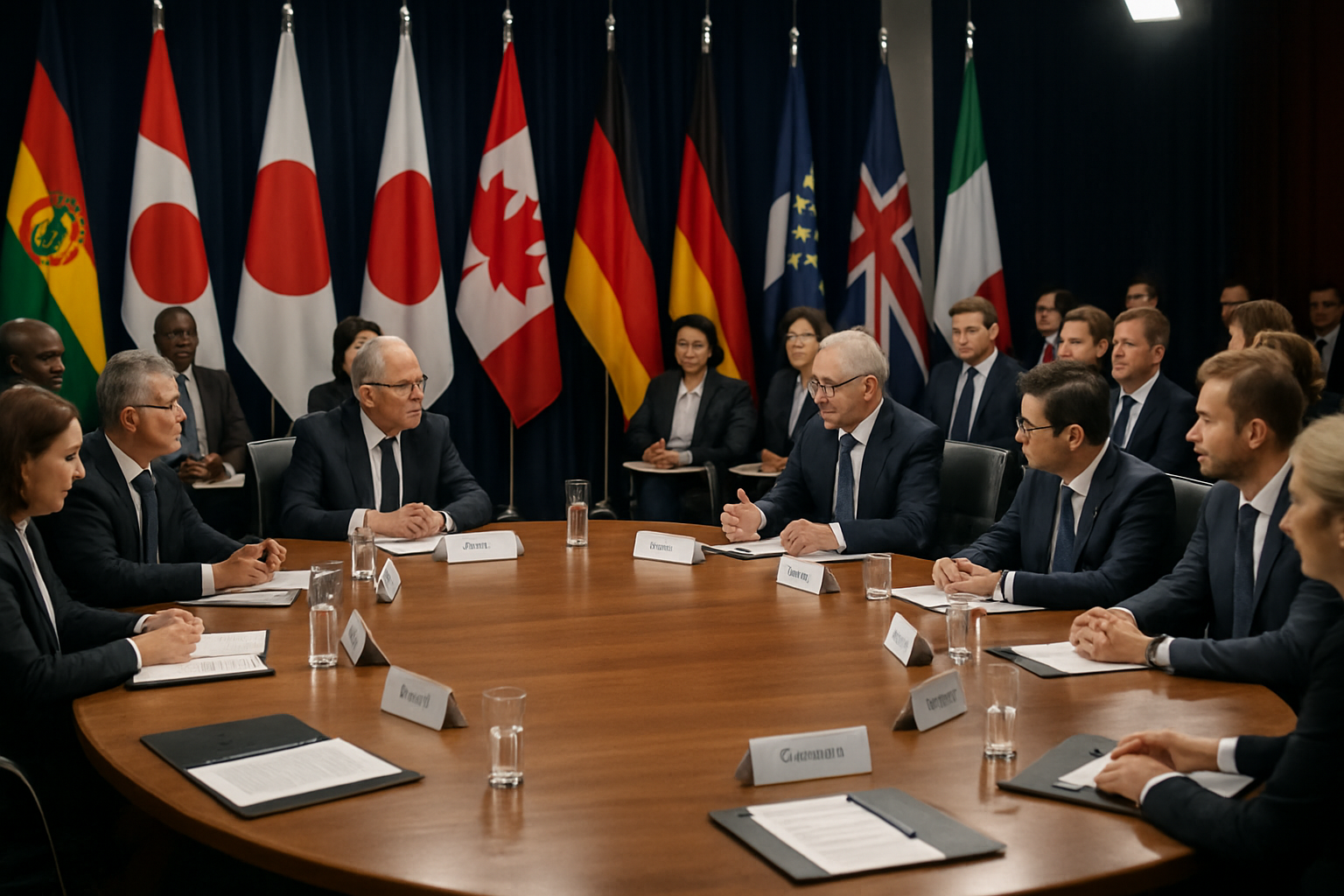
Bolivia has marked its return to international multilateral forums after more than 15 years, with Minister of Productive, Rural and Water Development Oscar Mario Justiniano participating in the 39th Regional Conference of the Food and Agriculture Organization (FAO) for Latin America and the Caribbean in Brasilia. Simultaneously, Canada's defense minister announced plans to deepen military and defense-industrial cooperation with Indo-Pacific partners as regional security tensions continue to escalate.
The dual developments underscore the evolving landscape of international cooperation, where traditional multilateral engagement intersects with emerging security partnerships in response to shifting global dynamics.
Bolivia's Multilateral Re-engagement
Bolivia's participation in the FAO conference represents a significant diplomatic milestone, marking what the Ministry of Productive, Rural and Water Development described as "the return of Bolivia to global planning spaces after more than 15 years." The conference, held in the Brazilian capital, focused on transforming agri-food systems, combating hunger, and reducing inequalities across Latin America and the Caribbean.
Minister Justiniano used the platform to present Bolivia's "Plan Bolivia Productiva y Resiliente 2026-2030," outlining the country's strategic vision for agricultural development and food security. The presentation garnered significant attention from international partners, with the FAO formally proposing the development of a Strategic Plan for Bolivia in response to the country's proactive engagement.
"This marks Bolivia's return to spaces of global planning after more than 15 years."
— Ministry of Productive, Rural and Water Development, Official Statement
Bolivia's re-engagement with multilateral institutions reflects broader shifts in Latin American diplomacy, where countries are increasingly seeking to balance bilateral partnerships with traditional multilateral frameworks. The timing is particularly significant given the region's recent emphasis on food security and agricultural resilience in the face of climate change and global supply chain disruptions.
Canada's Indo-Pacific Security Strategy
Meanwhile, Canada's defense minister has announced ambitious plans to expand military and defense-industrial cooperation with Indo-Pacific partners, signaling Ottawa's commitment to strengthening regional security architecture amid rising tensions. The announcement comes as regional security concerns intensify, particularly regarding military activities in contested areas and the need for enhanced collective defense capabilities.
Canada's approach emphasizes cooperation with what officials term "like-minded Indo-Pacific partners," focusing on middle-power diplomacy that strengthens democratic alliances while maintaining strategic independence. The initiative builds on recent Canadian diplomatic successes, including landmark agreements with India on uranium supply and critical minerals cooperation.
The Canadian strategy reflects a broader pattern of bilateral partnership development that has emerged as an alternative to traditional multilateral frameworks. Recent memory from our archives shows this trend accelerating throughout 2026, with various nations pursuing targeted cooperation agreements addressing specific national priorities rather than seeking complex multilateral consensus.
Evolving International Cooperation Models
The concurrent developments in Bolivia and Canada illustrate the dual-track nature of contemporary international cooperation. While Bolivia's return to FAO demonstrates the enduring value of established multilateral institutions for addressing global challenges like food security, Canada's Indo-Pacific strategy represents the growing importance of flexible bilateral and regional partnerships in addressing security concerns.
This evolution reflects lessons learned from recent international cooperation successes and failures. Historical context from recent diplomatic archives reveals that bilateral partnerships have often proven more responsive to rapidly changing circumstances than complex multilateral frameworks requiring extensive consensus-building.
The agricultural focus of Bolivia's international re-engagement is particularly significant given global food security challenges. The country's strategic position in South America, combined with its agricultural potential, makes its active participation in regional food systems transformation crucial for continental stability.
Regional Security Implications
Canada's enhanced Indo-Pacific engagement comes at a time when regional security dynamics are rapidly evolving. The emphasis on cooperation with "middle powers" reflects a strategic approach that seeks to build coalition capacity while avoiding direct confrontation with major powers in the region.
The Canadian initiative aligns with broader democratic partnership trends observed throughout 2026, where like-minded nations have sought to strengthen cooperation on defense industrial capacity, critical minerals supply chains, and technological security. This approach has proven particularly effective in addressing supply chain vulnerabilities while maintaining economic competitiveness.
"Canada aims to boost military and defense-industrial ties with like-minded Indo-Pacific partners as regional security tensions surge."
— Canadian Defense Minister
The focus on defense-industrial cooperation is especially noteworthy, as it represents a shift toward building sustainable security partnerships that extend beyond traditional military assistance to encompass technological cooperation and supply chain integration.
Implications for Global Governance
The parallel diplomatic initiatives by Bolivia and Canada reflect broader changes in international cooperation approaches. While multilateral institutions like the FAO continue to play essential roles in addressing global challenges, bilateral and regional partnerships are increasingly seen as more agile vehicles for addressing specific security and economic needs.
Bolivia's return to global planning forums after 15 years suggests a renewed commitment to multilateral engagement, potentially influenced by changing regional dynamics and the success of other Latin American countries in leveraging international cooperation for domestic development goals.
Canada's approach, meanwhile, demonstrates how middle powers are adapting to great power competition by strengthening partnerships with like-minded nations rather than relying exclusively on traditional alliance structures.
Future Cooperation Frameworks
The developments suggest that future international cooperation will likely feature a hybrid approach combining traditional multilateral institutions with flexible bilateral and regional partnerships. This evolution acknowledges both the continued importance of global governance institutions and the need for more responsive cooperation mechanisms.
For Bolivia, successful participation in the FAO conference could serve as a template for broader international re-engagement, potentially leading to increased involvement in other multilateral forums and regional integration initiatives.
Canada's Indo-Pacific strategy, if successful, may influence other middle powers to adopt similar approaches that balance alliance commitments with strategic autonomy and regional partnership development.
The intersection of these diplomatic initiatives highlights the dynamic nature of contemporary international relations, where traditional cooperation models are being adapted and supplemented to address 21st-century challenges ranging from food security to regional stability. The success of these approaches will likely influence the evolution of global governance mechanisms for years to come.