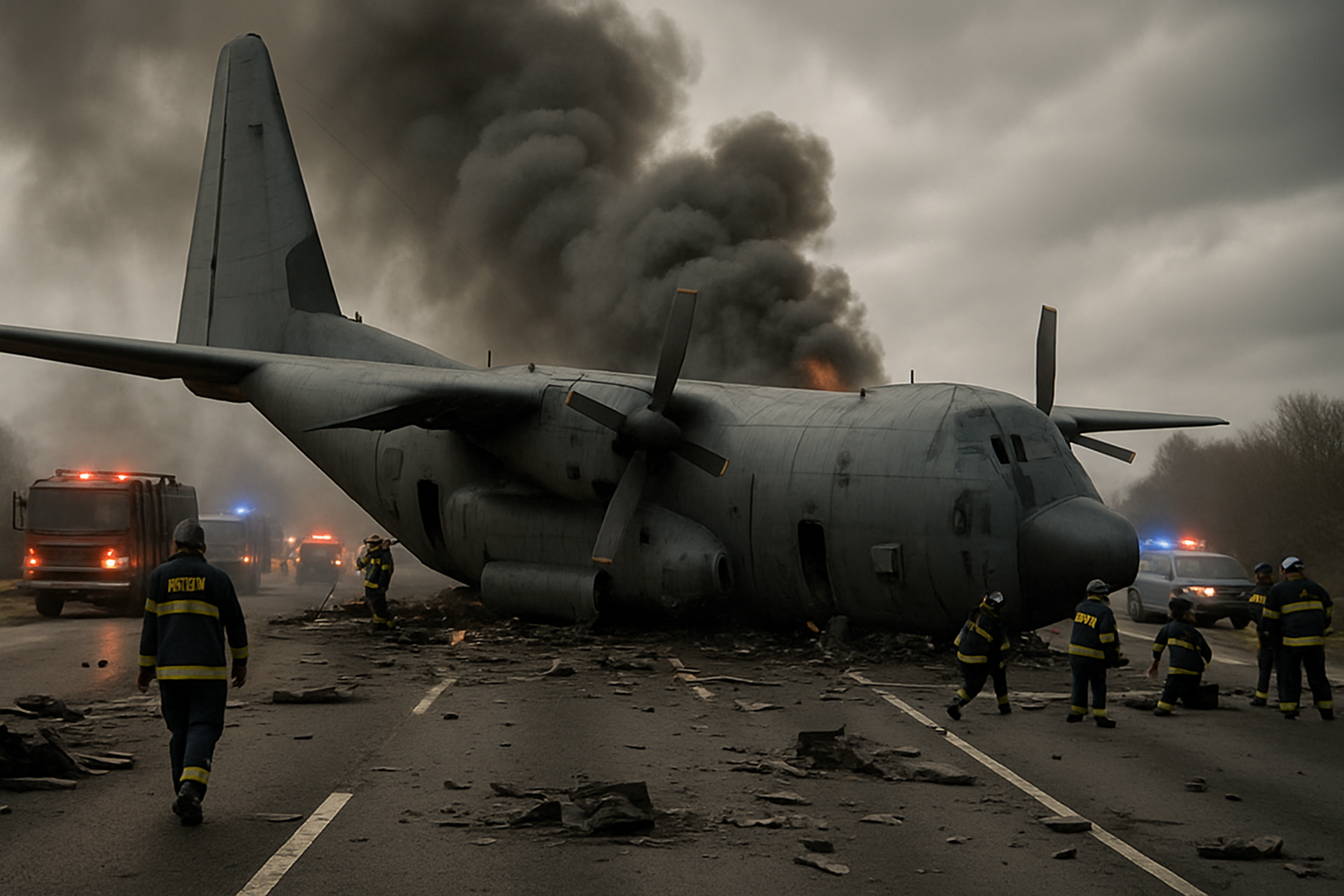
At least 15 people were killed when a Bolivian Air Force cargo plane carrying large quantities of newly printed cash crashed onto a busy highway near El Alto International Airport on Friday evening, authorities confirmed. The tragedy sent crowds scrambling to collect scattered banknotes that officials later declared legally worthless.
The Lockheed C-130 Hercules transport aircraft, identified as FAB-81, lost control while attempting to land during poor weather conditions around 18:20 local time. The military cargo plane, operated by the Bolivian Air Force (FAB), was en route from Santa Cruz when it skidded off the runway and crashed on Avenida Hernani, a major thoroughfare adjacent to the airport terminal.
Devastating Impact on Ground Vehicles
The aircraft struck multiple vehicles after leaving the runway, causing catastrophic damage across the crash site. Colonel Pavel Tovar, Bolivia's National Fire Director, reported that among the vehicles affected were minibuses, private cars, and even a semi-trailer truck.
"Some vehicles were reduced to twisted metal, and among the remains, there are people without life,"
— Colonel Pavel Tovar, National Fire Director
Emergency responders from the Police, Fire Department, and military personnel immediately launched rescue operations, working to recover bodies and establish a security perimeter around the crash zone. At least 10 injured individuals were transported to Hospital del Norte, with eight reported to be in critical condition according to medical staff.
Central Bank Currency Transport Revealed
In a subsequent press conference, Central Bank of Bolivia (BCB) President David Espinoza revealed that the aircraft was transporting newly printed banknotes as part of the bank's routine monetary operations. However, he emphasized a crucial detail that would later prove significant as crowds gathered at the crash site.
"We want to make clear for the public's knowledge that the banknotes found have no legal value, therefore their possession constitutes a crime," Espinoza stated. The bank president explained that the monetary material must first enter BCB vaults and undergo a technical process called "monetization" before being authorized for legal circulation through the financial system.
Chaos as Crowds Collect Worthless Bills
Despite official warnings, international media reports indicate that thousands of people gathered at the crash site attempting to collect the scattered banknotes. Norwegian and Russian news sources reported that nearly 5,000 people converged on the area, unaware that the currency had no legal value.
Espinoza urged anyone who had collected these bills to return them, warning that possession of the unauthorized currency constitutes a criminal offense under Bolivian law. The bills lacked proper serial numbers and had not completed the required monetization process that would make them legal tender.
Airport Operations Suspended
The crash prompted immediate closure of El Alto International Airport, with Navegación Aérea y Aeropuertos Bolivianos (Naabol) announcing that the runway would remain closed until at least 21:30, with possible extensions. The airport serves as a crucial logistics hub for the La Paz metropolitan area and handles significant cargo traffic.
The incident occurred during what authorities described as challenging weather conditions, though a full investigation into the exact cause of the crash is underway. The airport's proximity to residential and commercial areas made the accident particularly devastating for ground casualties.
International Response and Historical Context
The tragedy has drawn international attention, with European and Latin American media providing extensive coverage. This incident represents one of the most serious military aviation accidents in recent Bolivian history, highlighting ongoing challenges faced by regional air forces in maintaining aging aircraft fleets.
The C-130 Hercules, a workhorse of military aviation worldwide, has been in service with various air forces for decades. While generally considered reliable, older aircraft require intensive maintenance and are more susceptible to mechanical failures and weather-related incidents.
Ongoing Investigation and Recovery
Bolivian authorities have launched a comprehensive investigation into the crash, examining both mechanical factors and weather conditions that may have contributed to the accident. The investigation will likely focus on the aircraft's maintenance history, crew qualifications, and the decision to attempt landing during adverse weather.
Recovery operations continue at the crash site, with authorities working to clear debris and restore normal traffic flow on the affected highway. The exact number of casualties may still increase as rescue teams work through the wreckage and surrounding area.
This tragic incident underscores the inherent risks of military cargo operations, particularly when conducted in challenging weather conditions near populated areas. The investigation's findings will likely influence future safety protocols for military transport operations in Bolivia and potentially across the region.