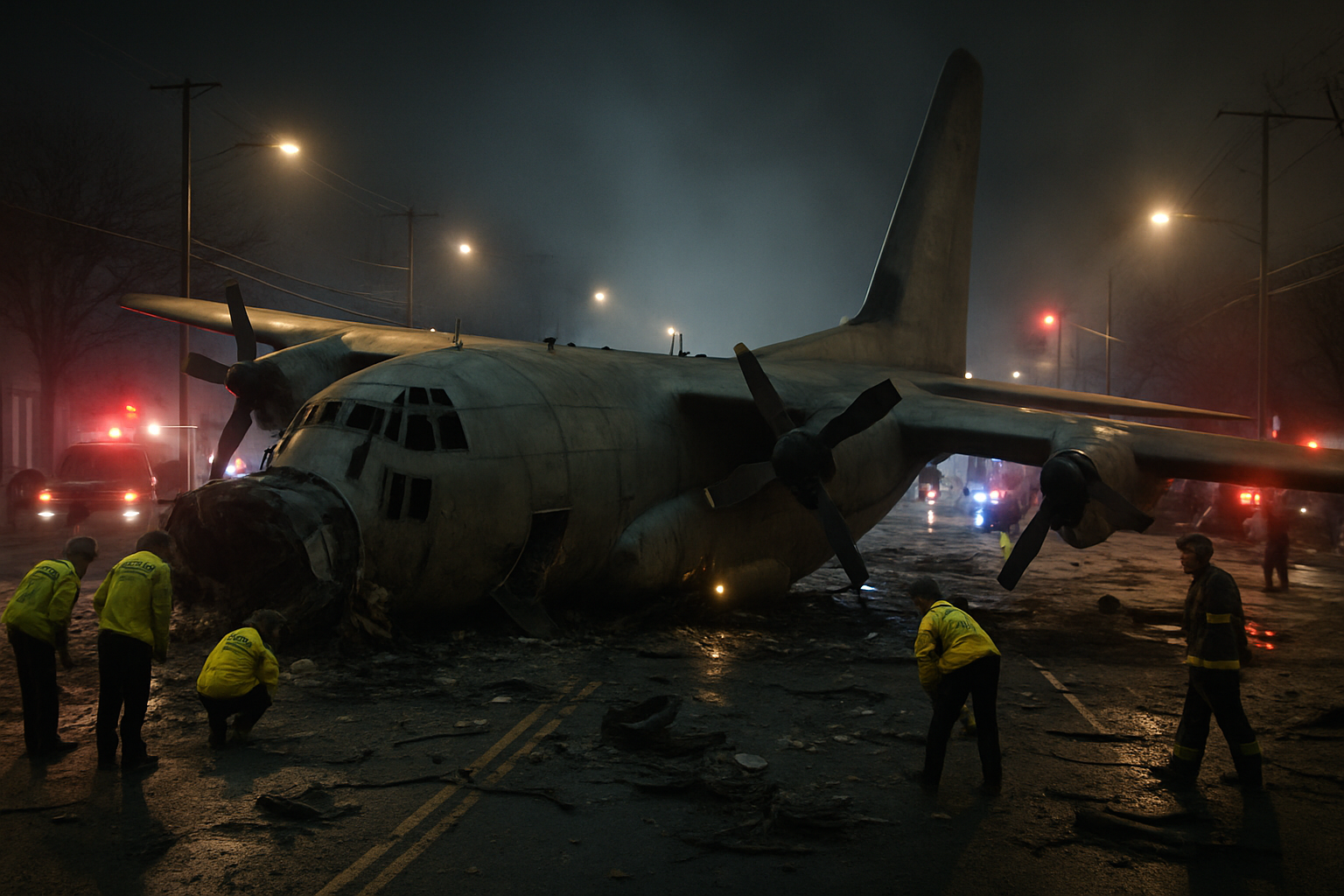
The devastating crash of a Bolivian military C-130 Hercules aircraft at El Alto International Airport, which claimed at least 22 lives, has intensified global scrutiny of aviation safety protocols as investigators recover the aircraft's black box amid widespread concerns about aging military fleets and high-altitude operational challenges.
The February 28, 2026 incident unfolded when the Bolivian Air Force cargo plane FAB-81, transporting newly printed banknotes from Santa Cruz, lost control during landing operations at 18:20 local time. The aircraft overran the runway and crashed onto Avenida Costanera highway, striking multiple civilian vehicles and creating unprecedented scenes as thousands of scattered banknotes attracted crowds despite police warnings.
Black Box Recovery and Investigation Progress
Bolivia's Ministry of Defense confirmed the successful recovery of the Cockpit Voice Recorder (CVR) from the wreckage, a critical component that records the final 30 minutes of flight operations. The device has been sent for expert analysis to determine whether mechanical failure, human error, or external factors contributed to the tragedy.
"The equipment recovered corresponds to the cockpit voice recorder, which continuously records crew conversations as well as sounds and alerts generated during flight," ministry officials stated in their latest bulletin. The investigation team is working to reconstruct the aircraft's final moments before impact.

Unprecedented Banknote Chaos Complicates Response
The cargo plane was carrying 17.1 million units of newly printed Bolivian currency when it crashed, creating an extraordinary security challenge. David Espinoza, president of the Central Bank of Bolivia, revealed that approximately 5 million bills were stolen by crowds who rushed to collect the scattered money.
The stolen currency, consisting of 10, 20, and 50 boliviano notes, had not completed the "monetization" process and therefore held no legal value. However, the Central Bank was forced to invalidate the entire Series B to prevent the stolen notes from entering circulation.
"We estimate that approximately 30% of the cargo was taken, though these bills are legally invalidated and cannot circulate in the financial system," Espinoza explained during a Saturday press conference.
— David Espinoza, President of Central Bank of Bolivia
Global Pattern of Aviation Incidents
The Bolivia crash represents part of a broader pattern of aviation safety concerns documented across multiple countries in recent weeks. Analysis of international incident reports reveals troubling trends affecting both military and civilian aviation operations.
In the United Kingdom, two separate incidents on February 28 highlighted ongoing safety challenges: a 49-year-old man died during a skydiving operation at Dunkeswell Aerodrome, while a light aircraft pilot survived after ditching into the sea at Lee-on-the-Solent, Hampshire.
These incidents follow a series of concerning events including the emergency landing of SAS flight SK4416 in Norway after a power bank overheated in the cabin, exposing crew members to toxic smoke, and multiple aircraft emergencies across European networks struggling with extreme weather conditions.
High-Altitude Operational Challenges
El Alto International Airport, situated at 4,150 meters (13,615 feet) above sea level, presents unique operational challenges that may have contributed to the severity of the crash. The extreme altitude affects aircraft performance, requiring longer takeoff and landing distances while reducing engine efficiency and pilot reaction times.
Aviation experts note that high-altitude operations in mountainous terrain create complex atmospheric conditions, particularly during landing approaches. The combination of thin air, variable wind patterns, and challenging geography makes El Alto one of the world's most demanding commercial airports for aircraft operations.
The crashed C-130 Hercules, while generally considered a reliable military transport aircraft, faces particular challenges in such extreme conditions. The aircraft's four-engine turboprop configuration, designed for rugged operations, nonetheless requires enhanced safety protocols when operating at such altitudes with heavy cargo loads.
International Aviation Safety Implications
The tragedy has prompted calls for comprehensive reviews of military aviation safety protocols, particularly regarding valuable cargo transport in challenging geographic conditions. The incident highlights vulnerabilities in aging military aircraft fleets that many developing nations rely upon for essential logistics operations.
Industry analysts point to the need for enhanced international cooperation in aviation safety standards, improved pilot training for extreme conditions, and modernization of aging military transport fleets. The crash also raises questions about operational procedures for flights carrying sensitive cargo near populated civilian areas.

Emergency Response and Coordination
The crash response involved multiple Bolivian institutions in what became the largest emergency operation in recent national history. Defense Ministry officials established an Accident Investigation Board under Colonel Ricardo Alarcón to examine all aspects of the incident, from weather conditions to mechanical systems and operational procedures.
Emergency medical services transported casualties to multiple facilities: Hospital Corea treated 8 patients, Hospital del Norte received 10, and Hospital Corazón de Jesús cared for 1 patient. The coordinated response demonstrated both the capabilities and limitations of emergency systems when facing major aviation disasters.
The incident's complexity was amplified by the chaotic scenes surrounding the scattered banknotes, which required deployment of riot police and the burning of recovered currency to prevent widespread looting. Security forces used tear gas to disperse crowds, highlighting the intersection of aviation safety with public security concerns.
Broader Aviation Industry Context
The Bolivia crash occurs against a backdrop of evolving aviation safety challenges globally. Recent months have witnessed multiple incidents across different sectors, from commercial airline emergencies to general aviation accidents and military transport failures.
Regulatory authorities worldwide are grappling with new safety concerns including lithium-ion battery risks in portable electronic devices, extreme weather operational challenges, and the maintenance demands of aging aircraft fleets. Japan recently announced the world's most restrictive aviation battery policy, banning portable power banks on all flights effective April 2026.
The aviation industry maintains statistical safety records that demonstrate flying remains the safest form of long-distance travel. However, individual incidents like the Bolivia crash underscore the ongoing need for vigilance, investment in safety systems, and enhanced international cooperation in safety standards development.
Investigation Timeline and International Support
Bolivian authorities estimate the investigation could extend up to six months as investigators analyze the recovered black box data alongside weather conditions, mechanical systems, and operational procedures. The Voice Data Recorder and Flight Data Recorder will undergo specialized analysis to establish the sequence of events leading to the crash.
International aviation experts have offered assistance to Bolivia's investigation team, reflecting the global importance of understanding the crash's causes. The findings will likely influence safety protocols for high-altitude military aviation operations throughout Latin America and beyond.
"This investigation will establish clear facts about what happened and why. We owe this to the families who lost loved ones and to aviation safety worldwide."
— Colonel Ricardo Alarcón, Accident Investigation Board
Lessons for Global Aviation Safety
The Bolivia military aircraft crash serves as a stark reminder of aviation's inherent risks, particularly for operations in challenging geographic and climatic conditions. The incident highlights several critical areas requiring enhanced attention: pilot training for extreme environmental conditions, aircraft maintenance protocols for high-altitude operations, emergency response coordination in complex scenarios, and security procedures for flights carrying valuable cargo.
As aviation volumes continue growing globally while operational environments become more challenging due to climate change and aging infrastructure, the industry faces mounting pressure to adapt safety systems accordingly. The Bolivia tragedy, while devastating for those directly affected, provides crucial lessons that could prevent similar incidents in the future.
The investigation's findings will likely influence international aviation safety standards for years to come, demonstrating how individual incidents can drive systemic improvements across the global aviation network. The ultimate measure of this tragedy's impact will be whether it leads to meaningful enhancements in aviation safety that protect lives and prevent future accidents.