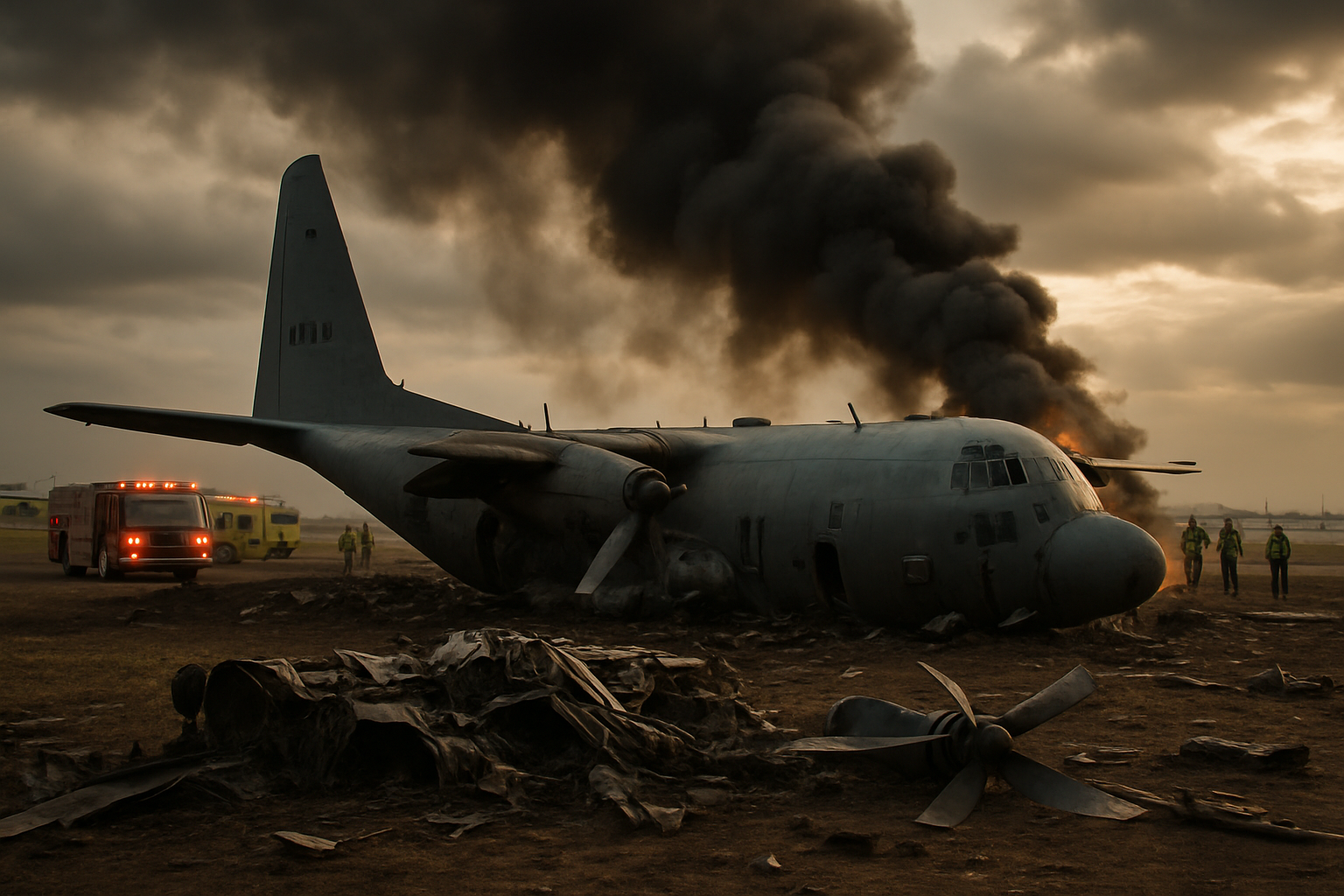
At least 15 people were killed and 28 injured when a Bolivian Air Force C-130 Hercules cargo plane carrying newly printed banknotes crashed at El Alto International Airport on Friday evening, February 27, 2026, after overshooting the runway and colliding with multiple vehicles on a nearby highway.
The military transport aircraft, with registration FAB-81, was carrying eight crew members and transporting newly minted Bolivian currency from Santa Cruz when it lost control during landing procedures around 18:15 local time. The plane skidded approximately one kilometer beyond the runway before crashing into Avenida Hernani highway, where it struck numerous civilian vehicles including minibuses, private cars, and a tractor-trailer.
Dramatic Rescue Operations and Casualties
Colonel Pavel Tovar, Bolivia's National Fire Director, confirmed the death toll during a press briefing, though he warned the number could rise as rescue operations continued. "Among the damaged vehicles are minibuses, private cars, and even a tractor-trailer that were struck when the aircraft crashed in the area. Some vehicles were reduced to twisted metal, and among the debris, there are lifeless people," Tovar stated.
The Health Ministry, led by Minister Marcela Flores, coordinated an emergency response involving multiple hospitals across El Alto and La Paz. The injured were distributed across several medical facilities, with Hospital Corea treating eight patients, Hospital del Norte receiving ten patients, and Hospital Corazón de Jesús caring for one patient.
Chaos as Crowds Rush for Scattered Money
The crash created extraordinary scenes as thousands of banknotes were scattered across the accident site, prompting large crowds to rush to collect the bills despite police attempts to establish security perimeters. Images shared across social media showed people arriving in vehicles to gather the scattered currency while police in riot gear tried to disperse them.
"That money has no serial number and therefore cannot be used,"
— Defense Minister Marcelo Salinas
Authorities were forced to take drastic action to prevent looting and public disorder. Police, prosecutors, and Central Bank officials decided to burn the scattered banknotes, which lacked legal serial numbers and had not completed the "monetization" process required for official currency circulation. The bills were essentially worthless as they had not been formally processed for legal tender status.
The situation turned violent as crowds became increasingly aggressive, throwing stones at police and military personnel attempting to secure the crash site. For several hours, authorities struggled to maintain order as approximately 5,000 people gathered at the scene, creating a dangerous situation for emergency responders.
Investigation Launched into Crash Cause
The Ministry of Defense and Bolivian Air Force Command immediately announced the formation of an Accident Investigation Board to determine the cause of the crash. According to Defense Minister Marcelo Salinas, the aircraft "landed and veered off the runway" before ending up in a nearby field.
Air Force Commander Sergio Lora confirmed that eight crew members were aboard the aircraft. Six were taken to medical centers for treatment, while two were initially unaccounted for and became the focus of intensive search and rescue operations.
The investigation will examine various factors including weather conditions, mechanical issues, pilot error, and airport infrastructure. The C-130 Hercules is a robust military transport aircraft with a strong safety record, making this crash particularly concerning for Bolivian aviation authorities.
Airport Closure and Transportation Impact
El Alto International Airport, which serves La Paz and surrounding regions, was forced to close until at least 21:30 local time following the accident. Navegación Aérea y Aeropuertos Bolivianos (Naabol) coordinated the closure, causing significant disruptions to both domestic and international flights.
The crash also severely impacted ground transportation, as Avenida Hernani is a major highway connecting El Alto with La Paz. Emergency services established wide security cordons around the accident site, forcing traffic diversions and causing extended delays throughout the metropolitan area.
International Media Attention
The dramatic crash garnered extensive international media coverage, with news outlets across Europe, Latin America, and Asia reporting on the incident. The unusual circumstances of scattered banknotes and crowd behavior created compelling visual content that spread rapidly across social media platforms.
International aviation safety experts noted the incident as highlighting the risks associated with military cargo operations near populated civilian areas, particularly during challenging weather conditions. The crash also demonstrated the ongoing challenges faced by aging military aircraft fleets in developing nations.
Historical Context and Regional Aviation Safety
This crash represents one of the most serious military aviation accidents in recent Bolivian history. The incident underscores ongoing concerns about aviation safety in the region, where challenging geographic conditions, aging aircraft, and limited infrastructure create elevated risks for both military and civilian aviation operations.
The crash at El Alto, located at approximately 4,150 meters above sea level, also highlights the particular challenges of high-altitude airport operations. The airport serves as a crucial transportation hub for Bolivia's administrative capital and surrounding highland regions.
El Alto International Airport has previously experienced weather-related disruptions due to its extreme altitude and exposure to Andean weather patterns. The investigation will likely examine whether these factors contributed to the aircraft's inability to stop within the runway's designated length.
Emergency Response Coordination
The accident triggered Bolivia's largest emergency response operation in recent memory, involving coordination between multiple agencies including the National Fire Service, National Police, Armed Forces, Health Ministry, and civil defense organizations.
Emergency medical services transported casualties to hospitals throughout the La Paz metropolitan area, with the most critically injured patients receiving priority treatment at facilities equipped to handle trauma cases. The coordinated response demonstrated both the strengths and limitations of Bolivia's emergency response capabilities.
The incident also tested inter-agency coordination as authorities struggled to balance immediate rescue operations with the need to secure scattered currency and maintain public order. The decision to burn the banknotes represented a pragmatic solution to prevent prolonged public disorder while allowing emergency services to focus on rescue operations.
Implications for Military Aviation
This crash raises important questions about military aviation safety protocols, particularly for cargo missions involving valuable or sensitive materials. The transport of newly printed currency typically requires heightened security measures, and the investigation will examine whether proper protocols were followed.
The incident may prompt reviews of military aviation safety procedures throughout Latin America, where many air forces operate aging aircraft under challenging conditions. The C-130 Hercules, while generally reliable, requires careful maintenance and operational protocols to ensure safe operations.
As rescue operations concluded and the investigation began, Bolivian authorities faced the challenging task of balancing transparency with security concerns while ensuring that lessons learned from this tragedy help prevent similar incidents in the future.