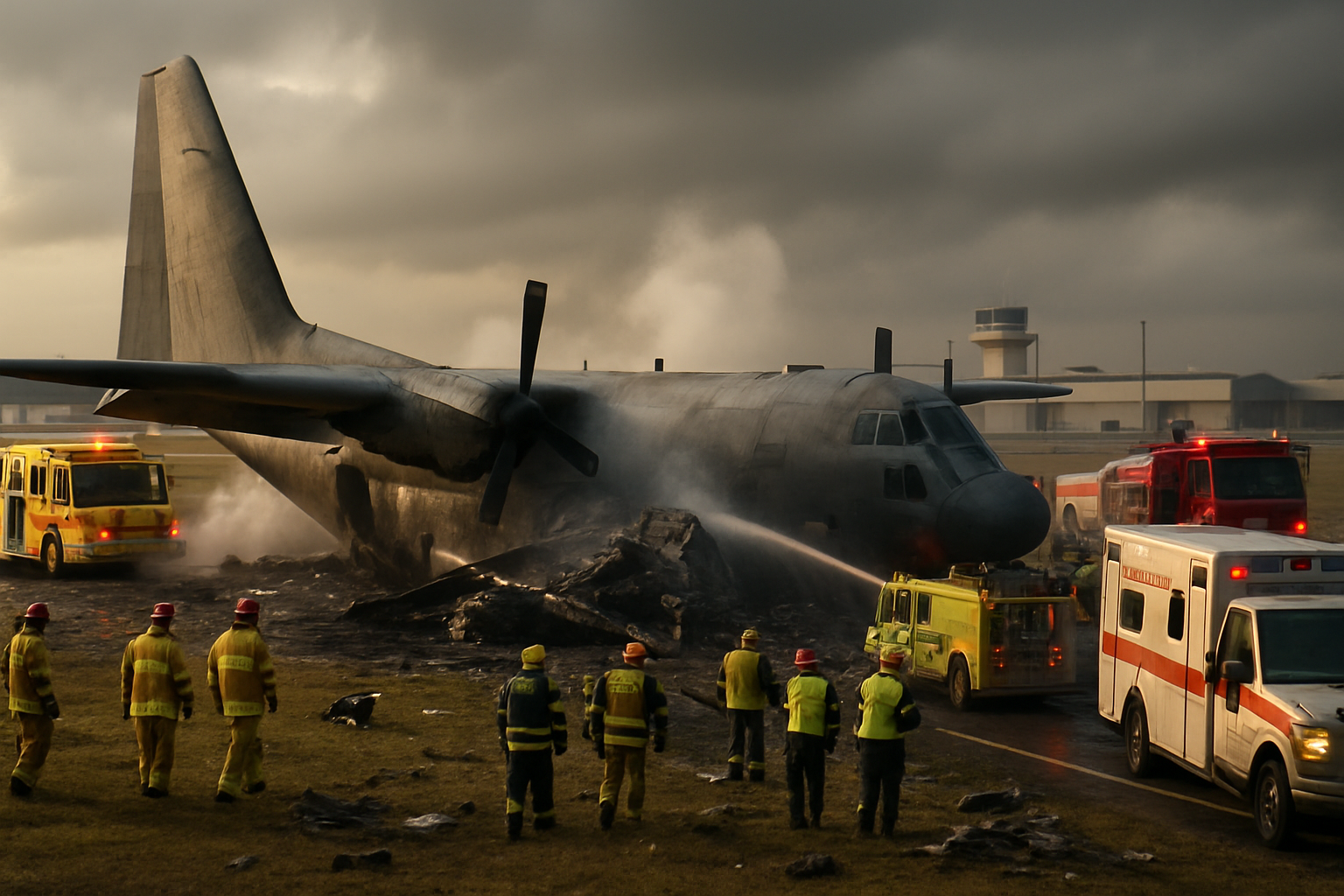
A Bolivian Air Force C-130 Hercules cargo plane crashed at El Alto International Airport on Friday evening, killing at least 22 people and injuring 28 others in one of Bolivia's most serious military aviation accidents in recent history.
The aircraft, carrying eight crew members and a cargo of newly printed banknotes from Santa Cruz, lost control during its landing approach at approximately 6:15 PM local time and skidded off the runway onto the busy Avenida Hernani highway, striking multiple civilian vehicles.
Death Toll Continues to Rise
Health Minister Marcela Flores confirmed Saturday that the death toll had risen to 22 people, including four children and a newborn baby, after additional bodies were recovered from the crash site. The Institute of Forensic Investigations (IDIF) conducted 20 autopsies, revealing 12 male victims, seven adult women, and one infant.
"We have 22 confirmed deaths, including four children, in addition to several adults. There are still bodies pending legal recovery," Minister Flores declared during a press briefing.
The casualties include both aircraft crew members and civilians in vehicles struck by the plane as it careened off the runway and traveled approximately one kilometer onto the main highway connecting El Alto to La Paz.
Aircraft and Cargo Details
Air Force Commander General Sergio Lora confirmed that the crashed aircraft was a C-130 Hercules with registration FAB 8-1, which had been transporting newly printed banknotes to the Central Bank of Bolivia. The plane carried eight crew members, six of whom were found alive and received medical attention, while search operations continued for the remaining two.
"We do not know the causes of the accident. An Accident Investigation Board is being established to determine what were the causes and factors that led to this fatal accident," stated Commander Lora.
— General Sergio Lora, Bolivian Air Force Commander
The aircraft was completing a routine cargo mission, transporting the currency as part of normal Central Bank operations. Bolivia's Defense Ministry later confirmed that all security protocols had been followed for the valuable cargo transport.
Chaotic Scenes at Crash Site
The accident created unprecedented scenes as thousands of newly printed Bolivian banknotes scattered across the crash site, drawing crowds of people attempting to collect the currency despite police warnings. Authorities were forced to deploy tear gas to disperse approximately 5,000 people who had gathered to collect the scattered bills.
Police Colonel René Tambo, chief of the Homicide division of the Special Force to Fight Crime (FELCC), confirmed the massive emergency response operation. "We are facing a regrettable event. There are deaths and injuries. We are carrying out the corresponding work," Tambo told journalists.
The presence of large crowds complicated rescue operations and forced authorities to establish wide security cordons around the crash site. Several ambulances were reportedly damaged during the chaos, and medical personnel suffered minor injuries while attempting to reach victims.
Government Response and Investigation
President Rodrigo Paz instructed multiple government ministries to coordinate emergency response efforts. Public Works Minister Mauricio Zamora joined the coordinated response alongside the Ministries of Defense and Government, working with the Central Bank of Bolivia, National Police, firefighters, and various rescue organizations.
The Ministry of Foreign Affairs expressed deep sorrow for the tragedy and thanked international expressions of solidarity, including support from the United Nations system and the international community. The CAF-Development Bank of Latin America and the Caribbean also issued a statement of solidarity with Bolivia following the accident.
An official Investigation Board has been established to determine the exact causes of the crash. The inquiry will examine all possible factors, including weather conditions, mechanical failure, and operational procedures that may have contributed to the accident.
Aviation Safety Concerns
The crash highlights ongoing challenges in military aviation safety, particularly for high-altitude operations. El Alto International Airport sits at an elevation of 4,150 meters (13,615 feet) above sea level, making it one of the world's highest commercial airports and creating challenging conditions for aircraft operations.
C-130 Hercules aircraft are generally considered reliable military transport planes, but the challenging high-altitude conditions and aging fleet issues common to many developing nations' air forces create additional operational risks. The aircraft was confirmed to have proper insurance coverage, according to military officials.
This incident represents the most serious Bolivian military aviation accident in recent history, prompting calls for comprehensive safety reviews of military cargo operations, especially those involving valuable cargo transport near populated civilian areas.
International Support and Implications
The tragedy has drawn international attention to aviation safety challenges faced by developing nations operating aging military aircraft fleets in difficult geographic conditions. Regional aviation experts noted that such incidents underscore the need for enhanced international cooperation in military aviation safety protocols and emergency response coordination.
The accident's timing, during what was supposed to be a routine banking operation, demonstrates the interconnected risks between military logistics operations and civilian infrastructure in Bolivia's challenging mountain geography.
As investigations continue, this tragedy serves as a stark reminder of the ongoing need for comprehensive safety measures, improved emergency response capabilities, and greater international cooperation in addressing transportation safety challenges affecting vulnerable communities throughout the region.