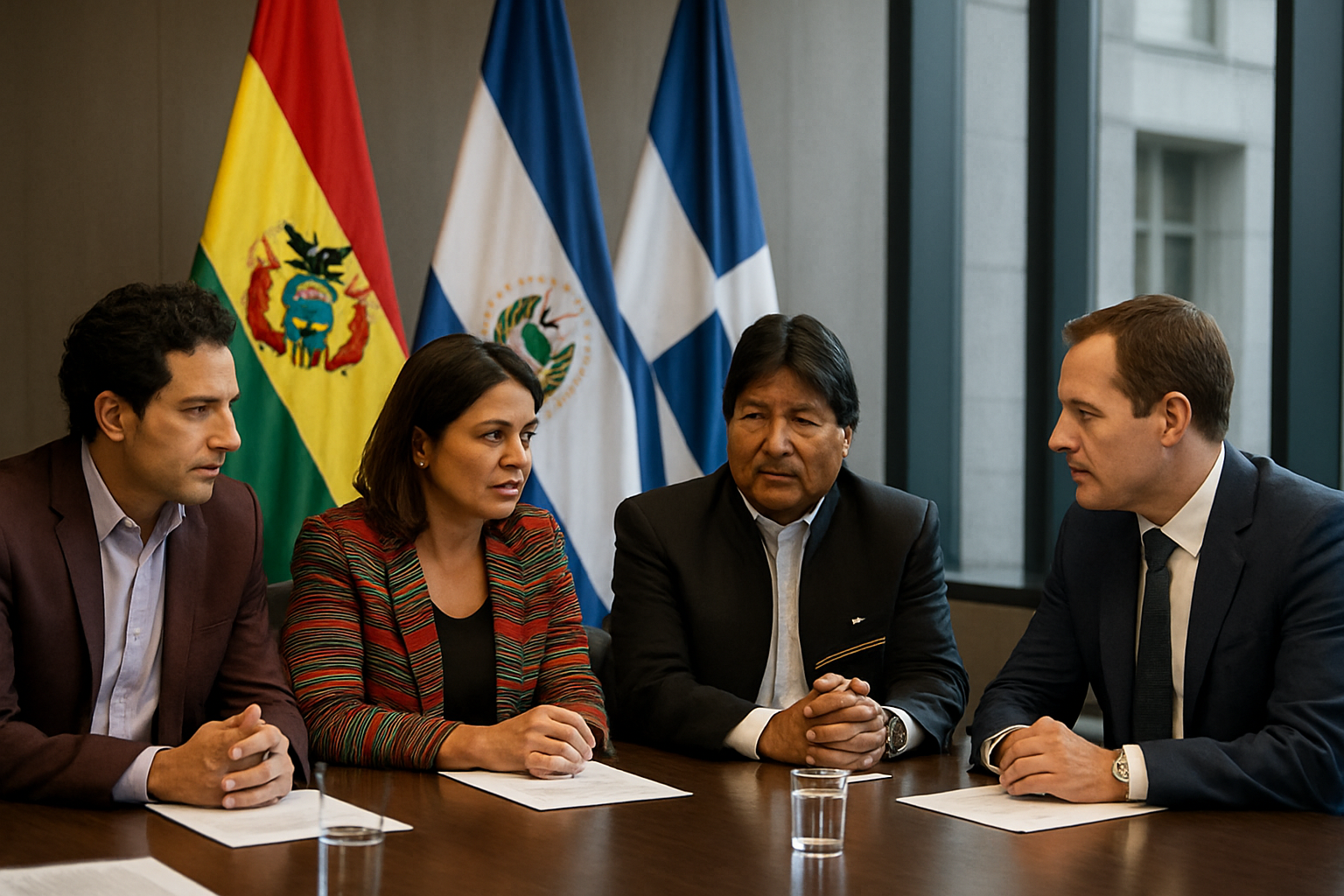
Bolivia is experiencing a historic shift toward multiparty democracy following recent subnational elections that have fundamentally transformed the nation's political landscape, according to political analyst Ricardo Paz. Simultaneously, El Salvador continues strengthening international cooperation through expanded partnerships with regional organizations.
The transformation in Bolivia has created what experts describe as an unprecedented "multicolor" political map, with no single party achieving clear dominance across the nation's departments. This marks a decisive break from decades of MAS (Movement for Socialism) hegemony that characterized Bolivian politics under Evo Morales and his successors.
Bolivia's Democratic Renaissance
Speaking on the political analysis program "Piedra, Papel y Tinta," consultant Ricardo Paz emphasized that Bolivia is transitioning "from a single-party system toward a broad-based multiparty democracy." The recent subnational elections have produced a fragmented political landscape where traditional power structures have given way to regional autonomy and negotiated governance.
"There are no clear winners or absolute losers, except for cases like National Unity, which disappeared from the territorial map," Paz explained. "What emerges is a multicolor Bolivia that forces us to relearn how to negotiate."
The analyst emphasized that power is shifting toward territorial governance, with governors and mayors becoming protagonists in a scenario requiring constant negotiation. "Autonomies are the path forward, and agreements will no longer be limited to the Legislative Assembly but must occur in each region," he noted.
This political fragmentation represents the culmination of several years of institutional crisis within MAS, which suffered significant defeats in key departments including La Paz, where traditional voting patterns have been disrupted. The collapse of centralized party dominance has created opportunities for regional political movements and independent candidates to gain influence.
El Salvador's Diplomatic Expansion
Meanwhile, El Salvador is actively expanding its international partnerships under the administration of President Nayib Bukele. Vice President Félix Ulloa recently met with Giorgio Silli, Secretary General of the Italo-Latin American International Organization (IILA), to explore new collaborative initiatives.
During the meeting, Vice President Ulloa outlined El Salvador's strategic vision encompassing security improvements, economic transformation, renewable energy development, tourism promotion, and institutional strengthening. The discussions highlighted the significant progress the country has achieved in creating more favorable conditions for investment and development.
The meeting also included Jorge Urbina, Trinational Secretary of the Trifinio Plan, who emphasized the importance of collaboration between international organizations and regional development initiatives. This reflects El Salvador's broader strategy of engaging multiple international partners to support its modernization agenda.
Regional Context of Democratic Evolution
These developments occur within a broader context of Latin American political transformation. The region has experienced significant changes in governance patterns, with traditional left-right political alignments giving way to more complex, issue-based coalitions.
Bolivia's embrace of multiparty politics comes after years of institutional crisis that culminated in the 2019 political upheaval and subsequent democratic restoration. The current President Rodrigo Paz has emphasized institutional rebuilding and democratic consensus-building as cornerstones of his administration.
The shift toward territorial governance in Bolivia reflects broader trends toward decentralization across Latin America, where local and regional authorities are gaining increased autonomy to address specific community needs. This evolution challenges traditional centralized governance models that dominated the region for decades.
International Cooperation and Security
El Salvador's diplomatic initiatives build upon the country's successful security transformation, which has evolved from having one of the world's highest homicide rates to becoming a regional model for crime reduction. This transformation has enhanced the country's international standing and attracted partnerships with organizations seeking to replicate successful governance models.
The country's engagement with IILA represents part of a broader strategy to diversify international relationships beyond traditional regional blocs. El Salvador has been actively pursuing partnerships with European, Asian, and Middle Eastern nations while maintaining strong ties within the Americas.
Vice President Ulloa's presentation of El Salvador's achievements in security, economic development, and institutional strengthening demonstrates the government's confidence in showcasing its policy successes to potential international partners.
Challenges and Opportunities
Bolivia's transition to multiparty democracy faces significant challenges, including the need to build consensus among diverse political factions with differing regional interests. The fragmentation that has ended single-party dominance also complicates governance, requiring sophisticated negotiation skills and coalition-building.
Economic pressures, including inflation and unemployment, add complexity to the political transition. Regional governors and mayors must balance local demands with national coordination requirements, creating potential tensions between autonomy and unity.
For El Salvador, the challenge lies in maintaining the momentum of its successful transformation while managing the expectations of international partners. The government must demonstrate that its achievements in security and governance can translate into sustainable economic development and social progress.
Future Implications
The political evolution in both countries reflects broader trends reshaping Latin American democracy. Bolivia's multiparty transition could provide a model for other nations seeking to move beyond polarized political systems toward more inclusive governance structures.
El Salvador's international cooperation strategy demonstrates how successful domestic reforms can enhance a nation's diplomatic leverage and attract beneficial partnerships. The country's experience may influence how other Latin American nations approach international engagement.
Both developments suggest that Latin American democracies are adapting to contemporary challenges through innovation rather than reverting to historical patterns. The emphasis on territorial governance in Bolivia and international partnerships in El Salvador indicates a maturation of democratic institutions capable of responding to citizen demands for effective governance.
As these political transformations continue to unfold, they will likely influence broader regional discussions about democratic governance, federalism, and international cooperation. The success or failure of these experiments in democratic innovation will have implications extending far beyond national borders, potentially reshaping how Latin American nations approach governance in the 21st century.