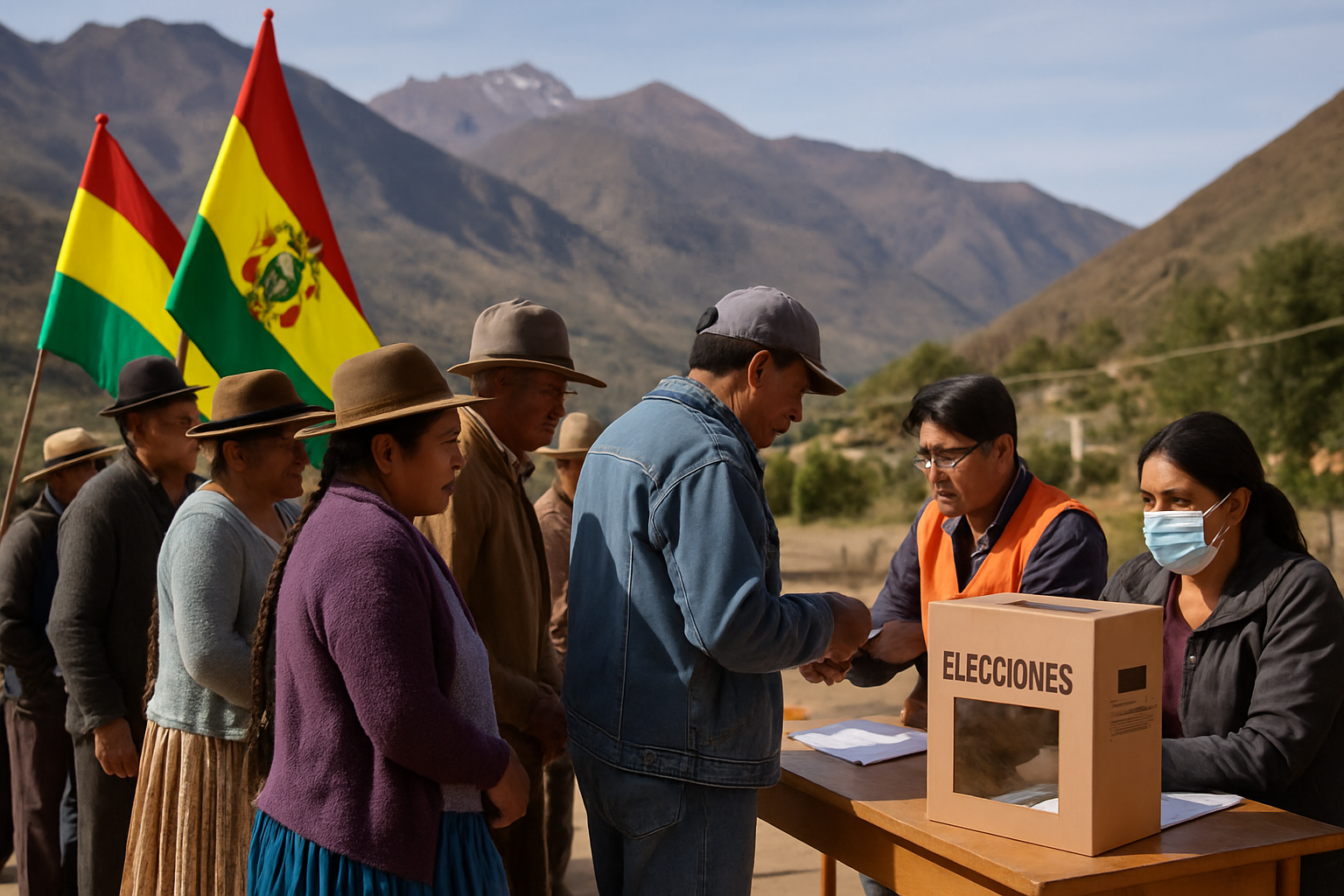
Bolivia successfully conducted regional elections on Sunday, March 22, 2026, with over 7.5 million citizens casting votes to select governors and mayors across the country's nine departments, despite weather-related delays in several regions that tested the resilience of the democratic process.
Supreme Electoral Tribunal (TSE) President Gustavo Ávila declared the electoral process a success at midday, reporting that 99.7% of polling stations had opened despite rain-related delays in some cities. "They are voting normally, we have not had any negative reports regarding the opening of polling stations; therefore, we could say that this electoral day has been a success so far," Ávila stated during a press conference.
Weather Challenges and Electoral Resilience
Heavy rains in La Paz and other regions created initial delays as citizens were slow to arrive at polling stations in the morning hours. However, the electoral authorities demonstrated institutional resilience by maintaining operations across the vast Andean nation. Only four polling stations faced significant problems – three in Santa Cruz department and one in Beni – representing a minimal disruption to the overall process.
Ávila emphasized that electoral regulations required all efforts to open the problematic stations, stating that "if these polling stations cannot be opened, the regulation tells us that they are counted as zero votes." This commitment to electoral completeness underscored the TSE's dedication to ensuring every eligible voter had the opportunity to participate.
International Oversight and Democratic Validation
The Union of Interamerican Electoral Organizations (Uniore) delegation, comprising approximately 20 representatives from electoral bodies across the Americas, praised the professionalism of the electoral process. "We are extremely satisfied because we can see there is a lot of professionalism, and the different circumstances for carrying out the process have been improving day by day," stated a Uniore representative during contact with local media.
The international observers received comprehensive briefings on all procedures being implemented for the subnational elections throughout the national territory, providing crucial external validation of Bolivia's democratic institutions. This oversight comes at a critical time for Bolivia's democracy, following years of political fragmentation and institutional challenges.
Political Competition and Calls for Transparency
The elections featured intense competition for key gubernatorial positions, with candidates emphasizing transparency and democratic accountability. In La Paz department, gubernatorial candidates Luis Revilla and Andrés Gómez both called for transparent results and timely reporting.
"We are choosing the path we want for our department, the destiny we want for our children, and we hope that at the end of the day, we can celebrate democracy and that the results are timely."
— Luis Revilla, La Paz Gubernatorial Candidate
Santa Cruz Governor Luis Fernando Camacho urged the population to not only vote but also to safeguard the transparency of results. "Go vote, but also go take care of it so that we have results that reflect the tranquility of all cruceños," he said before casting his ballot, emphasizing the importance of citizen oversight in maintaining electoral integrity.
Presidential Leadership and Democratic Renewal
President Rodrigo Paz cast his vote early and announced a new phase of collaboration with regional authorities. "From tomorrow we are going to start working with the elected authorities, they will have all the willingness to work," he declared, inviting regional leaders to join efforts during what he described as a "difficult moment" for the country.
Paz emphasized his administration's centrist approach, stating his government "does not commune with extremes" and would work with all elected authorities regardless of their ideological orientation. He highlighted his administration's achievements in ordering the economy and institutions while putting Bolivia "in the eyes of the world" during his five months in office.
Historical Context and Democratic Significance
The elections occurred against the backdrop of significant political transformation in Bolivia. Former Vice President David Choquehuanca made a public appearance during the voting process, criticizing the current government's internal divisions while calling for institutional unity. His comments reflected ongoing tensions within Bolivia's political establishment following the collapse of the MAS (Movement for Socialism) party's long-standing dominance.
These subnational elections represent a crucial test of Bolivia's democratic institutions amid ongoing political fragmentation. The peaceful conduct of voting across the country's challenging geography – from high-altitude cities to tropical lowlands – demonstrated the TSE's technical capacity and the population's continued commitment to democratic participation.
Regional Implications and Future Governance
President Paz announced that the election results would usher in a "new phase to give more weight to the regions," suggesting a shift toward greater decentralization and regional autonomy. This approach aligns with his administration's policy of distributing power more evenly between the central government and departmental administrations.
The successful completion of these elections amid weather challenges and political tensions provides a positive signal for Bolivia's democratic consolidation. As observed in the broader Latin American context, where youth-led democratic movements have gained momentum from Bangladesh to Nepal, Bolivia's stable electoral process offers regional stability amid global democratic pressures.
The final results will determine the composition of departmental governments and municipal administrations for the next electoral cycle, setting the stage for how President Paz's administration will collaborate with regional authorities across Bolivia's diverse political landscape. With international observers confirming the process's legitimacy and citizens demonstrating high participation despite weather challenges, the elections reinforce Bolivia's democratic institutions during a period of significant political transition.