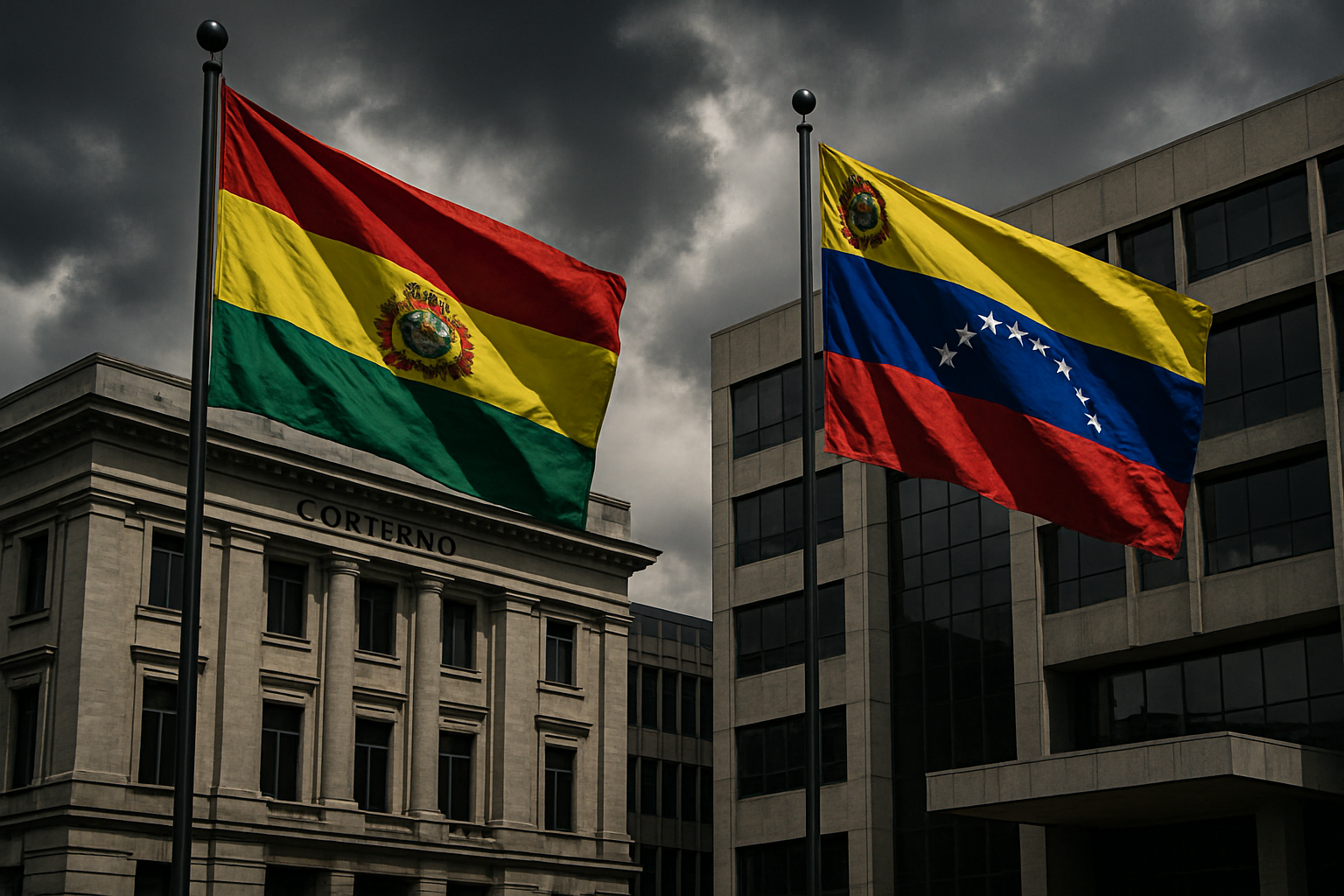
Political tensions are escalating across South America as Bolivia faces mounting scrutiny over banking irregularities following a deadly military aircraft crash, while Venezuela's ambitious political prisoner amnesty program encounters significant obstacles despite diplomatic breakthroughs with the United States.
Bolivia's Banking Controversy Deepens
Opposition alliance Libre has formalized a Petición de Informe Oral (PIO) demanding Central Bank Bolivia (BCB) President David Espinoza explain the origin, destination, and procedures surrounding 17.1 million banknotes that were being transported on the crashed C-130 Hercules FAB-81. The military aircraft crashed near El Alto International Airport, killing 22 people and raising serious questions about money handling protocols.
Deputy chief Lisa Claros cited multiple concerns about official communications that have created "public anxiety" over Series B banknote validity. The controversy centers on contradictory information initially provided by authorities, who claimed the cash had "no legal value, serial numbers, or signatures," but later proved to have validity, numbering, and official backing.
"The Central Obrera Boliviana denuncia with firmness that, once again, the Government responds to a tragedy with improvisation, contradicciones and lack of clarity, descargando sobre la población la incertidumbre y el costo social"
— Central Obrera Boliviana statement
Vice President Edmand Lara has denounced what he calls BCB and government "falsehoods and irregularities" surrounding the money transport. Most seriously, Lara accused authorities of burning recovered banknotes to eliminate compromising evidence, a charge that has intensified calls for a full investigation into financial protocols and transparency.
Venezuela's Complex Amnesty Implementation
Meanwhile, Venezuela's historic amnesty law continues to face implementation challenges despite significant progress. The Bloque Constitucional de Venezuela has criticized the designation of Tarek William Saab as interim Public Defender as "irregular," arguing that the position should go to the deputy director of the executive in such cases.
The comprehensive 1999-2026 amnesty law, covering political offenses spanning the entire Chávez-Maduro era, has released over 750 political prisoners since January 2026. However, human rights organizations report that more than 600 political prisoners remain detained, with families maintaining vigils and hunger strikes outside detention facilities.

The amnesty process has been complicated by Article 7, which requires prisoners to "present themselves to justice" - a provision opposition groups reject as criminalizing persecution victims. Additionally, Article 9 excludes those who "promoted attacks on national territory by foreign states or corporations," potentially affecting prominent opposition figures.
US-Venezuela Diplomatic Breakthrough
Despite amnesty challenges, Venezuela has achieved unprecedented diplomatic progress with the United States under Acting President Delcy Rodríguez's interim government. Oil exports have surged 60% to 800,000 barrels daily, with the US displacing China as Venezuela's top customer following Energy Secretary Chris Wright's historic February visit to Caracas.
The diplomatic breakthrough represents a dramatic shift from the maximum pressure campaign of the previous administration to what experts call "selective engagement." Former Spanish Prime Minister José Luis Rodríguez Zapatero continues mediation efforts in Caracas, while Cardinal Porras has organized nationwide prayer vigils supporting the democratic transition.
"Optimismo y ansias de cambio: las expectativas de los venezolanos tras la captura de Nicolás Maduro"
— Venezuelan public sentiment report
The transition has also seen other developments, including the reported detention of former Vice Minister of Sport Alexander "Mimou" Vargas, though the motives and whether this represents a broader crackdown remain unclear. The liberation of Argentine gendarme Nahuel Gallo, who was sent back to his country, signals some diplomatic normalization in the region.
Regional Implications
Both countries' situations reflect broader challenges facing South American democracies as they navigate between institutional accountability and political stability. Bolivia's banking irregularities highlight ongoing governance issues that have plagued the region, while Venezuela's democratic transition represents the most comprehensive political prisoner amnesty in recent Latin American history.
The international community is closely monitoring both situations. Venezuela's amnesty process is being watched as a potential template for post-authoritarian transitions, while Bolivia's handling of the banking controversy will test its commitment to transparency and institutional accountability.
Bolivia's Central Obrera Boliviana has been particularly vocal in criticizing what it sees as government improvisation in handling both the aircraft tragedy and the banking issues. The labor organization's statement reflects broader concerns about governmental competence during crisis situations.
Looking Forward
As both countries grapple with their respective challenges, the coming weeks will be critical. Bolivia faces mounting pressure to provide clear answers about the banking irregularities while properly honoring the victims of the aircraft crash. The government of President Rodrigo Paz has attempted to maintain focus on victim support while addressing opposition demands for transparency.
In Venezuela, the success or failure of the amnesty implementation will significantly impact the credibility of the democratic transition. With María Corina Machado, the Nobel Peace Prize laureate, recently announcing her intention to return to Venezuela "in a few weeks," the political landscape continues to evolve rapidly.
The international dimensions of both crises - from Bolivia's need for transparent governance to Venezuela's diplomatic breakthroughs with the US - demonstrate how domestic political developments in South America increasingly intersect with broader regional and global dynamics. The resolution of these challenges will likely influence democratic development patterns across Latin America for years to come.