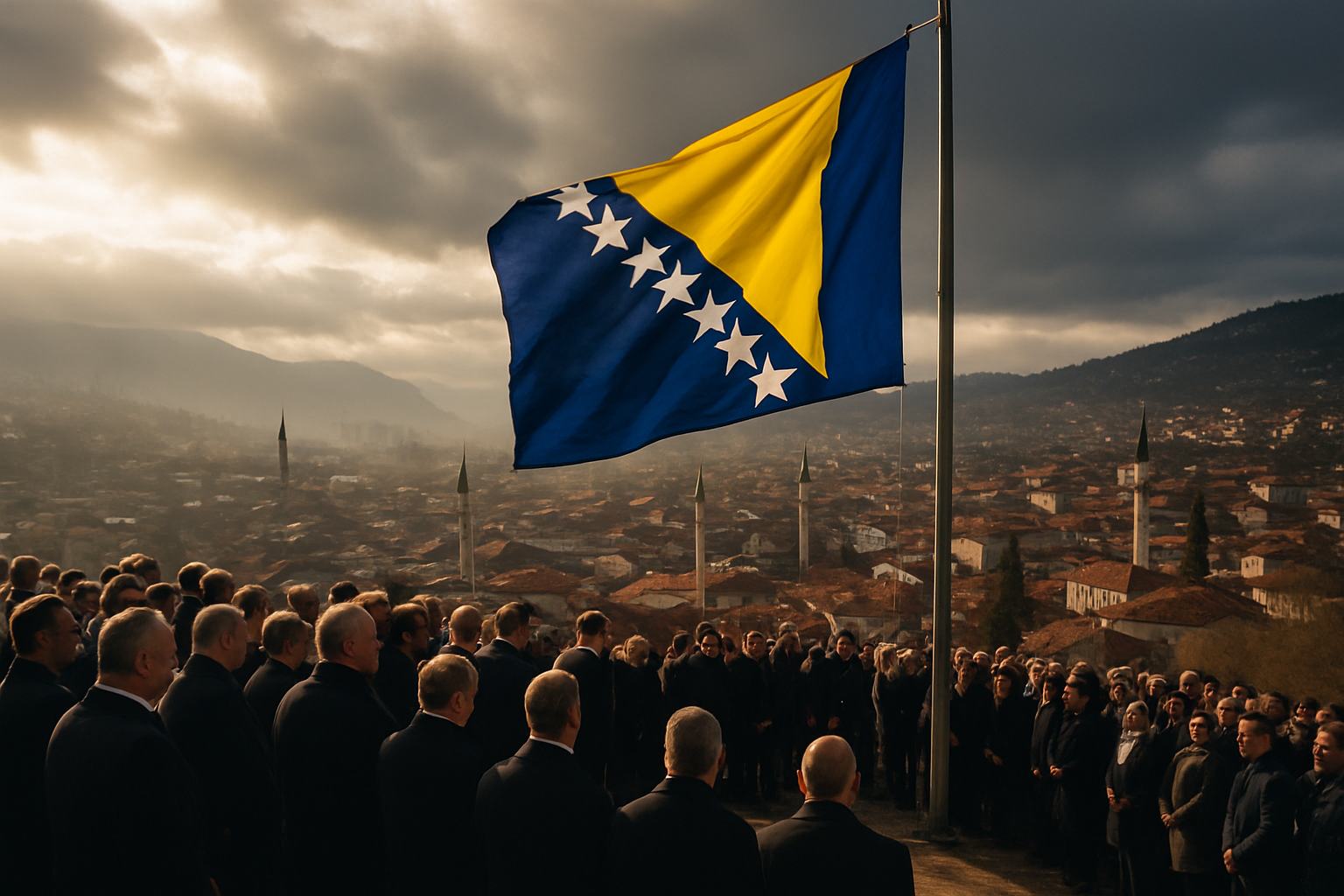
Bosnia and Herzegovina marked its Independence Day on March 1st with political leaders delivering strong messages of national unity while categorically rejecting separatist movements, as the country continues its path toward European integration amid ongoing regional challenges.
The traditional Independence Day ceremonies began with the solemn raising of the national flag on Hum Hill above Sarajevo, where representatives from all levels of government gathered alongside citizens to commemorate the historic referendum of March 1, 1992, when the majority of Bosnians and Herzegovinians voted for an independent and democratic state.
Political Leaders Unite in Condemning Separatism
Denis Bećirović, a member of Bosnia and Herzegovina's Presidency, delivered particularly strong remarks emphasizing that the country's potential NATO membership would mark "the end of any talk of divisions and a safe harbor for the state." In his Independence Day statement, Bećirović declared that those who observe March 1st as a day of mourning represent protagonists of the "Greater Serbia" project, which was decisively rejected by the referendum.
"March 1st is a holiday of freedom and dignity. Without the referendum, Bosnia and Herzegovina would not have avoided the Greater Serbia project, but citizens decisively prevented it."
— Denis Bećirović, Member of the Presidency
Željko Komšić, the current Chairman of the Presidency, reinforced these themes during his remarks at memorial sites throughout Sarajevo. "Bosnia and Herzegovina will not disappear. There is room for everyone in this country," he stated, while emphasizing that the country continues to fight against policies that threaten its independence and territorial integrity.
Historical Context and NATO Aspirations
Bećirović placed the Independence Day celebrations within a broader historical context, noting that Bosnia and Herzegovina has maintained its distinctiveness and authenticity throughout history - from the medieval Bosnian state through the Ottoman period, when the Bosnian Sandžak and Eyalet existed, to the Austro-Hungarian era, which also recognized Bosnia and Herzegovina's special status.
The emphasis on NATO membership as a guarantor of territorial integrity reflects ongoing geopolitical tensions in the region. Political leaders view NATO accession as crucial for cementing the country's sovereignty and preventing any future attempts at territorial division or separatist movements.
Ceremonial Traditions and Commemorative Events
Following the flag-raising ceremony on Hum Hill, officials participated in a series of commemorative events throughout Sarajevo. These included laying flowers at the Martyrs' Memorial at Kovači and at the grave of Alija Izetbegović, the first president of the Republic of Bosnia and Herzegovina during the independence struggle.
Additional commemorative activities took place at several significant locations, including:
- The Eternal Flame memorial
- The Memorial to Murdered Children of Besieged Sarajevo (1992-1995)
- The memorial to murdered police officers in Veliki Park
- The Vraca Memorial Park
- The Novi Grad Memorial
These ceremonies served not only as remembrance of those who sacrificed for independence but also as a demonstration of the continuing commitment to the democratic values established in 1992.
Veterans and Civil Society Perspectives
Omer Osmanović, the outgoing Minister for Veterans' Affairs of the Sarajevo Canton, provided a personal perspective on the significance of Independence Day during a special television program. Reflecting on his generation's experience, he emphasized the honor of participating in Bosnia and Herzegovina's democratic emergence.
"First, I had the honor of belonging to a generation that could participate in elections. I was of age... These were the first elections of my life. Then I had the honor of being able to fight for Bosnia and Herzegovina, and now I have the honor of participating in the building and continuous defense of Bosnia and Herzegovina."
— Omer Osmanović, Outgoing Veterans' Minister
Osmanović also acknowledged the challenges facing the country, noting that while 30-plus years have passed since independence, Bosnia and Herzegovina could have been better positioned today, ideally as a member of both the European Union and NATO.
International Recognition and Current Status
The Independence Day commemorations highlighted the international recognition Bosnia and Herzegovina achieved following the referendum. European Community countries recognized the independent and sovereign state on April 6, 1992, followed by the United States the next day. The country was admitted to United Nations membership on May 22, 1992.
Today, Bosnia and Herzegovina continues its European integration process, with EU membership remaining a key strategic goal alongside NATO accession. The country's leadership views these Western integrations as essential for securing long-term stability and preventing any resurgence of separatist ideologies.
Contemporary Challenges and Democratic Resilience
The strong anti-separatist messaging during this year's Independence Day celebrations comes amid ongoing regional tensions and concerns about territorial integrity. Political leaders used the occasion to reaffirm their commitment to maintaining Bosnia and Herzegovina as a unified, multi-ethnic state within its internationally recognized borders.
The ceremonies also demonstrated the country's democratic resilience, with representatives from all levels of government and various ethnic communities participating in the commemorative events. This broad participation reflects the continued commitment to the multi-ethnic, democratic principles established during the independence referendum over three decades ago.
As Bosnia and Herzegovina marked its 34th Independence Day, the consistent themes of unity, sovereignty, and European integration dominated the political discourse, while the traditional ceremonies served as both remembrance of the past and recommitment to the democratic future envisioned by those who voted for independence in 1992.