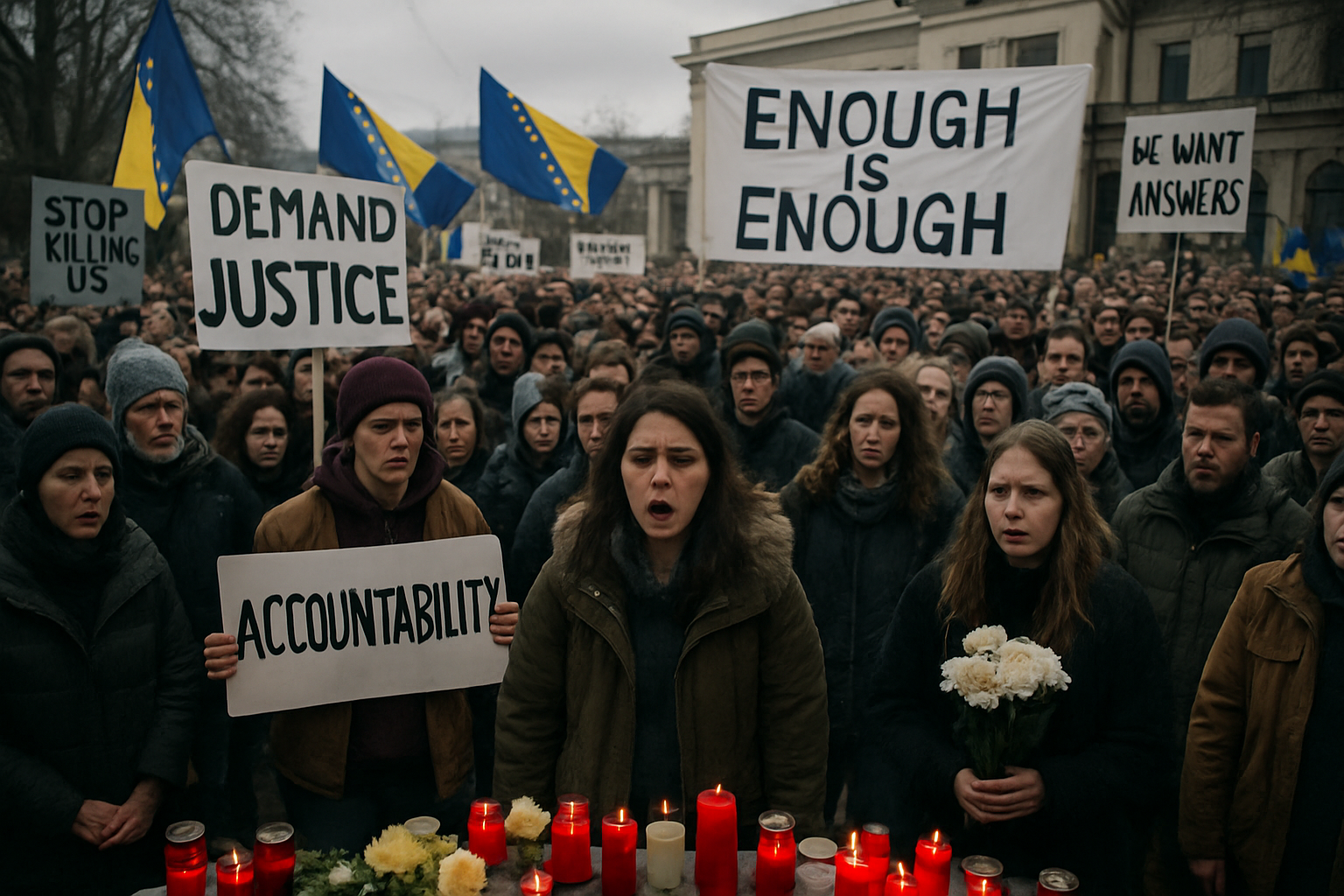
Mass protests continue to sweep across Bosnia and Herzegovina as citizens demand accountability and systematic changes following the tragic February 12, 2026 tramway accident that claimed the life of 23-year-old student Erdoan Morankić and left 17-year-old Ella Jovanović fighting for her life with an amputated leg.
Six days after the devastating derailment near Sarajevo's National Museum, thousands of protesters gathered again at noon on February 21, 2026, at the exact intersection where the tragedy occurred. The demonstration, part of sustained civic action that has already forced the resignation of Sarajevo Canton Prime Minister Nihad Uk, represents one of the most significant displays of public anger in post-war Bosnia Herzegovina.
Community Voices Echo Call for Change
The protest brought together citizens from all walks of life, with particularly powerful testimony from students and families affected by transportation safety failures. A female student addressed the crowd through tears, asking the haunting question: "How many more times will a mother open the news instead of the door when her child comes home?"
Her words referenced not only the recent victims but a pattern of tragic losses including David, Dženan, Džejla, and other young lives lost to systemic failures in Bosnia's infrastructure and safety protocols.
"We are starved, tortured, betrayed, deceived, disappointed, and one of our own has been killed."
— Student statement echoing broader frustrations
Among the most moving moments was the appearance of Sead Marevac, father of ten-year-old Hamze who died in 2012. His presence connected current protests to a decade-long pattern of institutional failure and impunity.
Celebrity Support Amplifies Message
The movement gained additional visibility when prominent Bosnian influencer Hana Hadžiavdagić joined the demonstrations, making a symbolic statement that resonated across social media: "I'm returning the horse's head when you return the money" - a reference to government corruption and mismanagement of public funds.
Her participation highlighted how the protests have transcended traditional political boundaries, drawing support from entertainment figures, students, parents, and ordinary citizens united in demanding fundamental changes to how Bosnia Herzegovina governs public safety.
Spreading Solidarity
The protests have expanded beyond Sarajevo's borders, with solidarity demonstrations reported in other Bosnian cities. In Zenica, approximately 70 citizens gathered at Trg Bosne i Hercegovine under the banner "Young People of Zenica for Young People of Sarajevo," protesting in silence with banners asking "How many more lives?" and "Watch out for me and my friends!"
This regional solidarity demonstrates how the Sarajevo tragedy has catalyzed broader concerns about transportation safety, government accountability, and institutional responsiveness across the country.
The February 12 Tragedy
The incident that sparked this sustained civic uprising occurred at 12:02 PM on February 12, 2026, when a tramway traveling from the Railway Station direction derailed while making a left turn at the intersection of Prva transverzala and Ulica Zmaja od Bosne. The tram struck a passenger vehicle, metal pole, and protective barrier before coming to rest.
Erdoan Morankić from Brčko, a 23-year-old student, was waiting at the tram station when the derailment occurred. He died at the scene. Four others were injured, including 17-year-old medical student Ella Jovanović from Sarajevo Medical High School, who required emergency leg amputation and remains in critical condition.
The community's immediate response was overwhelming support for the victims, with hundreds gathering to lay flowers and light candles while displaying a banner reading "We are with you Ella Jovanović, stay strong."
Government Response and Political Fallout
The sustained protests achieved their first major victory when Sarajevo Canton Prime Minister Nihad Uk resigned on February 15, stating: "When I choose between the voice and courage of young people on one side and my function on the other, the choice is clear."
However, protesters' demands extend far beyond individual resignations. Their formal requirements, read during the February 21 demonstration, include:
- Establishment of a truly lawful state with functional institutions
- Guaranteed safety in public transportation systems
- Complete overhaul of the current Sarajevo Canton government
- Transparent investigation and accountability for the tragedy
- Systematic reforms to prevent similar incidents
Deeper Systemic Issues
The protests reflect broader concerns about aging infrastructure throughout post-war Bosnia Herzegovina. The tramway system, like much of the country's public transportation network, suffers from decades of deferred maintenance and insufficient investment.
Investigation continues into the technical causes of the derailment, with authorities examining both mechanical failure and human error as potential factors. Tramway driver Adnan Kasapović was initially detained but later released when the Sarajevo Canton Court refused the prosecution's custody request, a decision that further inflamed public sentiment.
"The system punished me with 9,000 marks for my son's death, and from my dead child's backpack, they stole money."
— Sead Marevac, father of 2012 victim Hamze
A Pattern of Institutional Failure
The current protests build on a documented history of transportation safety failures and institutional unresponsiveness. Sead Marevac's testimony about his son's 2012 death revealed how families of victims often face additional trauma from bureaucratic failures and alleged corruption in the aftermath of tragedies.
His account of being financially penalized while his deceased child's belongings were violated represents the kind of institutional cruelty that has fueled current demands for comprehensive reform rather than cosmetic changes.
International Context
These demonstrations occur within a broader context of youth-led movements demanding accountability across Europe and globally. Similar to protests that have achieved political change in other countries, Bosnia's movement combines immediate demands for justice with longer-term visions of institutional transformation.
The protests also highlight the particular vulnerability of student populations who rely heavily on public transportation in Sarajevo, where many families cannot afford private vehicles and the tramway system serves as a vital lifeline connecting residential areas to educational institutions.
Looking Forward
As protesters continue their vigil at the site of the tragedy, their message remains clear: this is not merely about one accident, but about fundamental questions of how democratic institutions should serve and protect their citizens.
The sustained nature of the demonstrations - continuing daily for over a week - indicates deep public determination to achieve meaningful change rather than accept symbolic gestures or temporary political adjustments.
The movement's emphasis on peaceful protest, combined with powerful personal testimony and broad cross-section support, has created what many observers see as a pivotal moment for Bosnian democracy. Success in achieving their demands could serve as a template for civic action across the Balkans region.
With investigations ongoing and political pressure mounting, the coming days will test whether Bosnia's institutions can respond meaningfully to citizen demands or whether the protests will need to intensify to achieve the systematic changes protesters say are essential for preventing future tragedies.