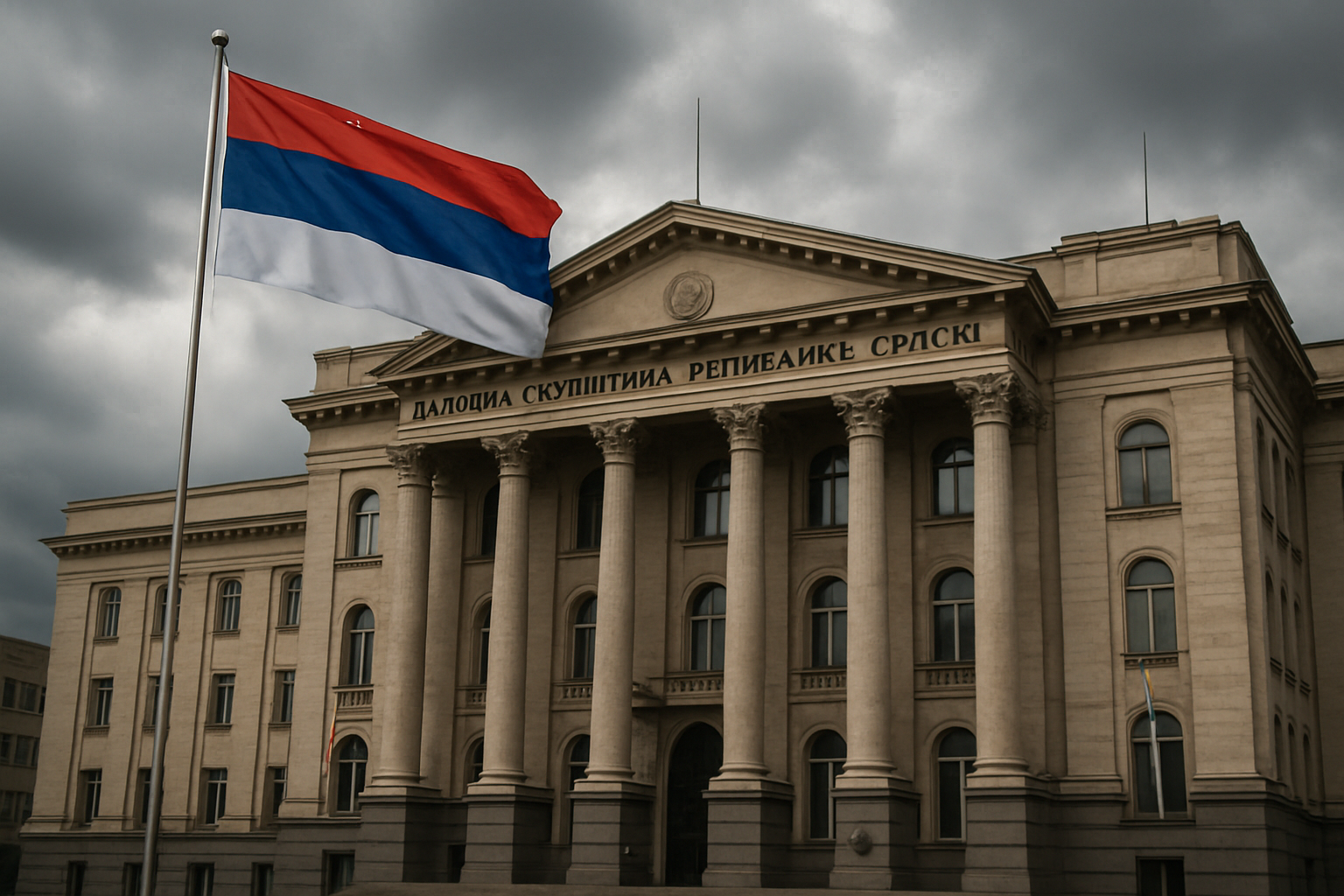
The National Assembly of Republika Srpska (NSRS) held an extraordinary session on March 16, 2026, unanimously accepting the second resignation of Prime Minister Savo Minić with 49 votes, marking a dramatic escalation in the ongoing constitutional crisis that has gripped Bosnia and Herzegovina's Serb entity.
The emergency parliamentary session came just hours after Minić submitted his second resignation, citing insurmountable constitutional challenges to his legitimacy. Only governing coalition members attended the session, with opposition parties boycotting the proceedings in protest of what they described as an "unconstitutional government formation process."
Constitutional Court Challenge at the Heart of Crisis
The crisis stems from a fundamental challenge to Minić's appointment process before the Constitutional Court of Bosnia and Herzegovina. Legal experts point to irregularities in the nomination procedure, where questions were raised about whether proper constitutional protocols were followed when he was initially proposed for the prime ministerial position.
Sources close to the proceedings indicate that the Constitutional Court was preparing to rule on the legality of Minić's appointment, creating an untenable position for the Prime Minister. Rather than face a potentially damaging court ruling that could have declared his entire tenure illegitimate, Minić chose to resign for the second time.
This represents an unprecedented situation in the post-war history of Republika Srpska, where a prime minister has been forced to resign twice due to constitutional challenges rather than political disagreements or vote of no confidence.
Historical Context of Political Instability
The current crisis must be understood within the broader context of political instability that has plagued Bosnia and Herzegovina in recent years. The country's complex constitutional structure, established by the Dayton Peace Agreement in 1995, creates multiple layers of government that often struggle to function cohesively.
Recent memory includes the dramatic tram accident crisis in Sarajevo that led to the resignation of Sarajevo Canton Prime Minister Nihad Uk in February 2026. That crisis saw sustained protests by young people demanding government accountability following a fatal tram derailment that killed 23-year-old Erdoan Morankić and critically injured 17-year-old medical student Ella Jovanović.
The protests, organized under the banner "Reci dosta" (Say Enough), demonstrated the power of civic engagement to effect political change. The movement spread beyond Sarajevo, with solidarity demonstrations in Belgrade and other regional cities, highlighting the interconnected nature of political accountability across the Western Balkans.
International Implications and EU Concerns
The resignation crisis in Republika Srpska comes at a particularly sensitive time for Bosnia and Herzegovina's European integration aspirations. The European Union has been monitoring political stability in the Western Balkans closely, as institutional crises can derail the lengthy EU accession process.
Brussels has repeatedly emphasized that EU membership candidates must demonstrate stable democratic institutions capable of implementing reforms and maintaining the rule of law. The repeated resignations and constitutional challenges in both entities of Bosnia and Herzegovina raise questions about the country's institutional maturity.
Regional experts note that this crisis differs from typical parliamentary disagreements seen in established democracies. Instead, it represents deeper structural problems with the constitutional framework established by the Dayton Agreement, which critics argue has created unwieldy institutions prone to deadlock and legitimacy challenges.
Economic and Social Impact
The political uncertainty has immediate economic implications for Republika Srpska and the broader Bosnian economy. International investors require political stability to make long-term commitments, and repeated governmental crises create an atmosphere of uncertainty that can deter foreign direct investment.
The resignation also comes amid ongoing challenges with aging infrastructure throughout the region. The February tram accident in Sarajevo highlighted systematic problems with public transportation maintenance that affect both entities of Bosnia and Herzegovina. These infrastructure challenges require sustained political leadership to address effectively.
Young people, in particular, have expressed frustration with the political system's inability to provide stable governance focused on improving living conditions and economic opportunities. The protests following the Sarajevo tram accident demonstrated this demographic's willingness to demand accountability from political leaders.
The Path Forward
With Minić's second resignation now officially accepted, Republika Srpska faces the challenge of forming a new government that can withstand constitutional scrutiny. The process will require careful attention to legal procedures to avoid repeating the constitutional challenges that forced Minić's departure.
Political observers suggest that the next prime ministerial candidate must be chosen through a more transparent and constitutionally sound process. This may require broader consultation with legal experts and opposition parties to ensure the appointment can withstand potential court challenges.
The crisis also highlights the need for broader constitutional reform discussions in Bosnia and Herzegovina. The current framework, designed primarily to end the 1992-1996 war, may require updating to function more effectively in a peacetime democratic context.
Regional Democratic Resilience
Despite the political turmoil, the crisis demonstrates certain positive aspects of democratic institutional functioning. The fact that constitutional challenges can force governmental changes shows that legal constraints on political power remain effective, even in complex political systems.
The peaceful nature of the governmental transition, despite its constitutional irregularities, contrasts favorably with more dramatic political crises seen in other parts of the world. Opposition parties, while boycotting the parliamentary session, have not challenged the legitimacy of the democratic process itself.
Civil society organizations continue to play an important watchdog role, as demonstrated by the successful protests following the Sarajevo tram accident. This civic engagement provides a crucial check on political power and demonstrates the population's commitment to democratic accountability.
Looking Ahead
The resolution of this crisis will serve as an important test of Bosnia and Herzegovina's democratic maturation. Success in forming a constitutionally sound government could strengthen confidence in the country's institutions and advance EU integration prospects.
However, failure to resolve the underlying constitutional issues could lead to continued instability and further complicate the country's European integration trajectory. The international community, particularly EU institutions, will be watching closely to see whether Bosnian political leaders can demonstrate the institutional sophistication required for eventual EU membership.
The coming weeks will be crucial in determining whether this crisis becomes a catalyst for necessary constitutional reforms or simply another episode in Bosnia and Herzegovina's ongoing struggle to build fully functional democratic institutions nearly three decades after the end of the war.