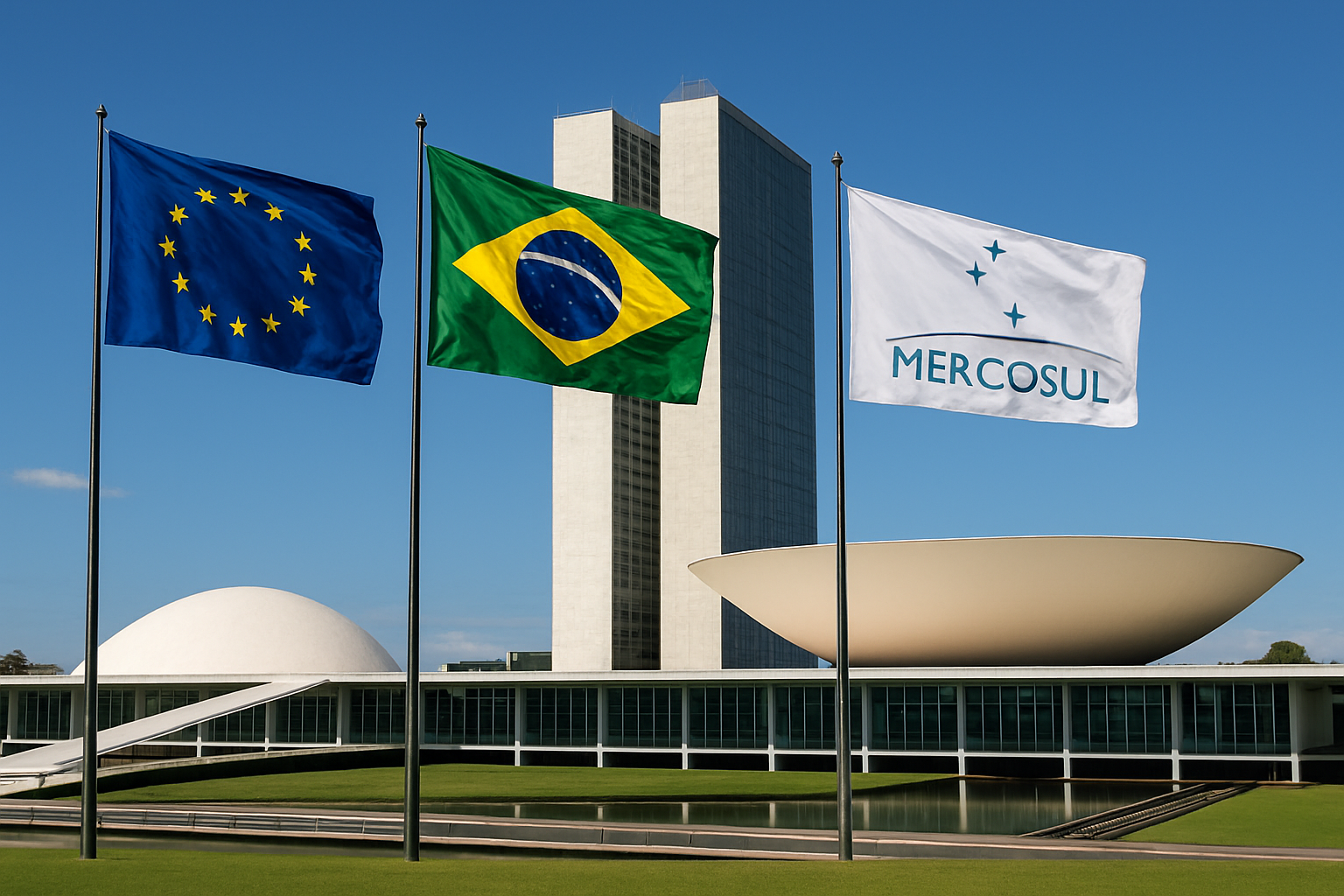
Brazil's Congress has unanimously ratified the landmark EU-Mercosur free trade agreement on March 4, 2026, marking a crucial step forward for one of the world's most significant trade deals despite ongoing European resistance and mounting global economic pressures.
The Brazilian Senate's approval follows similar ratifications by Argentina and Uruguay, leaving only Paraguay's lower house vote pending to complete the Mercosur bloc's legislative approval process. The agreement, decades in the making, would create one of the world's largest free trade zones, covering 780 million people and representing 25% of global GDP.
European Commission's Provisional Implementation Faces Resistance
The Brazilian ratification comes amid a complex European political landscape. European Commission President Ursula von der Leyen announced provisional implementation of the trade components in February 2026, bypassing traditional European Parliament approval procedures. This unprecedented move sparked fierce opposition from France, led by President Emmanuel Macron, who characterized the agreement as a "bad surprise."
France has mobilized significant resistance through Agriculture Minister Marc Fesneau, citing unfair competition from cheaper agricultural imports, particularly beef, soybeans, sugar, and poultry. Ireland, Austria, and Poland have joined France in maintaining reservations about the agreement, requiring extended parliamentary approval processes that could take months or years.
However, the German government and Green Party leader Franziska Brantner support the implementation as essential for European competitiveness in an increasingly multipolar world. This division reflects broader tensions within the EU about balancing economic opportunities with agricultural protection and environmental concerns.
Strategic Response to Global Trade Realignment
The push for EU-Mercosur implementation represents part of the EU's strategic response to the Trump administration's aggressive bilateral trade policies. The agreement is being positioned as a tool to counter President Trump's "America First" tariff policies, which have included threats against European trade and the pursuit of bilateral deals that bypass EU frameworks.
"The agreement proceeds despite ongoing judicial review and incomplete Brazilian Senate ratification."
— Portuguese Government Statement, February 2026
Trump's bilateral agreements with Argentina (eliminating over 1,600 tariffs) and India (reducing duties from 50% to 18%) demonstrate America's preference for country-by-country negotiations over multilateral EU engagement. This approach has created urgency within European circles to finalize alternative trade partnerships.
Economic Scope and Environmental Concerns
The EU-Mercosur agreement would eliminate tariffs on billions of euros worth of goods annually, benefiting European automobile, machinery, chemical, and pharmaceutical exporters while providing South American agricultural products improved access to European markets. The deal creates unprecedented opportunities for market integration across both regions.
Environmental groups, however, continue to express serious concerns about the agreement's potential impact on Amazon deforestation and ecosystem damage. Despite sustainability chapters requiring Paris Climate Agreement adherence and anti-deforestation measures, critics argue that enforcement mechanisms remain insufficient.
Greenpeace has characterized the provisional implementation as a "betrayal of the European Green Deal," reflecting broader concerns about whether trade agreements can effectively balance economic growth with environmental protection.
Implementation Challenges and Timeline
The agreement faces a complex implementation pathway with significant political and legal hurdles. European Parliament approval remains required despite the provisional implementation, with uncertain prospects given member state opposition. The European Court of Justice review adds additional complexity to the implementation timeline.
The Commission has emphasized the provisional nature of implementation pending full ratification across participating countries. This phased approach prioritizes measures with broad support while allowing European Parliament committee hearings to examine environmental impact, economic effects, and compliance mechanisms.
Member states retain challenge rights through legal and political channels, and the success or failure of this implementation approach will influence European trade policy for the remainder of the decade.
Regional Political Dynamics
Brazil's unanimous Senate approval demonstrates strong domestic support for the agreement under President Luiz Inácio Lula da Silva's administration. The ratification aligns with Brazil's broader strategy to diversify trade relationships and reduce dependence on any single economic partner, particularly in light of global trade uncertainties.
Argentina's earlier approval under President Javier Milei's government reflects his administration's broader free-trade reform agenda, while Uruguay's ratification shows continued commitment to regional integration despite domestic economic challenges.
Paraguay's pending lower house vote represents the final legislative hurdle within Mercosur, with approval expected given the country's strong agricultural export interests and regional integration commitments.
Global Implications and Precedent Setting
The EU-Mercosur agreement represents a critical test of whether democratic societies can maintain economic sovereignty while participating in global development amid authoritarian competition. Success would establish Europe as a genuine "third pole" in global competition, while failure could risk subordination to US-China economic systems.
The agreement's implementation approach may serve as a template for future EU trade agreements where unanimous support proves elusive. The Commission's willingness to use institutional flexibility to advance strategic economic partnerships despite internal divisions demonstrates an evolution in European trade policy approaches.
"This agreement creates opportunities for 780 million people across both regions with unprecedented market integration."
— European Commission Statement
The precedent established by this implementation could significantly influence how the EU approaches global partnerships and manages internal disagreements in an era of increasing geopolitical competition and economic uncertainty.
Looking Ahead
With Brazil's ratification now complete and Paraguay's approval anticipated, the focus shifts to European implementation challenges. The coming months will prove decisive in determining whether the European Union can successfully balance internal divisions with external strategic necessities.
The agreement's ultimate success will depend on effectively managing environmental concerns, addressing agricultural sector anxieties, and proving that multilateral trade frameworks can compete effectively with bilateral approaches in delivering economic benefits to participating nations.
As global trade architecture continues to evolve amid great power competition, the EU-Mercosur agreement stands as a significant test of democratic trade policy coordination and a potential model for future international economic cooperation in an increasingly fragmented world.