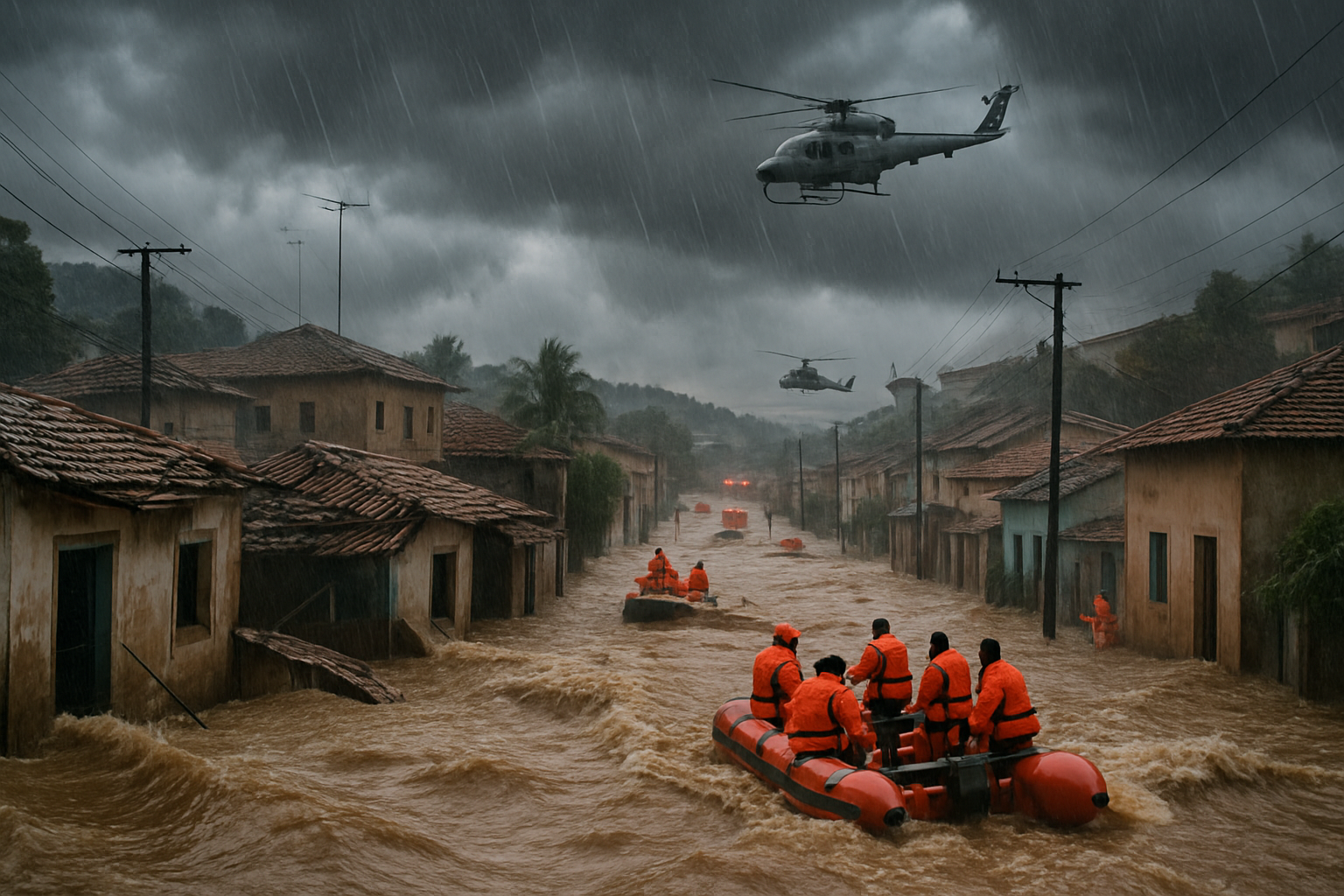
Catastrophic flooding and landslides in southeastern Brazil's Minas Gerais state have claimed at least 30 lives with 39 people still missing, as rescue teams race against time to locate survivors amid what officials describe as the worst natural disaster to hit the region in decades.
The death toll has steadily climbed from initial reports of 22 fatalities as emergency responders gain access to previously isolated areas devastated by unprecedented rainfall that began over the weekend. The hardest-hit cities of Juiz de Fora and Ubá have borne the brunt of the destruction, with local authorities declaring states of emergency and mobilizing unprecedented rescue resources.
Record-Breaking Rainfall Overwhelms Infrastructure
Minas Gerais experienced what meteorologists are calling the wettest February on record, with some areas receiving rainfall equivalent to their entire annual average in just 36 hours. The deluge caused multiple rivers to burst their banks, transforming streets into raging torrents of brown water that swept away vehicles, homes, and infrastructure.
In Juiz de Fora, Mayor Margarida Salomão declared a state of natural catastrophe, describing the precipitation intensity as unprecedented in the city's recorded history. "We have never witnessed rainfall of this magnitude and destructive power," Salomão stated during an emergency briefing. "The city's drainage systems were completely overwhelmed within hours."
"We have never witnessed rainfall of this magnitude and destructive power. The city's drainage systems were completely overwhelmed within hours."
— Margarida Salomão, Mayor of Juiz de Fora
Civil Defense officials report that at least 20 landslides have been documented across the region, with the Parque Burnier neighborhood in Juiz de Fora particularly devastated. A massive landslide completely engulfed 12 houses in the area, contributing to the rising casualty count.
Massive Emergency Response Operation
More than 200 people have been successfully rescued from the floodwaters, according to emergency services, with firefighters and community volunteers working around the clock despite dangerous and unstable terrain conditions. The scale of the disaster has prompted what officials describe as one of Brazil's largest emergency response operations in recent memory.
Emergency responders are using specialized equipment to access areas cut off by landslides and flooding. Helicopters have been deployed for aerial reconnaissance and rescue operations in remote areas where ground access remains impossible. The Brazilian military has also been mobilized to support civilian authorities in the disaster response.
Over 700 residents have been evacuated from their homes, with 440 people currently housed in temporary emergency shelters established by Civil Defense. The evacuations have been particularly challenging as many communities became completely isolated when roads and bridges were washed out or blocked by debris.
Infrastructure Devastation and Economic Impact
The flooding has caused extensive damage to critical infrastructure throughout the region. Transportation networks have been severely disrupted, with major roads rendered impassable and several bridges sustaining significant damage. Essential services including electricity, water supply, and communications have been interrupted across wide areas.
Agricultural regions have been particularly hard hit, with thousands of hectares of cropland now underwater. The flooding poses a significant threat to livestock and is expected to have substantial economic repercussions for farmers who depend on the land for their livelihoods.
The disaster has also affected urban areas, with neighborhoods completely isolated and businesses forced to close indefinitely. Local authorities estimate that the economic impact could reach into the billions of reals, making this one of the costliest natural disasters in the state's recent history.
Climate Context and Rising Concerns
The catastrophic flooding occurs during what climatologists have identified as an exceptionally active rainy season in South America, coinciding with global temperature records that have raised serious concerns about climate volatility. January 2026 marked the 18th consecutive month of global temperatures exceeding 1.5°C above pre-industrial levels, creating atmospheric conditions that enable more extreme precipitation events.
Scientists warn that southeastern Brazil's vulnerability to extreme precipitation events is increasing as climate patterns become more volatile. The current disaster highlights the urgent need for enhanced flood defenses and climate-adaptive infrastructure to protect communities from increasingly severe weather events.
The unprecedented nature of this flooding has exposed critical gaps in emergency preparedness systems, with traditional flood management infrastructure proving inadequate against the intensity of rainfall experienced. This has prompted calls for a fundamental reassessment of disaster preparedness strategies and infrastructure design standards.
Community Resilience and Volunteer Response
Despite the overwhelming scale of the disaster, remarkable examples of community resilience and solidarity have emerged. Local volunteers have mobilized en masse to support evacuation efforts and provide assistance to displaced families. Neighborhoods that remain accessible have opened their doors to flood victims, demonstrating the strength of community bonds during crisis.
Emergency coordination between local, state, and federal agencies has been praised for its effectiveness despite the challenging conditions. The rapid deployment of resources and personnel has been crucial in preventing the death toll from rising even higher.
Churches, schools, and community centers have been converted into temporary shelters, with local organizations providing food, clothing, and emotional support to those who have lost everything. Social media has played a vital role in coordinating rescue efforts and connecting separated families.
Long-Term Recovery Challenges
Recovery from this disaster is expected to require significant investment in infrastructure repairs and reconstruction. The extent of the damage means that some communities may take months or even years to fully recover, particularly in areas where entire neighborhoods have been destroyed by landslides.
Authorities are already discussing the need for "building back better" with climate-resilient infrastructure that can withstand future extreme weather events. This includes enhanced flood defenses, improved drainage systems, and stricter building codes for areas prone to landslides.
The psychological impact on survivors is also a growing concern, with mental health services reporting increased demand for support. Many residents have lost not only their homes but also their livelihoods, creating long-term challenges for community recovery and resilience.
National and International Response
President Luiz Inácio Lula da Silva has expressed solidarity with the victims and their families, offering federal support for the emergency response and recovery efforts. The federal government has mobilized additional resources and is coordinating with state authorities to ensure that all necessary assistance is provided.
The disaster has drawn attention from international observers and climate scientists, who view it as another example of the increasing frequency and intensity of extreme weather events globally. This has renewed discussions about international cooperation on climate adaptation and disaster preparedness.
As search and rescue operations continue, authorities remain focused on locating the dozens of people still missing while simultaneously beginning the long process of recovery and reconstruction. The tragedy serves as a stark reminder of Brazil's vulnerability to extreme weather and the urgent need for comprehensive climate adaptation strategies.