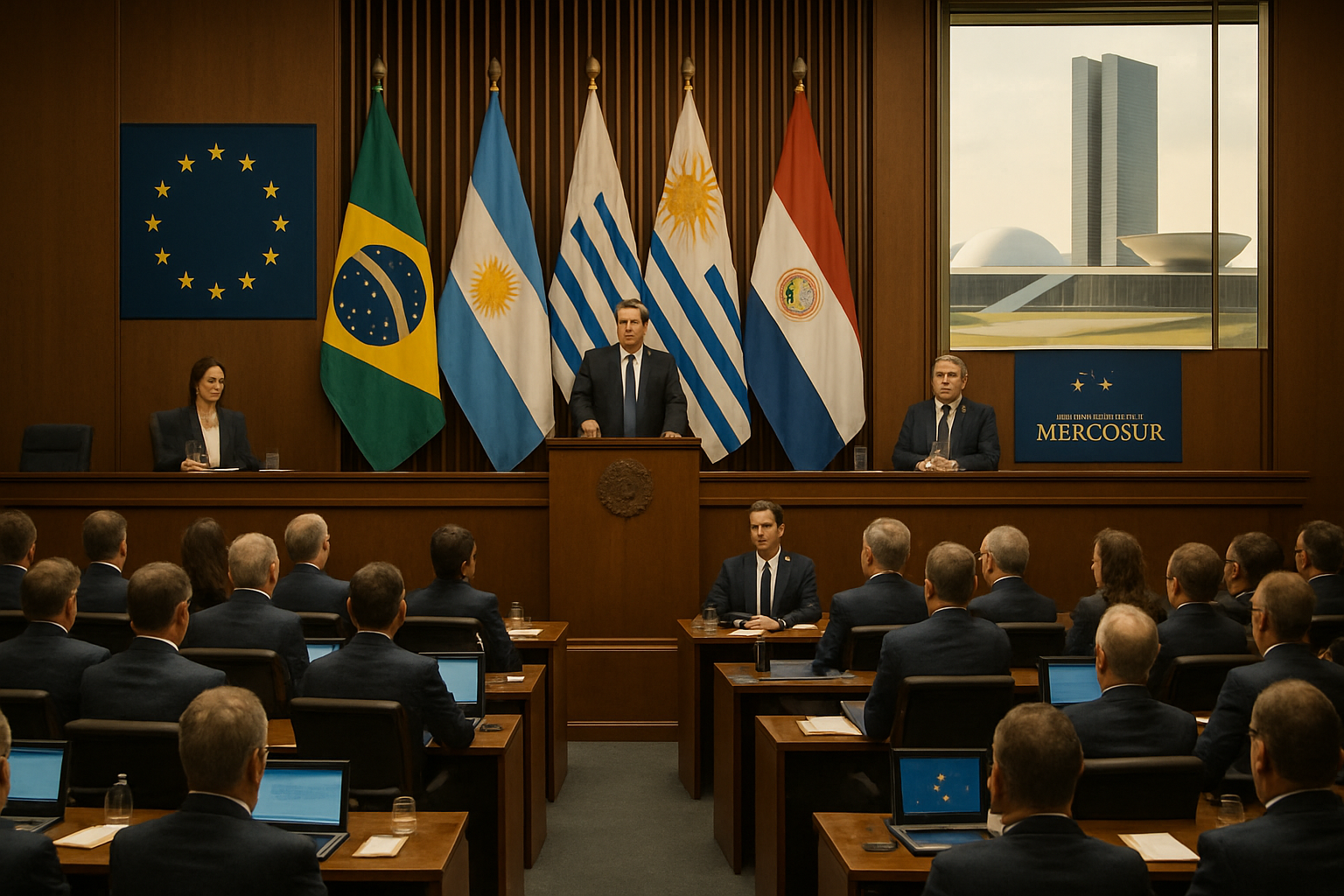
Brazil's parliament has officially ratified the historic Mercosur-European Union trade agreement, completing another crucial step toward implementing one of the world's most significant trade deals that would create a free trade zone covering 780 million people and 25% of global GDP.
The ratification comes as Brazil and the Inter-American Development Bank (IDB) announced a comprehensive initiative to prepare Brazilian companies, particularly small and medium enterprises, to capitalize on the commercial opportunities the agreement will provide. According to government officials, provisional implementation could begin as early as May 2026.
Brazilian Vice President and Minister of Development, Industry, Commerce and Services Geraldo Alckmin detailed the government's expectations that the agreement could begin implementation from May, which would initiate the reduction of tariffs between Mercosur and EU member states. This timeline represents the culmination of more than two decades of complex negotiations between the South American trading bloc and Europe.
Regional Momentum Building
Brazil's ratification follows successful approval by Argentina and Uruguay, with Paraguay's parliament having also given unanimous approval to the agreement, according to Italian news sources. This leaves only the presidential signature from Paraguay's President Santiago Peña to complete the South American ratification process.
Senate President Rodrigo Pacheco emphasized the strategic importance of the agreement, stating that "trade is the key to peace and development." The unanimous support from Paraguay's deputies demonstrates the regional consensus behind this transformative trade deal.
The agreement represents a fundamental shift in global trade architecture, particularly as it emerges during a period of increased bilateral trade arrangements and growing economic nationalism in other parts of the world.
European Implementation Challenges
While South American nations have shown strong support for the agreement, European implementation remains more complex. European Commission President Ursula von der Leyen announced provisional implementation in February 2026, bypassing traditional European Parliament approval procedures to advance the trade components while judicial review continues.
This unprecedented use of EU institutional flexibility came despite fierce opposition from France, led by President Emmanuel Macron, who characterized the provisional implementation as a "bad surprise." French resistance centers on concerns about agricultural competition from cheaper South American imports, particularly in beef, soybeans, sugar, and poultry sectors.
Several EU member states including Ireland, Austria, and Poland maintain reservations that could require extended parliamentary approval processes potentially lasting months or years. However, Germany and other major European economies support implementation as essential for European competitiveness in the global marketplace.
Strategic Economic Impact
The agreement is positioned to eliminate tariffs on billions of euros worth of goods annually, benefiting European automobile, machinery, chemical, and pharmaceutical exporters while providing South American agricultural products with improved access to European markets.
For Brazil specifically, the IDB partnership program aims to help companies adapt to European regulatory and commercial requirements. This preparation is crucial given the scale of the opportunity - the agreement creates unprecedented market integration opportunities for 780 million people across both regions.
The timing is particularly significant as it occurs alongside other major trade developments, including China's announcement of zero-tariff access for 53 African countries beginning May 1, 2026, and various bilateral agreements being pursued by the United States under the Trump administration.
Environmental and Political Considerations
Critics continue to raise environmental concerns about the agreement, particularly regarding potential acceleration of Amazon deforestation and ecosystem damage. Environmental groups, including Greenpeace, have characterized the provisional implementation as a "betrayal of the European Green Deal."
However, the agreement includes comprehensive sustainability chapters requiring adherence to the Paris Climate Agreement and anti-deforestation measures. Supporters argue these environmental protections, combined with economic opportunities, provide incentives for sustainable development rather than environmental degradation.
The agreement also represents a crucial test of EU institutional evolution, demonstrating the bloc's willingness to use institutional flexibility to advance strategic partnerships despite internal divisions when facing global competitive pressures.
Global Trade Architecture Implications
The Mercosur-EU agreement emerges as part of a broader transformation in global trade governance. Rather than pursuing universal multilateral frameworks, nations and trading blocs are increasingly developing targeted bilateral and regional arrangements that address specific strategic and economic priorities.
This approach allows for more flexible cooperation on issues where consensus exists while avoiding paralysis on more contentious matters. The EU's ability to implement the agreement provisionally, despite internal opposition, demonstrates institutional adaptation to contemporary global competitive realities.
The agreement also serves as the EU's response to increasing competition from other global powers. It represents European efforts to establish a "third pole" in global trade competition, offering an alternative to both Chinese Belt and Road Initiative projects and American bilateral trade strategies.
Implementation Timeline and Next Steps
With Brazilian parliamentary approval complete and Paraguay's ratification expected imminently, the South American side of the agreement is nearly ready for implementation. The May 2026 timeline mentioned by Vice President Alckmin would represent remarkably rapid progress from ratification to implementation.
European Parliament approval remains required despite provisional implementation, and the European Court of Justice review continues. However, the Commission's decision to proceed with provisional implementation suggests confidence that these remaining hurdles can be managed.
The phased rollout will likely prioritize measures with broad support while committee hearings continue examining environmental impact, economic effects, and compliance mechanisms. Member states retain legal and political challenge rights, but the momentum toward implementation appears strong.
Success of this agreement could provide a template for future EU trade agreements where unanimous support proves elusive, demonstrating that institutional flexibility can advance strategic economic partnerships even amid internal divisions. The outcome will significantly influence European trade policy approaches and global partnership strategies for the remainder of the decade.