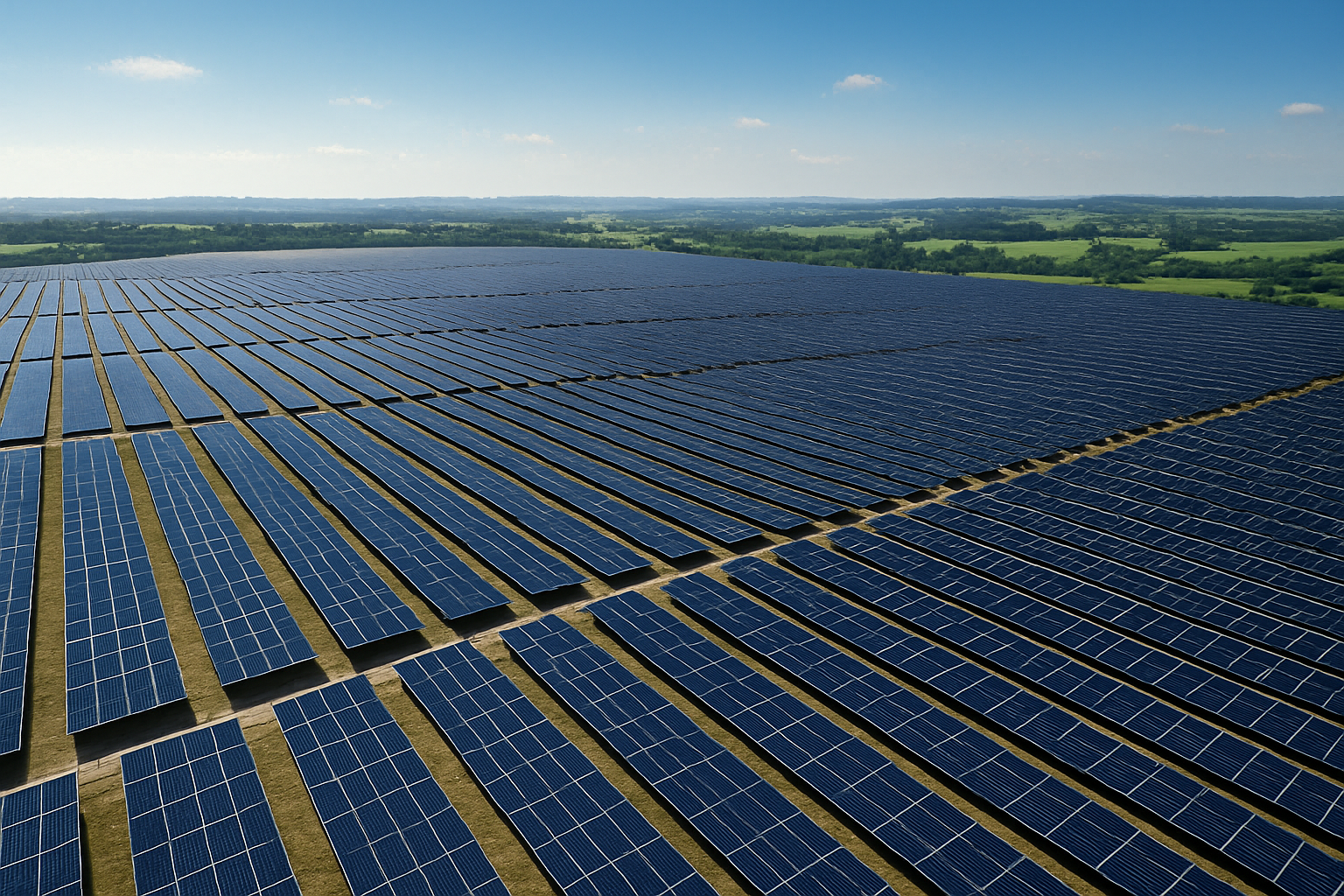
Britain achieved a historic double milestone in renewable energy this week, breaking solar power generation records on consecutive days while the government approved the nation's largest solar farm project, marking a decisive moment in the UK's clean energy transition.
Solar farms across England, Wales and Scotland generated 14.1GW of electricity at lunchtime on Monday, April 7, surpassing the previous record of 14GW set in July 2025. The achievement was short-lived, however, as Tuesday's sunny spring weather powered the grid to an even greater milestone of 14.4GW, demonstrating the rapidly expanding capacity of Britain's renewable energy infrastructure.
The record-breaking generation coincided with the government's approval of the Springwell solar farm in North Kesteven, Lincolnshire, which will cover an area equivalent to 1,700 football pitches when completed. The massive installation represents the UK's most ambitious solar energy project to date and underscores the government's commitment to achieving net-zero emissions by 2050.
Exceptional Weather Conditions Drive Record Performance
The consecutive records were achieved during what meteorologists described as exceptional spring weather conditions, with clear skies and high solar irradiation levels across much of Britain. The 14.4GW peak generation on Tuesday occurred during optimal afternoon conditions when solar panels operate at maximum efficiency.
These achievements are particularly significant given that they occurred in April, traditionally not the peak season for solar generation. The records suggest that Britain's installed solar capacity is now sufficient to make meaningful contributions to the national grid even during less optimal periods, indicating the maturation of the technology as a reliable energy source.
Energy analysts noted that the records come at a crucial time, with natural gas prices having surged 24% in Europe as geopolitical tensions continue to affect energy markets. The demonstration of solar energy's potential offers a glimpse of Britain's energy independence prospects as renewable capacity continues to expand.
Springwell Solar Farm: A Landmark Project
The government's approval of the Springwell solar farm represents a paradigm shift in the scale of renewable energy projects being developed across the UK. Covering approximately 1,200 hectares, the installation will be capable of generating sufficient clean electricity to power hundreds of thousands of homes.
The project's approval follows extensive environmental impact assessments and community consultations, addressing concerns about land use and agricultural displacement. Government officials emphasized that the installation will be designed to allow continued agricultural use of the land, with solar panels positioned to accommodate sheep grazing and maintain biodiversity corridors.
Planning documents indicate the Springwell facility will incorporate advanced solar panel technology with battery storage capabilities, enabling the installation to provide grid stability services and store excess energy generated during peak sunshine hours for release during periods of high demand.
Strategic Context in Global Energy Transition
The dual achievements come as Britain accelerates its renewable energy deployment amid mounting climate pressures. January 2026 was confirmed as the hottest month in recorded history, extending a streak of 18 consecutive months where global temperatures exceeded 1.5°C above pre-industrial levels. The sustained warming demonstrates the urgency of transitioning away from fossil fuels.
Britain's solar expansion occurs within a broader context of renewable energy development across Europe. Portugal has been evaluating abandoned mining areas for renewable installations, while Poland achieved negative electricity prices for residential solar customers when wind and solar production exceeded demand, demonstrating the economic viability of distributed renewable energy.
However, the global transition faces significant supply chain challenges. China maintains control of 60-90% of critical materials essential for renewable infrastructure, including lithium, cobalt, and rare earth elements. The US-EU-Japan Critical Minerals Partnership, involving 55 countries and seven African alternative suppliers, represents an effort to address these strategic vulnerabilities.
Building Energy Security Through Domestic Generation
The record-breaking solar performance highlights Britain's growing energy security through domestic renewable generation. Unlike imported fossil fuels subject to price volatility and geopolitical disruption, solar energy provides predictable, locally-generated electricity that strengthens national energy independence.
Energy sector analysts calculate that the combination of record generation and the forthcoming Springwell installation could reduce Britain's reliance on energy imports by several percentage points, providing both economic and strategic benefits. The development comes as global energy markets remain volatile, with oil prices rising above $100 per barrel due to Middle East tensions affecting the Strait of Hormuz, through which 40% of global oil transits.
Technology Integration and Grid Modernization
Britain's solar achievements demonstrate the successful integration of renewable energy with existing grid infrastructure. The National Grid has invested heavily in smart grid technology and grid management systems that enable rapid balancing of supply and demand as renewable generation fluctuates with weather conditions.
Advanced forecasting systems now provide 30-minute predictions of solar generation levels, enabling grid operators to prepare for changes in renewable output and maintain grid stability. This technological sophistication has been essential for accommodating the growing proportion of variable renewable energy in Britain's electricity mix.
The Springwell project will incorporate next-generation battery storage technology, addressing one of the key challenges in renewable energy deployment. Energy storage systems enable solar installations to provide consistent power even when sunlight is not available, making renewable energy more comparable to traditional power plants in terms of grid reliability.
Economic Implications and Job Creation
The expansion of Britain's solar sector creates significant economic opportunities beyond the immediate energy benefits. The Springwell project alone is expected to generate hundreds of construction jobs during the installation phase, followed by permanent positions for operations and maintenance.
Industry data suggests that every megawatt of solar capacity installed supports approximately 3.6 jobs across the renewable energy supply chain, from manufacturing and installation to maintenance and grid integration services. As Britain's installed solar capacity approaches 15GW, the sector now supports tens of thousands of specialized jobs.
The economic benefits extend to rural communities, where large-scale solar installations provide landowners with stable, long-term revenue streams while maintaining agricultural use of the land. The Springwell project includes provisions for local community benefit funds, ensuring that surrounding areas share in the economic advantages of hosting renewable infrastructure.
International Context and Climate Leadership
Britain's solar achievements occur during what industry analysts describe as a "renewable energy renaissance" across multiple countries. Estonia maintains European leadership with 88% renewable electricity and Europe's largest battery storage facility serving 90,000 households. Croatia achieved 100% success rates in geothermal exploration, while renewable energy initiatives are advancing across Africa, with Namibia positioning itself as a "global player in delivering climate solutions."
The timing is particularly significant given the accelerating climate crisis. The consecutive solar records were achieved during the 23rd month of sustained global warming, with temperatures continuing to exceed critical climate thresholds. Scientific warnings emphasize that the current period represents a critical window for implementing renewable energy solutions at scale.
Britain's demonstrations of solar energy potential provide international momentum for renewable deployment worldwide. The combination of record generation and large-scale project approval offers a template for other nations seeking to rapidly expand clean energy capacity while maintaining grid stability and economic development.
Challenges and Future Prospects
Despite the encouraging achievements, significant challenges remain in Britain's renewable energy transition. The global semiconductor crisis, with memory prices increasing sixfold, affects smart grid systems and renewable energy control infrastructure. These supply chain constraints could slow the deployment of advanced grid management technologies essential for integrating higher levels of renewable energy.
Environmental groups have raised concerns about the rapid pace of solar farm development, emphasizing the need for careful planning to protect agricultural land and biodiversity. The government has responded by requiring comprehensive environmental impact assessments and promoting agrovoltaic systems that combine solar generation with continued agricultural use.
Looking ahead, Britain's renewable energy sector must balance rapid deployment with sustainable development principles. Success will depend on maintaining public support through transparent planning processes, ensuring community benefits, and addressing legitimate environmental concerns while accelerating clean energy deployment to meet climate targets.
A Watershed Moment for British Energy
The combination of record-breaking solar generation and approval of the UK's largest solar farm represents a watershed moment in Britain's energy transition. The achievements demonstrate that renewable energy has evolved from an experimental technology to essential infrastructure capable of providing significant contributions to national electricity supply.
Government officials emphasized that this week's milestones are just the beginning of an accelerated renewable energy deployment program. With plans for additional large-scale solar installations and continued investment in grid modernization, Britain is positioning itself as a leader in the global clean energy transition.
The success of the Springwell project and the achievement of consecutive solar records will likely accelerate investment in renewable energy across the UK, creating positive momentum for achieving net-zero emissions targets while strengthening energy security in an increasingly unstable global environment.
As climate pressures continue to intensify and global energy markets remain volatile, Britain's solar achievements offer a compelling demonstration of renewable energy's potential to provide clean, reliable, and domestically-generated electricity. The historic week in April 2026 may be remembered as the moment when solar power definitively established itself as a cornerstone of Britain's energy future.