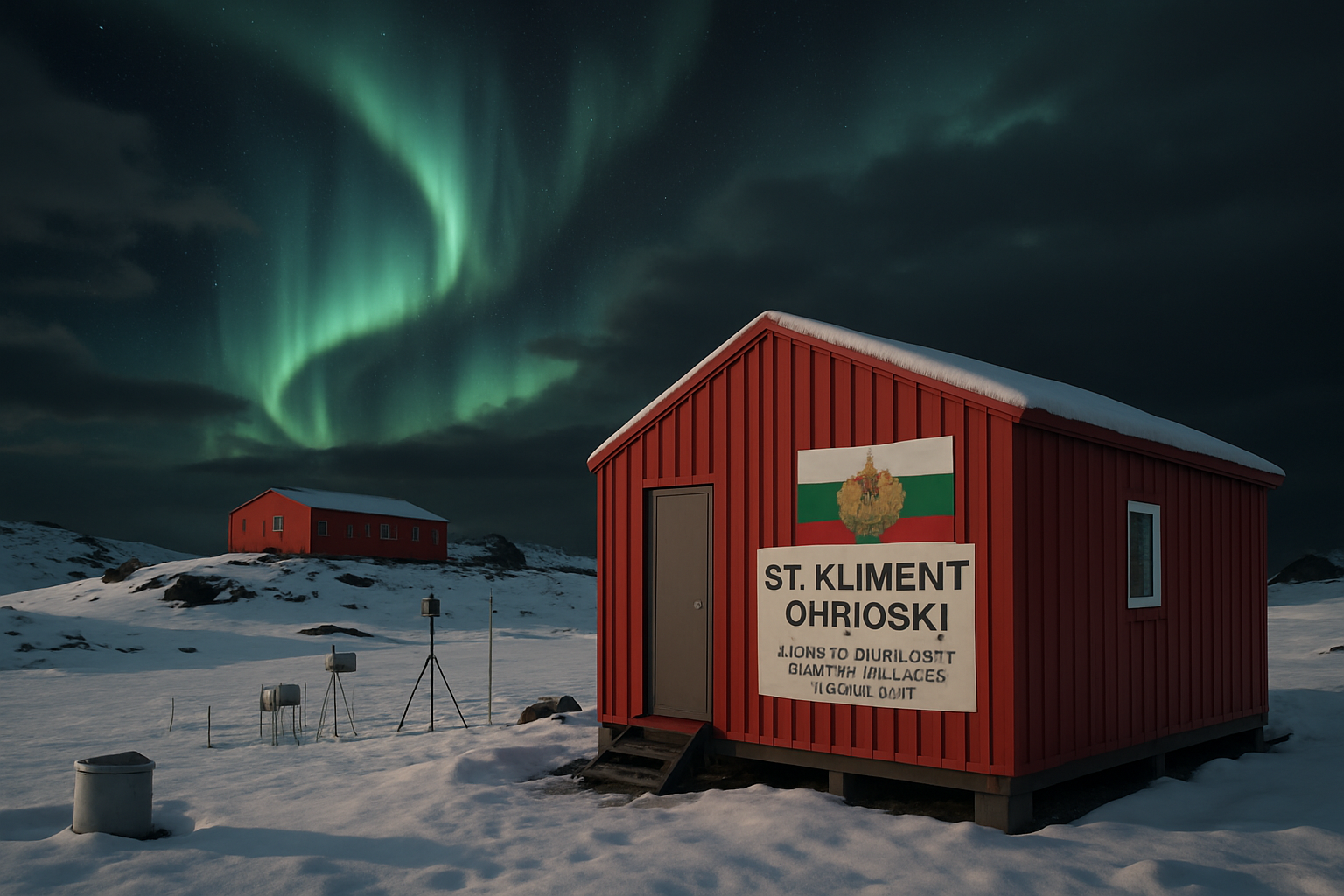
Bulgaria's 34th Antarctic expedition successfully established a state-of-the-art meteorological and seismological laboratory at the "St. Kliment Ohridski" Antarctic base on February 10, 2026, following dramatic weather delays that temporarily stranded expedition members aboard their research vessel.
The new facility represents a landmark collaboration between Bulgaria's Antarctic Institute and the United Arab Emirates, formally inaugurated by expedition leader Professor Hristo Pimpirev, Admiral Boyan Mednikarov, Professor Miroslav Tsvetkov, and UAE scientists Ahmed Al Kaabi and Badr Al Ameri, who participated for the second consecutive year in Bulgaria's Antarctic research program.
Expedition Overcomes Severe Antarctic Conditions
The 34th Bulgarian Antarctic expedition faced significant challenges before successfully establishing the laboratory. Participants were forced to remain aboard the research vessel "St. Cyril and Methodius" (NIK 421) for two additional days after severe storms prevented their planned transfer to the Antarctic base.
According to expedition reports, all scientific projects scheduled for the initial arrival days were canceled due to the intense weather conditions that made safe operations impossible. The storm system, characterized by powerful winds and dangerous visibility conditions, underscored the extreme operational challenges faced by Antarctic research teams.
"The weather delays highlighted the unpredictable nature of Antarctic conditions, but our team remained committed to the mission objectives," said journalist Živko Konstantinov, who documented the expedition's progress for the Bulgarian Telegraph Agency (BTA).
International Collaboration at the Heart of Research
The newly opened laboratory represents a significant milestone in Bulgarian-UAE scientific cooperation, building on the partnership established during the previous year's expedition. The facility is equipped with advanced meteorological and seismological monitoring equipment designed to collect crucial climate data from one of Earth's most important regions for understanding global climate patterns.
"This laboratory will serve as a critical observation point for monitoring climate change impacts in Antarctica, providing data essential for global climate modeling."
— Professor Hristo Pimpirev, Bulgarian Antarctic Expedition Leader
The presence of UAE scientists Ahmed Al Kaabi and Badr Al Ameri for the second consecutive year demonstrates the growing international recognition of Bulgaria's Antarctic research program. Their participation brings additional expertise in desert climate systems, offering unique comparative perspectives on extreme environmental conditions.
Strategic Importance for Climate Science
The establishment of this laboratory comes at a critical time for climate research, as Antarctica plays a crucial role in global weather patterns and sea level regulation. The meteorological equipment will monitor temperature variations, wind patterns, precipitation, and atmospheric conditions, while the seismological instruments will track tectonic activity that could influence ice sheet stability.
Bulgaria's Antarctic base "St. Kliment Ohridski," located on Livingston Island in the South Shetland Islands, provides an ideal location for such research due to its position in the Antarctic Peninsula region, one of the fastest-warming areas on the continent. The peninsula has experienced significant ice loss in recent decades, making detailed monitoring essential for understanding regional and global climate impacts.
Research Capabilities and Equipment
The new laboratory houses sophisticated instruments capable of continuous data collection throughout the Antarctic winter. The meteorological station includes automated weather monitoring systems that can operate in extreme cold conditions, while the seismological equipment employs sensitive sensors designed to detect even minor ground movements that could indicate ice sheet dynamics.
Data collected from the facility will be integrated into international climate databases, contributing to global research efforts coordinated through the Scientific Committee on Antarctic Research (SCAR) and the Antarctic Treaty System's environmental protection protocols.
Bulgaria's Growing Antarctic Research Legacy
The 34th expedition represents three decades of Bulgarian commitment to Antarctic research, with the country maintaining a continuous presence on the continent since the early 1990s. The research vessel "St. Cyril and Methodius" serves as the primary logistics platform, enabling Bulgarian scientists to conduct year-round research operations from their permanent base.
Previous expeditions have contributed to understanding Antarctic marine ecosystems, glaciology, and atmospheric sciences. The new laboratory significantly expands these capabilities by providing permanent infrastructure for long-term climate monitoring that can operate independently of expedition schedules.
Admiral Boyan Mednikarov, who participated in the laboratory inauguration, emphasized the strategic importance of maintaining continuous scientific presence in Antarctica. "This investment in permanent research infrastructure ensures Bulgaria's continued contribution to global climate science while strengthening our international partnerships," he stated.
Regional and Global Climate Implications
The timing of this laboratory establishment is particularly significant given recent global climate developments. January 2026 marked the 18th consecutive month of the past 19 to exceed 1.5°C above pre-industrial levels, according to historical climate data referenced in related Antarctic research programs.
Antarctic research has become increasingly critical as the continent's ice sheets play a fundamental role in global sea level regulation. The West Antarctic Ice Sheet, in particular, has shown signs of instability that could have dramatic implications for coastal communities worldwide if current warming trends continue.
The Bulgarian-UAE laboratory will contribute to monitoring these changes, providing essential data for climate models used by the Intergovernmental Panel on Climate Change (IPCC) and other international scientific bodies. The seismological component is particularly valuable for understanding ice sheet dynamics and potential tipping points in Antarctic ice stability.
International Cooperation Model
The Bulgarian-UAE partnership represents an innovative model for international Antarctic research cooperation, bringing together expertise from different climatic regions to enhance understanding of global environmental systems. The UAE's experience with extreme desert conditions provides valuable comparative insights for understanding adaptation mechanisms in harsh environments.
Professor Miroslav Tsvetkov, who participated in the laboratory opening, noted that the partnership demonstrates how countries with different geographical advantages can collaborate effectively in addressing global challenges. "Climate change affects all nations, regardless of their location, making international cooperation not just beneficial but essential," he observed.
The collaboration also establishes a framework for future partnerships between Bulgaria and other nations interested in Antarctic research. The successful integration of UAE scientists into Bulgarian expedition operations could serve as a model for expanding international participation in Antarctic research programs.
Future Research Priorities
The new laboratory's research agenda focuses on several key areas critical to understanding climate change impacts. Priority projects include monitoring atmospheric composition changes, tracking ice sheet movement patterns, and analyzing the interaction between oceanic and atmospheric systems in the Antarctic Peninsula region.
Long-term objectives include establishing baseline measurements for future comparative studies and contributing to predictive models for Antarctic ice sheet behavior under various warming scenarios. The facility's data will be particularly valuable for understanding threshold conditions that could trigger irreversible changes in Antarctic ice dynamics.
Scientists plan to coordinate their research with other Antarctic research stations operated by treaty nations, ensuring that data collection follows standardized protocols that enable meaningful international comparisons. This coordination is essential for building the comprehensive datasets needed to understand continent-wide climate trends.
Technological Innovation and Challenges
The laboratory incorporates cutting-edge technology designed to withstand extreme Antarctic conditions while maintaining continuous operation throughout the polar winter. Specialized heating systems, reinforced structures, and satellite communication equipment enable year-round data collection and transmission to research institutions in Bulgaria and the UAE.
Technical challenges include maintaining equipment functionality during temperatures that can drop below -40°C and ensuring reliable power supply through solar panels and backup generators during the months-long polar night. The facility's design incorporates lessons learned from previous Antarctic research stations to maximize operational reliability.
Remote monitoring capabilities allow researchers in Sofia and Abu Dhabi to access real-time data and adjust research protocols without requiring physical presence at the station. This technological integration enables more efficient use of expedition resources while maintaining continuous scientific operations.
Environmental Stewardship and Protocol Compliance
The laboratory's construction and operation strictly adhere to Antarctic Treaty environmental protection protocols, ensuring minimal environmental impact while maximizing scientific benefit. All materials and equipment were transported using established logistics procedures that minimize contamination risks and environmental disturbance.
Waste management systems incorporate advanced recycling and containment technologies required for Antarctic operations. Energy systems prioritize renewable sources where possible, with solar panels providing primary power supplemented by efficient backup generators during winter months.
The facility's design includes provisions for complete removal if necessary, ensuring compliance with Antarctic Treaty requirements that all research infrastructure be reversible and leave no permanent environmental impact.
Economic and Educational Benefits
Beyond its scientific contributions, the laboratory project provides significant benefits for Bulgaria's research infrastructure and international standing. The facility enhances Bulgaria's position in international climate research networks and creates opportunities for Bulgarian scientists to participate in global research initiatives.
Educational partnerships with Bulgarian universities enable student researchers to participate in Antarctic studies, providing valuable experience in extreme environment research techniques. These programs help develop the next generation of climate scientists while strengthening Bulgaria's scientific capacity.
The UAE partnership also creates opportunities for technology transfer and joint research initiatives that extend beyond Antarctic studies. Collaborative expertise in extreme environment research has applications for space exploration, renewable energy development, and environmental monitoring technologies.
Looking Forward: Antarctic Research in the Climate Era
The successful establishment of Bulgaria's new Antarctic laboratory represents more than a single scientific achievement—it demonstrates the critical role that international cooperation must play in addressing global climate challenges. As climate change accelerates, the need for comprehensive monitoring and understanding of Antarctic systems becomes increasingly urgent.
The facility positions Bulgaria and the UAE to contribute meaningfully to the global scientific effort required to understand and respond to climate change. Data from the laboratory will inform policy decisions, support climate adaptation planning, and contribute to the international scientific consensus on climate change impacts and responses.
Future expansions of the facility may include additional international partners, advanced research capabilities, and enhanced coordination with global climate monitoring networks. The laboratory serves as a foundation for Bulgaria's continued commitment to Antarctic research and international climate science cooperation.
As extreme weather events like the storms that delayed the expedition become more frequent and intense, the importance of understanding Antarctic climate systems grows ever more critical. The new Bulgarian-UAE laboratory stands ready to contribute essential data to this vital global research effort, representing hope that international cooperation can rise to meet the challenges of our changing climate.