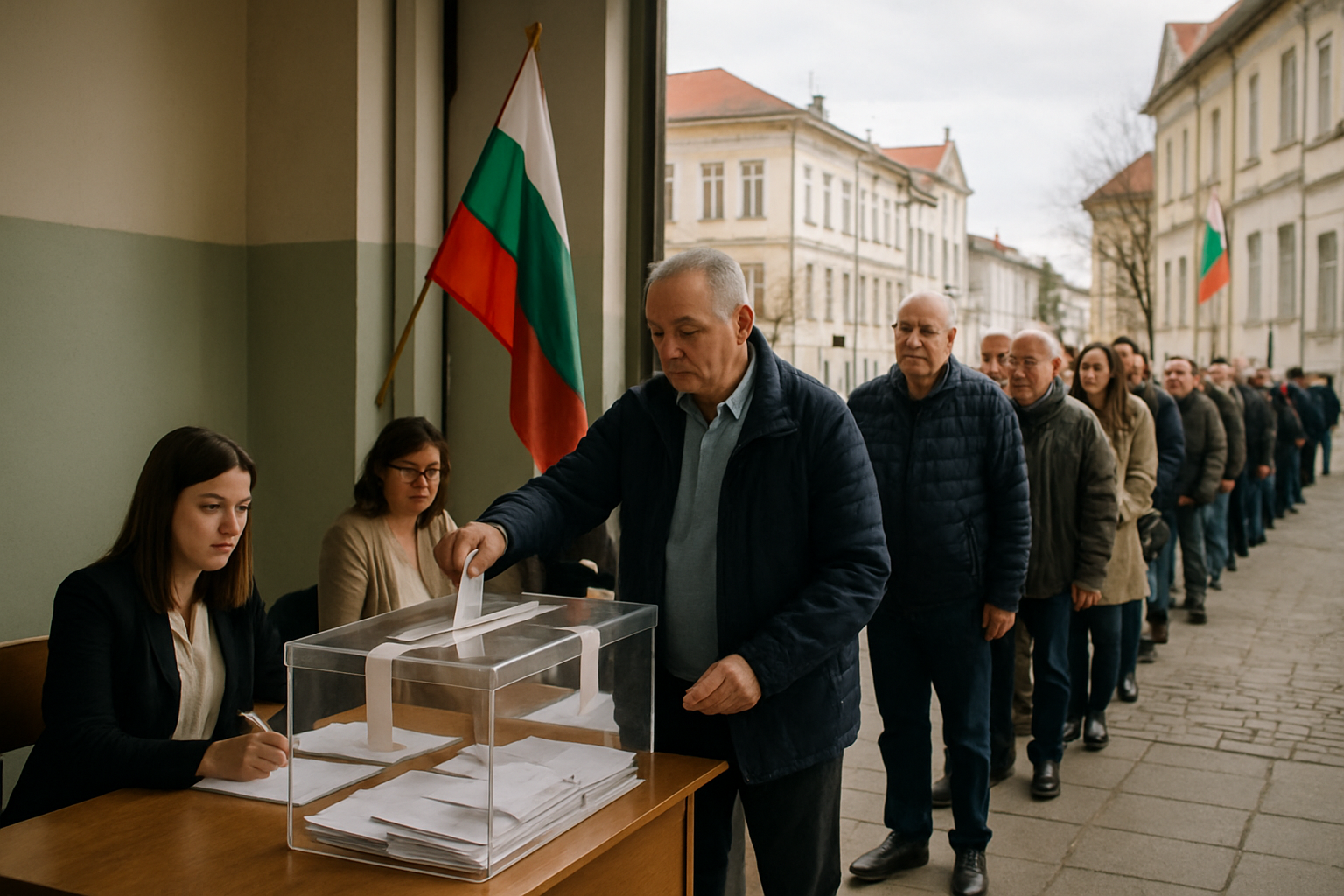
Bulgaria headed to the polls on Sunday for its eighth parliamentary election in just five years, as the European Union's poorest member state struggles to break a cycle of political instability that has plagued the country since mass anti-corruption protests in 2021.
Former President Rumen Radev's Progressive Bulgaria party emerged as the frontrunner in pre-election polling, with surveys showing the ex-military commander commanding between 31-34% of voter support. The 61-year-old general, who served as president from 2017-2022, has positioned himself as the candidate to "end oligarchy" and tackle the systemic corruption that has paralyzed Bulgarian governance for years.
Political Crisis Reaches Breaking Point
The election represents Bulgaria's latest attempt to form a stable government after more than five years of unprecedented political turbulence. The crisis began in 2020-2021 when massive anti-corruption demonstrations forced the resignation of longtime Prime Minister Boyko Borissov's GERB party government, which had dominated Bulgarian politics for over a decade.
Since then, the country has cycled through a series of caretaker administrations and short-lived coalitions, with no government managing to complete a full term. The political deadlock has severely hampered Bulgaria's ability to absorb EU development funds, implement necessary reforms, and address pressing economic challenges.
"After so many rounds of elections and no government able to complete its mandate, the predominant attitude among Bulgarian citizens is that one party should have a majority and bear full responsibility for governance," according to Alpha Research polling data cited by Sofia Globe.
Radev's Pro-Russian Positions Raise Concerns
While Radev's anti-corruption message resonates with frustrated voters, his foreign policy positions have alarmed European observers. The former general has consistently called for renewing ties with Russia and has opposed military aid to Ukraine, putting him at odds with EU consensus on the war.
Italian media outlet La Repubblica described Radev as potentially becoming "the next Orbán" - a reference to Hungarian Prime Minister Viktor Orbán's confrontational relationship with Brussels. European officials worry that a Radev victory could create another Putin ally within EU leadership, further complicating the bloc's unified response to Russian aggression.
"The risk of a new Putin ally at the EU summit is real. But he could face great difficulties finding a majority in a country in crisis that is voting for the eighth time in five years."
— La Repubblica analysis
Complex Coalition Mathematics
Despite leading in polls, Radev faces significant challenges in forming a governing coalition. Bulgaria's fragmented political landscape makes it unlikely any single party will achieve an outright majority, necessitating complex negotiations between ideologically diverse groups.
Borissov's GERB party, despite being weakened by corruption scandals, remains a significant force that could play a kingmaker role in coalition talks. The party's willingness to work with Radev - given their historical antagonism - remains highly questionable.
Romanian media analysis suggests the chances of forming a stable government remain low even after this eighth election, with Digi24 noting that "the same polling shows that this time the chances of this happening are very low."
European Implications and Strategic Concerns
Bulgaria's political instability carries implications far beyond its borders. As a NATO member and EU state that recently joined the eurozone on January 1, 2026, Bulgaria occupies a strategically important position in the Balkans. The country hosts the Balkan Stream pipeline, a crucial energy corridor that has become a focal point of European energy security discussions.
The prolonged political crisis has contributed to Bulgaria's brain drain problem, with thousands of young, educated Bulgarians emigrating to more stable EU countries. This demographic decline undermines the country's long-term economic prospects and development capacity.
International observers are closely monitoring the election process, with early reports suggesting largely peaceful voting despite the high political stakes. The EU has repeatedly emphasized the importance of democratic stability in Bulgaria, particularly given ongoing concerns about the rule of law and corruption in several member states.
Economic Challenges Mount
Bulgaria's political paralysis has coincided with mounting economic pressures. The country struggles with high inflation, limited wage growth, and significant infrastructure needs that require sustained government attention and EU fund utilization.
The inability to maintain stable governance has hindered Bulgaria's capacity to implement necessary reforms and efficiently deploy European development assistance. This has created a vicious cycle where economic stagnation fuels political instability, which in turn undermines economic progress.
A Critical Test for Bulgarian Democracy
Sunday's election represents a critical test for Bulgarian democratic institutions. The country's ability to break the cycle of governmental deadlock and form a functioning administration will determine whether Bulgaria can restore confidence in its political system and begin addressing its structural challenges.
For voters, the choice extends beyond partisan preferences to fundamental questions about Bulgaria's future direction. Radev's promise to combat corruption appeals to citizens exhausted by years of scandal and dysfunction, but his pro-Russian orientation raises questions about Bulgaria's commitment to European integration and Atlantic partnerships.
As ballot counting begins, the eyes of Europe are on Bulgaria - a nation at a crossroads between its European aspirations and the persistent pull of political instability that has defined the last five years of its democratic journey.