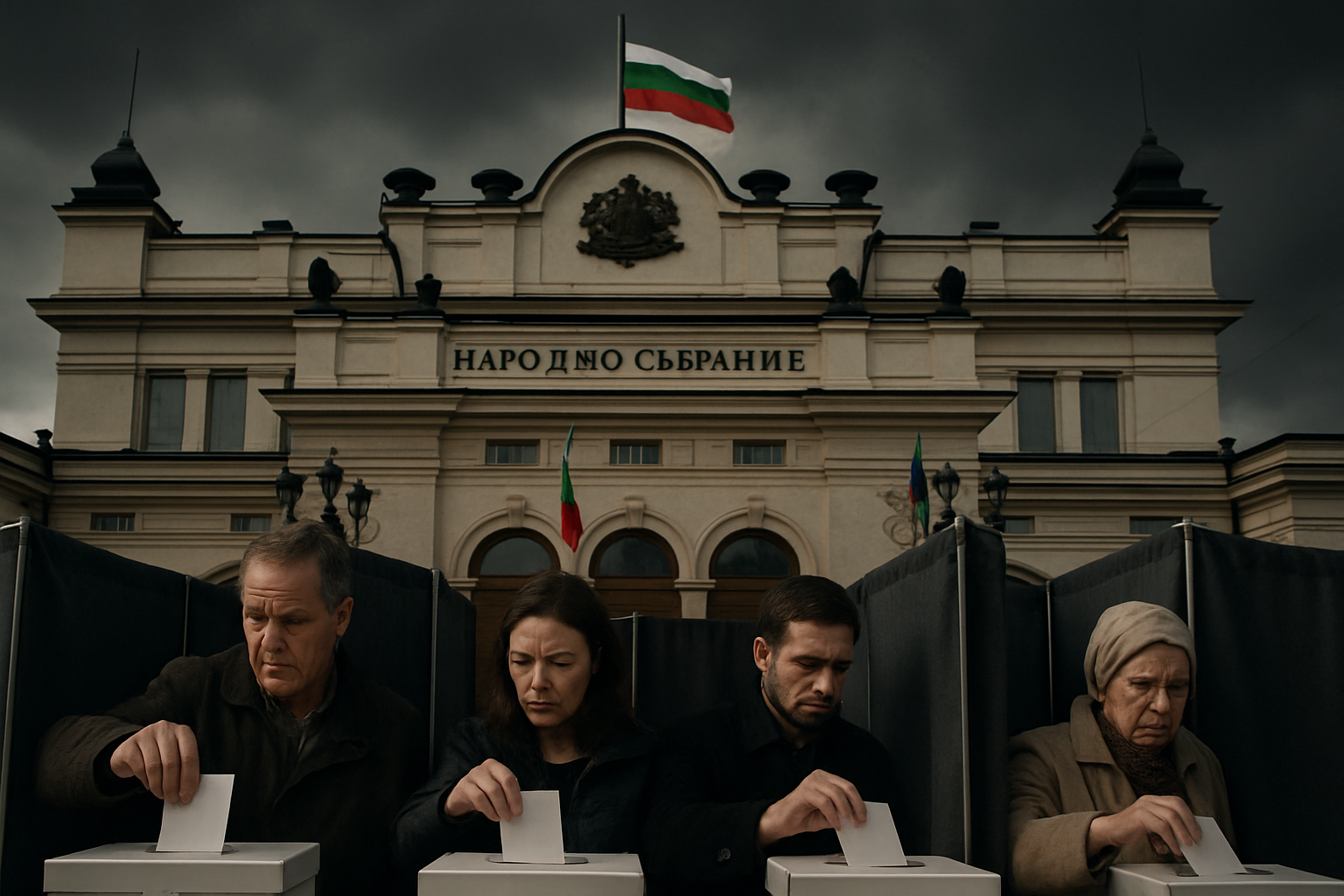
Bulgaria held its eighth parliamentary election since 2021 on Sunday, April 19, 2026, as the country desperately seeks to break a devastating cycle of political instability that has plagued the nation for over five years and prevented the formation of any stable government.
The election, conducted against a backdrop of unprecedented political chaos, saw dramatically high voter turnout with exit polls indicating significant shifts in the political landscape. Early projections from sociological agencies showed one party achieving support levels not seen in years, while new political formations emerged to challenge the established order.
Record Turnout and Early Results
By 5 PM, voter participation had reached extraordinary levels, with one million more Bulgarians casting ballots compared to the previous election when overall turnout was 38.94%. According to Parvan Simeonov, head of polling agency "Myara," the high participation suggested intense public engagement with the political process despite widespread fatigue with the ongoing crisis.
Exit polls from multiple agencies painted a picture of dramatic political realignment. One party achieved what pollsters described as "unprecedented" support of 37.1%, later climbing to 38.1% - figures not seen for many years in Bulgarian politics. This represented a sharp break from competitors, with the second-place party falling to just 14.5% according to some projections.
The results suggested that between six and seven parties would cross the four percent threshold required for parliamentary representation, including at least one completely new political formation that emerged from what observers described as "the pain of many parents and their desire for justice."
International Context and European Implications
The election occurred within the broader context of Bulgaria's recent accession to the eurozone on January 1, 2026, making political stability crucial for the country's continued European integration. As both a NATO member and EU state hosting critical energy infrastructure including the Balkan Stream pipeline, Bulgaria's governmental paralysis has had implications extending far beyond its borders.
Former President Rumen Radev, who stepped down from the presidency in January to run in the election, emerged as a controversial figure. According to international reporting, Radev - described as eurosceptic and opposed to military support for Ukraine's war effort against Russia - was positioned to potentially win, raising concerns about Bulgaria becoming what some analysts called the "next Orbán" within EU leadership.
"This election represents Bulgaria's latest attempt to break the five-year cycle of caretaker administrations and short-lived coalitions, with no government completing a full term since the crisis started."
— Political Analysis, Based on Historical Context
Electoral Irregularities and Prime Minister Intervention
The election was marred by serious allegations of irregularities and unprecedented intervention by interim Prime Minister Andrey Gyurov. In a dramatic Facebook video released during voting hours, Gyurov made explosive claims about electoral misconduct.
"The Ministry of Interior has information about 50 people with immunity who are ready to go out and buy [votes] as a last chance to enter parliament. The Ministry of Interior is watching them and will counteract, but you can stop them with your vote," Gyurov declared in the clip, directly naming political figures Georgi Kandrev and Emil Dechev.
The Prime Minister's intervention represented an extraordinary breach of electoral protocols, with officials typically maintaining strict neutrality during voting periods. Gyurov also addressed concerns about voting machine malfunctions, stating that only 0.8% of machines were experiencing technical difficulties.
Serious Incident in Burgas
A major scandal erupted at a polling station in Burgas when a member of the electoral commission, Georgi Angelov, improperly opened a sealed box containing machine-generated voting receipts. The incident prompted an immediate complaint from the GERB party to the Regional Electoral Commission, alleging a serious violation of established electoral procedures.
The episode highlighted ongoing concerns about the integrity of Bulgaria's voting technology and the training of electoral officials, issues that have plagued previous elections during the ongoing political crisis.
The Long Road to Political Stability
Sunday's vote marked the eighth attempt since 2021 to form a stable government in Bulgaria, following the collapse of long-serving Prime Minister Boyko Borissov's GERB government amid massive anti-corruption protests in 2020-2021. The country has been trapped in a cycle of snap elections, caretaker governments, and failed coalition negotiations that has lasted over five years.
The political paralysis has had severe consequences for Bulgarian society and economy. EU fund absorption has been hampered, critical reforms delayed, and the country has experienced significant brain drain as young Bulgarians emigrated seeking better opportunities. Meanwhile, demographic decline has accelerated, with the population aging rapidly as birth rates remain among Europe's lowest.
European Integration at Stake
The election's outcome carries significant implications for Bulgaria's position within European institutions. The country's recent eurozone membership on January 1, 2026, was intended to anchor Bulgaria more firmly within European structures, but ongoing political instability threatens to undermine these gains.
European observers have expressed concern about the potential for democratic backsliding in Bulgaria, particularly given trends in other Central and Eastern European countries. The high stakes of the election were reflected in the intense participation by Bulgarian voters, many of whom view Sunday's vote as potentially decisive for the country's democratic future.
Complex Coalition Mathematics Ahead
Despite early projections showing one party with a commanding lead, complex coalition mathematics remain likely given Bulgaria's fragmented political landscape. Even with strong performance, forming a stable government will require negotiations between ideologically diverse parties, a process that has repeatedly failed over the past five years.
The emergence of new political formations, including parties driven by specific social concerns, adds additional complexity to coalition formation. Political analysts noted that these new entrants could serve as kingmakers, potentially holding the balance of power in parliamentary negotiations.
The election represented a critical test for Bulgarian democracy's capacity to break the governmental deadlock cycle that has undermined public confidence in political institutions. Success in forming a stable, effective government would provide a foundation for addressing the country's accumulated economic and social challenges while maintaining Bulgaria's European integration trajectory.
With vote counting continuing into the evening, Bulgarians awaited results that could determine whether their country finally emerges from its prolonged political crisis or faces yet another period of governmental instability. The stakes could not be higher for both Bulgaria's democratic institutions and its position within the European community of nations.