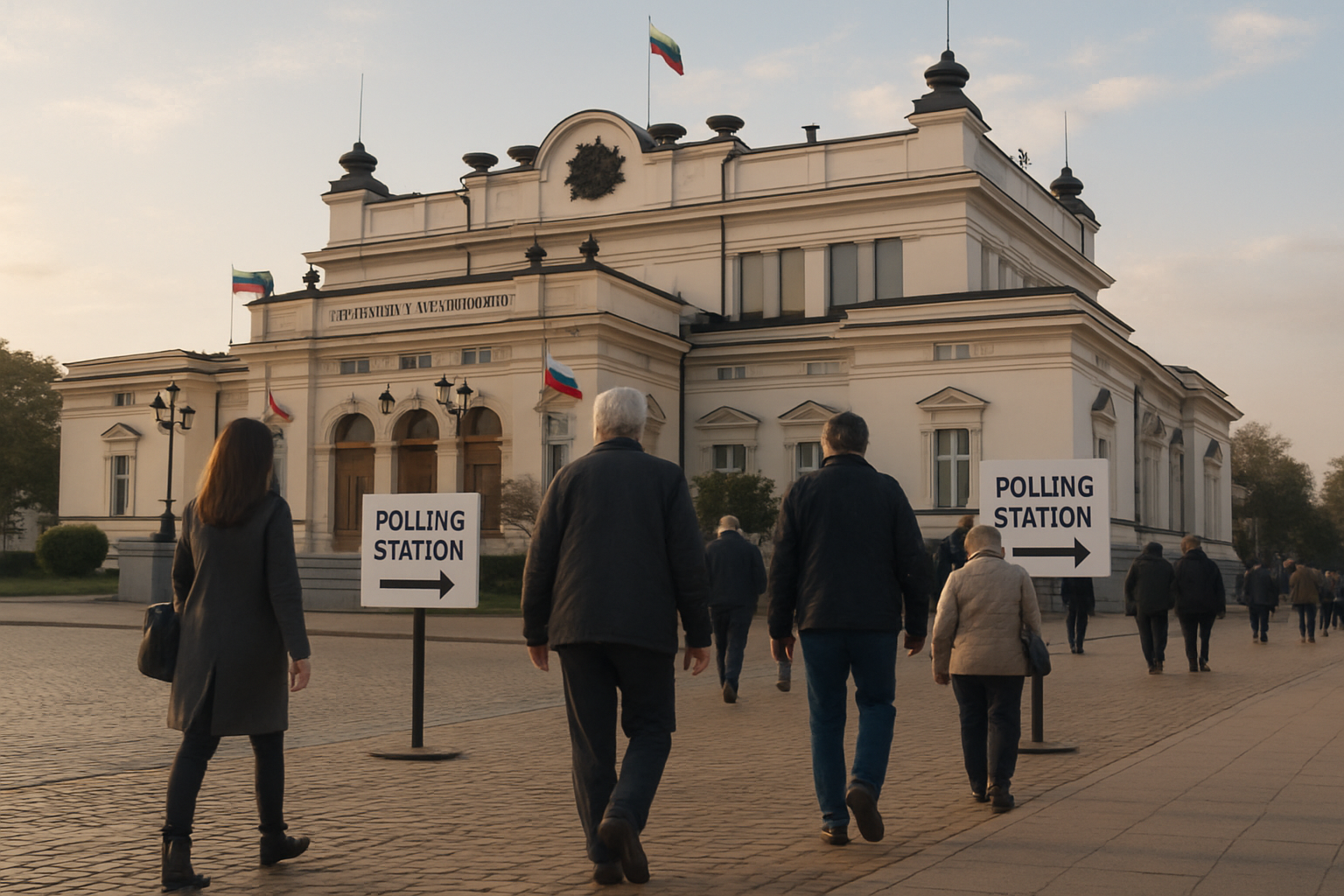
Bulgarian voters headed to the polls on April 19, 2026, for their eighth general election in just five years, with former president Rumen Radev emerging as the frontrunner in a contest many hope will finally break the country's debilitating cycle of political instability.
Polling stations across the Balkan nation opened at 7:00 AM as approximately 6.7 million eligible voters faced a choice between continuing the political deadlock or backing Radev's Progressive Bulgaria party, which leads in pre-election surveys with 31-34% support according to multiple polling organizations.
Radev's Anti-Corruption Campaign
The 61-year-old former air force general has positioned himself as the candidate to "end the oligarchy" and tackle the corruption that has plagued Bulgarian politics for decades. His campaign has focused heavily on anti-corruption measures, promising systemic changes to break the grip of powerful business interests on the political system.
"We will put an end to the oligarchy once and for all. Bulgarian citizens deserve a government that serves them, not the wealthy few who have captured our institutions."
— Rumen Radev, Progressive Bulgaria Leader
This marks Radev's transition from the presidency back to parliamentary politics after serving as Bulgaria's head of state from 2017 to 2022. His decision to enter the electoral fray reflects the severity of the ongoing political crisis that has left Bulgaria without stable governance since 2021.
A Country in Political Crisis
Bulgaria's political landscape has been characterized by unprecedented instability since mass protests in 2020-2021 toppled longtime leader Boyko Borissov's GERB party government. The current election represents the eighth attempt in five years to form a stable parliamentary majority, highlighting the depth of the institutional crisis.
The pattern of repeated elections began when corruption allegations and public anger over the country's oligarch-dominated system sparked nationwide demonstrations. Since then, no party has managed to secure sufficient support to govern effectively, leading to a series of caretaker administrations and snap elections.
Austrian media has drawn comparisons between Radev and Hungarian Prime Minister Viktor Orbán, questioning whether Bulgaria's former president could become "the next Orbán" in the European Union. These concerns stem from Radev's historically close ties to Russia and his criticism of EU sanctions policy.
Russia Concerns and EU Relations
Radev's candidacy has sparked debate about Bulgaria's future foreign policy orientation, particularly regarding relations with Russia and the European Union. Critics have pointed to his past statements questioning the effectiveness of EU sanctions against Moscow and his calls for maintaining dialogue with the Kremlin.
The timing of these elections is particularly sensitive, coming as Bulgaria recently joined the eurozone on January 1, 2026, and as the country continues to play a crucial role in European energy security through the Balkan Stream pipeline. Bulgaria remains strategically important as a NATO member state and EU frontier country bordering Turkey and the Western Balkans.
"Bulgaria's choice in this election will have implications far beyond our borders. We are at a crossroads between European integration and potential isolation."
— European Commission Official (speaking anonymously)
Economic Challenges and Voter Frustration
Beyond geopolitical concerns, Bulgarian voters are grappling with significant domestic challenges that have fueled the ongoing political crisis. Years of governmental instability have hampered economic policy implementation and EU fund absorption, while corruption perceptions remain stubbornly high.
The country's GDP growth has lagged behind regional peers, and many Bulgarians have emigrated to Western Europe seeking better opportunities. Brain drain and demographic decline have emerged as critical long-term challenges requiring sustained political attention and stable governance.
Youth unemployment and rural development issues have featured prominently in the campaign, with all major parties promising reforms to address these structural problems. However, voters have grown skeptical of political promises after years of unfulfilled commitments.
Coalition Mathematics and Governance Prospects
Even if Radev's Progressive Bulgaria achieves its projected vote share, forming a stable government will likely require complex coalition negotiations. The fragmented nature of Bulgaria's political landscape means that any future administration will need to bridge significant ideological differences.
The traditional pro-European GERB party, despite trailing in polls, could still play a kingmaker role in coalition formation. Other significant players include the Movement for Rights and Freedoms (representing ethnic Turkish interests) and various smaller parties spanning the political spectrum.
Political analysts warn that even a clear electoral victory might not guarantee governmental stability, given the deep polarization and mutual distrust among Bulgaria's political elite. The country's constitutional system requires a parliamentary majority to form government, often necessitating uncomfortable alliances.
European Implications
Bulgaria's election outcome will be closely watched in Brussels and other European capitals, particularly given concerns about democratic backsliding in several EU member states. The country's strategic location and recent eurozone membership make its political stability a matter of broader European interest.
EU officials have emphasized the importance of maintaining the rule of law and anti-corruption efforts, key criteria for continued access to European funding. Bulgaria currently receives significant EU structural funds, but disbursement has been linked to judicial reforms and governance improvements.
The election also comes at a time when the EU is reassessing its approach to member states with concerning democratic trends, following experiences with Hungary and Poland. A Radev victory could potentially add Bulgaria to the list of countries requiring enhanced monitoring.
Breaking the Deadlock
As polls closed at 8:00 PM local time, early exit polls suggested a victory for Radev's Progressive Bulgaria, though the margin of victory and coalition prospects remained unclear. International observers monitored the voting process, which proceeded largely without incident despite some reported irregularities.
The election represents perhaps Bulgaria's best hope for ending the political instability that has plagued the country since 2021. However, the path to stable governance will depend not only on the electoral outcome but also on political leaders' ability to compromise and form a functioning coalition.
For ordinary Bulgarians, the stakes could not be higher. After years of caretaker governments and political uncertainty, many voters expressed hope that this election might finally deliver the stable leadership their country desperately needs to address long-standing challenges and secure its European future.