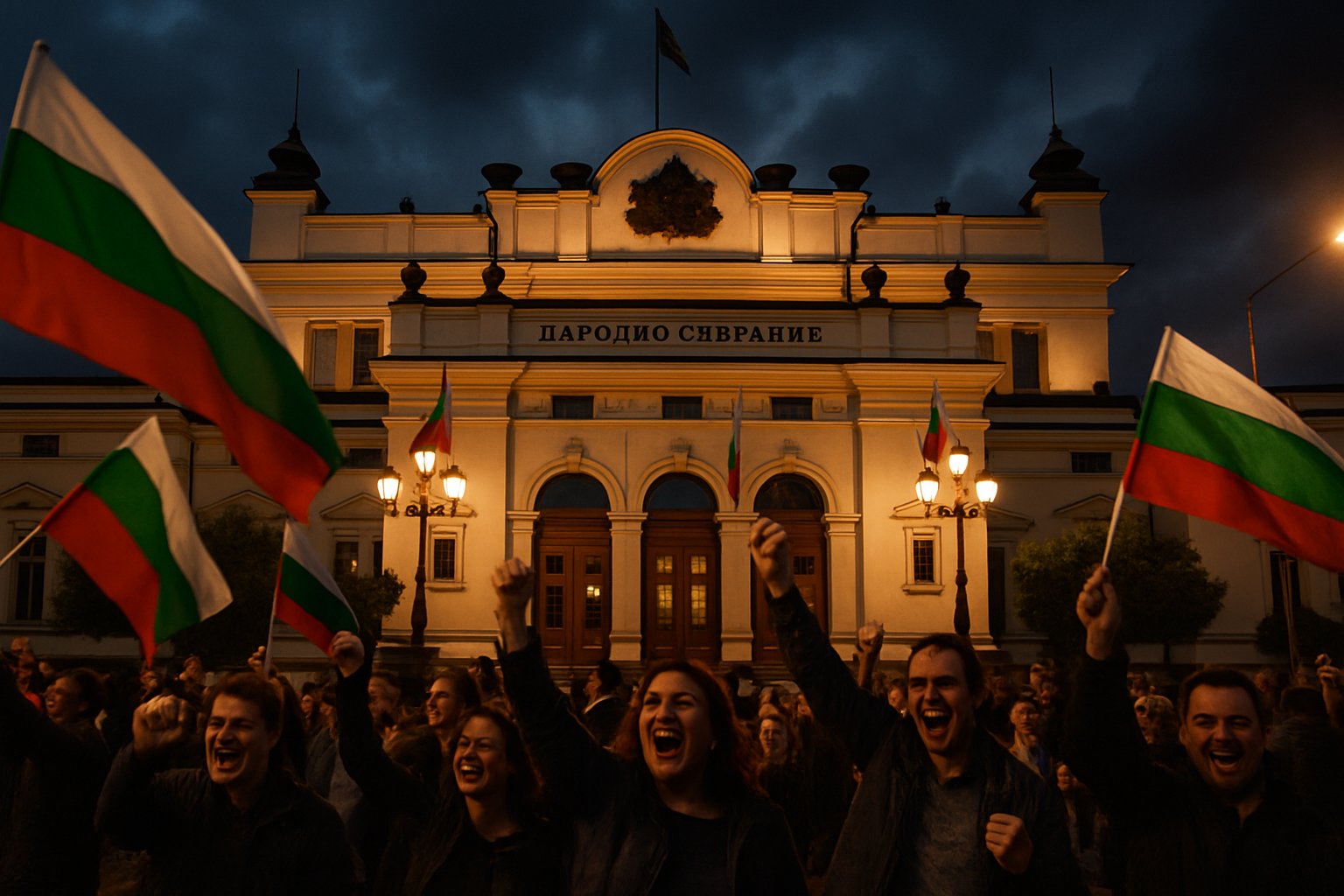
In a seismic political shift that has reverberated across Europe, former Bulgarian President Rumen Radev's Progressive Bulgaria coalition achieved a historic landslide victory in the country's parliamentary elections on April 19, 2026, securing an unprecedented parliamentary supermajority that could fundamentally alter Bulgaria's political trajectory and relationship with the European Union.
Exit polls and preliminary results from multiple agencies show Progressive Bulgaria capturing between 43.5% and 51% of the vote, translating to an estimated 129-134 seats in the 240-member parliament—the first absolute majority achieved by any party since 1997. The stunning victory represents a complete transformation of Bulgaria's fragmented political landscape and ends five years of chronic governmental instability that has plagued the EU's poorest member state.
A Historic Electoral Breakthrough
The magnitude of Radev's victory has stunned political observers across Europe. According to Alpha Research, one of Bulgaria's leading polling agencies, Progressive Bulgaria secured 43.5% of the vote, while data from Trend agency suggested support reaching as high as 51%. The coalition's nearest rival, the former ruling GERB-SDS bloc led by Boyko Borissov, managed only 13.5-15.1% support, representing a catastrophic collapse for the party that dominated Bulgarian politics for over a decade.
"This is an historic record that Rumen Radev is setting," declared analysts at Alpha Research as results poured in on Sunday evening. "Such a thing has not happened since 1997, when the United Democratic Forces, led by Ivan Kostov, won a full majority after the nightmarish Zhan-Videnova winter."
"The wave of support for Radev has materialized. This is a situation that offers many opportunities, but also risks."
— Haralan Aleksandrov, Political Analyst
European Concerns Over Pro-Russian Alignment
Radev's decisive victory has triggered alarm bells in Brussels and Western capitals, given his well-documented pro-Russian positions and criticism of EU sanctions against Moscow. The former air force general, who served as Bulgaria's president from 2017 to early 2026 before stepping down to enter parliamentary politics, has consistently advocated for restored ties with Russia and opposed military aid to Ukraine.
German media outlets described the electoral outcome as potentially creating "the next Orbán" within the EU, referring to Hungarian Prime Minister Viktor Orbán's confrontational stance toward Brussels. Italian sources characterized Radev's positions as representing a potential "serious challenge" to European unity on the Ukraine crisis, particularly given Bulgaria's strategic location hosting the Balkan Stream pipeline that carries Russian gas through southeastern Europe.
The timing of the victory is particularly significant as Bulgaria recently joined the eurozone on January 1, 2026, and holds a crucial strategic position as a NATO member state on the alliance's southeastern flank. European officials had hoped that eurozone membership would anchor Bulgaria more firmly within Western institutional frameworks, but Radev's triumph suggests a potential reversal of this trajectory.
Ending Five Years of Political Chaos
The election represents Bulgaria's eighth attempt since 2021 to form a stable government following the collapse of Boyko Borissov's GERB administration amid massive anti-corruption protests in 2020-2021. The country has endured a debilitating cycle of snap elections, caretaker governments, and failed coalition negotiations that has paralyzed governance and hampered EU fund absorption.
Record voter turnout—one million more participants than the previous election when turnout was just 38.94%—demonstrated intense public engagement despite widespread political fatigue. The surge in participation appears to have benefited Radev's coalition disproportionately, as voters sought a decisive break from the political paralysis that has characterized Bulgarian politics for half a decade.
According to Trend agency data, Radev's Progressive Bulgaria drew support from across the political spectrum: 18.5% from the reform-oriented "We Continue the Change - Democratic Bulgaria" alliance, 15.7% from former GERB supporters, and significant percentages from nationalist Vazrazhdane voters and traditional left-wing constituencies.
Regional and International Reactions
The scale of Radev's victory immediately drew congratulations from regional allies who share his skepticism toward Western policies. Serbian President Aleksandar Vučić called Radev within hours of the results to congratulate him on his "electoral success and victory," expressing confidence that the results would strengthen "stability and progress" and improve bilateral cooperation.
Russian media outlets prominently featured the election outcome, with Meduza reporting that the coalition "wants to cooperate with Russia" and emphasizing Radev's opposition to Ukraine military aid. The coverage reflected Moscow's satisfaction with the emergence of a potentially sympathetic government within the EU framework.
Meanwhile, European officials maintained diplomatic silence, though private communications obtained by several news agencies indicated serious concern about the implications for EU decision-making processes, particularly on issues related to sanctions policy and support for Ukraine.
Coalition Mathematics and Governance Prospects
Despite Progressive Bulgaria's commanding victory, the complex mathematics of Bulgarian politics may still require careful alliance management. The coalition's supermajority provides unprecedented authority to implement its agenda without extensive negotiations, but Radev will need to maintain unity within his own three-party alliance while addressing the expectations of voters who delivered such a decisive mandate.
The election saw six to seven parties crossing the 4% parliamentary threshold, including what analysts described as a completely new political formation that campaigned as being "created from pain of many parents and desire for justice." This newcomer party, which pollsters had given a maximum of 2% chance of success, appears to have entered parliament, demonstrating the volatile nature of Bulgarian voter sentiment.
GERB's collapse to just 14.5% represents one of the most dramatic political reversals in modern European politics, effectively ending Boyko Borissov's dominance over Bulgarian politics that stretched back over 15 years. The former prime minister's party, once considered the natural party of government, now faces an uncertain future in opposition.
Implications for European Integration
The electoral outcome poses significant challenges for Bulgaria's relationship with European institutions and fellow member states. As a recent eurozone member hosting critical energy infrastructure, Bulgaria's potential pivot toward Moscow could complicate EU efforts to maintain unity on sanctions against Russia and support for Ukraine.
Radev has been a vocal critic of EU sanctions policy, arguing that such measures harm Bulgarian economic interests while failing to achieve their stated objectives. His platform has consistently emphasized the need for "pragmatic" relationships with all neighbors, including Russia, and he has questioned the wisdom of extensive military support for Ukraine.
The victory also comes as the EU grapples with internal divisions over how to respond to the ongoing conflict in Ukraine and manage relationships with member states that maintain different positions on key foreign policy issues. Hungary's Viktor Orbán has previously blocked or delayed various EU initiatives related to Ukraine support, and Radev's emergence as a potential ally could further complicate Brussels' decision-making processes.
Domestic Agenda and Economic Challenges
Beyond foreign policy concerns, Radev's government will face substantial domestic challenges that contributed to voter dissatisfaction with previous administrations. Bulgaria remains the EU's poorest member state, with significant infrastructure needs, persistent corruption problems, and ongoing demographic decline as young Bulgarians continue emigrating to Western Europe.
The five years of political instability have exacerbated these structural problems, hampering the implementation of EU-funded development projects and deterring foreign investment. Radev's coalition has promised to "end oligarchy" and tackle corruption, themes that resonated strongly with voters frustrated by the apparent inability of previous governments to deliver meaningful change.
The campaign also emphasized economic nationalism and the protection of Bulgarian sovereignty against what Radev characterized as excessive external interference. This messaging appears to have struck a chord with voters across traditional party lines, contributing to the coalition's ability to draw support from both left-wing and right-wing constituencies.
Looking Ahead: Challenges and Opportunities
As Radev prepares to form Bulgaria's next government, he faces the complex task of translating electoral success into effective governance while managing competing domestic and international pressures. His supermajority provides unprecedented legislative authority, but also places full responsibility for Bulgaria's trajectory squarely on his coalition's shoulders.
International observers will be closely monitoring how Radev's government approaches key issues including EU integration, NATO commitments, and relationships with neighboring countries. The success or failure of his administration could have implications far beyond Bulgaria's borders, potentially serving as a template for other EU member states grappling with similar tensions between national sovereignty and European integration.
The April 19 elections may ultimately be remembered as a watershed moment in Bulgarian politics—either as the beginning of a new era of stable governance that addresses the country's long-standing challenges, or as the start of a more confrontational relationship between Bulgaria and its European partners. With Radev now holding the keys to power with an unprecedented mandate, the coming months will reveal which direction Bulgaria ultimately chooses.