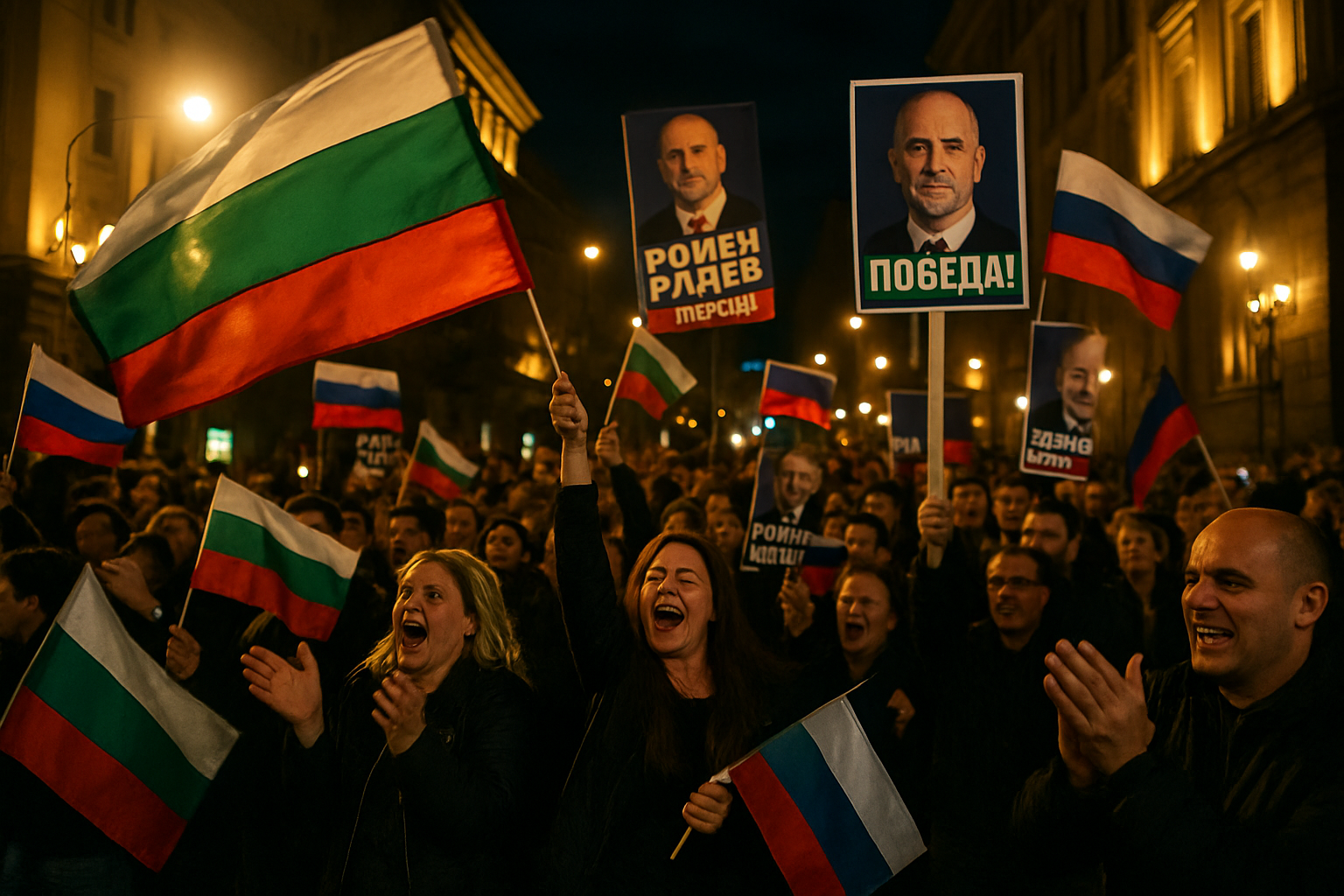
Former Bulgarian President Rumen Radev's Progressive Bulgaria coalition has claimed decisive victory in parliamentary elections, securing an estimated 44-45% of the vote and achieving what appears to be an absolute majority in the 240-member parliament, ending five years of unprecedented political instability.
The results mark a dramatic conclusion to Bulgaria's eighth parliamentary election since the political crisis began in 2021, following mass anti-corruption protests that toppled Boyko Borissov's GERB government. Early projections suggest Radev's coalition has secured between 129-135 seats, potentially allowing them to govern alone for the first time since 1997.
Historic Electoral Breakthrough
Preliminary results from Bulgarian media outlet Dnevnik showed Progressive Bulgaria leading with 44.5% of the vote after counting over 63% of ballots. This performance significantly exceeded polling expectations and represents the most decisive electoral outcome in Bulgarian politics in nearly three decades.
Speaking to supporters after polls closed, Radev declared his coalition had "defeated apathy" and secured a mandate for comprehensive change. "This victory demonstrates a renewed civic engagement, but we must acknowledge that distrust in Bulgarian politics remains high," he stated, according to reports from Novinite.
The election saw record-breaking participation, with over one million more voters than the previous election, when turnout was 38.94%. This surge in participation appears to have primarily benefited Radev's pro-European platform, which drew support across traditional party lines.
Opposition Collapses
The results represent a catastrophic collapse for GERB-SDS, Borissov's center-right coalition, which fell to a historic low of 12.3% and approximately 36 seats – a dramatic reversal from their previously dominant position in Bulgarian politics.
The pro-European PP-DB coalition managed 12.6% for 36 seats, while the ethnic Turkish DPS party secured 6.8% and 21 seats. The nationalist Vazrazhdane party achieved 4.2% for 12 seats. Notably, several major parties including the Bulgarian Socialist Party (BSP), which traces its lineage to the former Communist Party, failed to cross the 4% threshold required for parliamentary representation.
This electoral breakdown reflects a fundamental realignment of Bulgarian politics, with voters apparently rejecting both traditional center-right and socialist alternatives in favor of Radev's message of systemic change.
End of Political Paralysis
The election represents Bulgaria's latest attempt to break a five-year cycle of governmental deadlock and caretaker administrations. Since the 2020-2021 mass protests demanding an end to oligarchic corruption, no government has completed a full term, creating a crisis of governance that has hampered EU fund absorption and economic development.
Radev, who served as president from 2017 to early 2022 before stepping down to enter parliamentary politics, campaigned on a 240-page platform promising to "end oligarchy," tackle corruption, and restore Bulgaria's momentum toward deeper European integration.
The coalition's absolute majority would eliminate the need for complex coalition negotiations that have stymied previous governments during the crisis period. All caretaker ministers must now resign to facilitate complete governmental restructuring, according to constitutional requirements.
European Implications
Bulgaria's political crisis has significant implications beyond its borders. As a NATO member, EU state, and recent eurozone entrant (joining January 1, 2026), the country plays a crucial role in European energy security as the host of the Balkan Stream pipeline connecting Russian gas supplies to Central Europe.
Radev's past positions have raised concerns in European capitals. He has previously criticized EU sanctions against Russia and opposed military aid to Ukraine. Some European media have characterized him as potentially becoming "the next Viktor Orbán," referring to Hungary's increasingly autocratic leader who has clashed repeatedly with Brussels over rule-of-law issues.
However, Radev's campaign platform emphasized accelerating European integration and implementing comprehensive democratic reforms. His victory statement stressed Bulgaria's commitment to its "European trajectory" while addressing domestic inequality and corruption concerns.
Economic Challenges Ahead
The new government faces substantial economic challenges. Bulgaria remains the EU's poorest member state, struggling with high inflation, limited wage growth, and significant infrastructure needs. The country has also experienced severe brain drain and demographic decline, undermining its long-term economic prospects.
Political instability has created a vicious cycle where economic stagnation fuels further political dysfunction. The governmental paralysis has hampered EU fund absorption and reform implementation, contributing to Bulgaria's struggle to converge economically with Western European standards.
Radev's platform promises wealth taxes targeting oligarchs, judicial independence restoration, media freedom expansion, and accelerated European integration. The absolute majority would provide unprecedented legislative authority to implement these reforms without the coalition negotiations that have paralyzed previous governments.
Regional Context
The Bulgarian results come against a backdrop of broader political upheaval across Eastern and Central Europe. Hungary recently experienced its own electoral drama with Viktor Orbán facing unprecedented challenges from pro-European opposition forces. Similar patterns of political fragmentation and anti-establishment sentiment have emerged across the region.
Bulgaria's role as a bridge between Europe and the Black Sea region makes its political stability crucial for broader regional security. The country's membership in both NATO and the EU, combined with its energy infrastructure connections, means that governmental paralysis affects not just domestic politics but regional strategic calculations.
Looking Forward
The election results provide a template for how pro-European platforms can succeed by combining EU integration advocacy with addressing domestic concerns about inequality and corruption. Radev's coalition appears to have successfully mobilized voters frustrated with both oligarchic corruption and governmental instability.
The critical test for Bulgarian democracy will be whether this electoral mandate can translate into effective governance that addresses the accumulated challenges of the crisis period while maintaining Bulgaria's European integration path. Success could provide a foundation for long-term political stability; failure might deepen the crisis that has plagued the country since 2021.
As vote counting continues and final results are certified, Bulgaria stands at a potential turning point. After years of political crisis and governmental deadlock, the country may have found a path toward the stable, effective governance that has eluded it since the mass protests began five years ago.