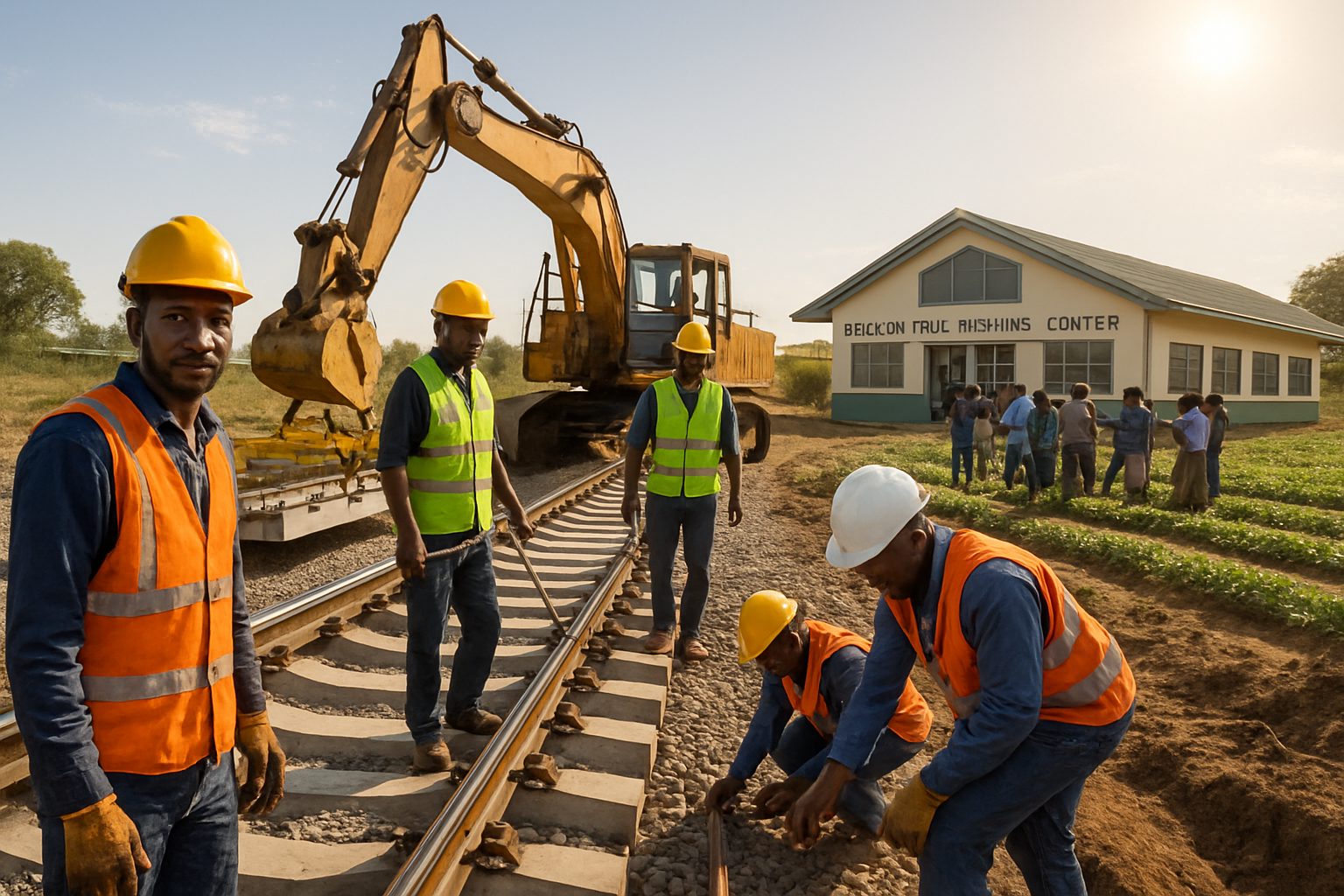
Burkina Faso is spearheading Africa's development transformation through innovative railway education programs and comprehensive agricultural resilience projects, marking a pivotal moment in the continent's unprecedented infrastructure renaissance valued at over $570 billion globally.
On March 17, 2026, SITARAIL made history by providing over 300 students from a primary school in Ouagadougou with their first-ever train experience on the Ouagadougou-Koudougou route. For the vast majority of these young passengers, this represented not just a journey, but a window into Africa's transportation future and the continent's growing connectivity infrastructure.
Simultaneously, a joint mission comprising the UN Food and Agriculture Organization (FAO), Burkina Faso's Ministry of Agriculture and Water, and the Belgian Embassy conducted a crucial field visit to the Yaadga region on March 16, 2026. This mission represents the ongoing implementation of project "GCP/BKF/068/BEL," dedicated to strengthening food security and building community resilience against climate change effects.
Educational Infrastructure as Development Strategy
The SITARAIL educational initiative represents a sophisticated understanding that infrastructure development must include community engagement and education. By introducing young Burkinabè citizens to railway transportation, the program builds public awareness and support for the continent's expanding rail networks.
This educational approach aligns with broader African development patterns that emphasize human capital development alongside physical infrastructure. As documented in Planet News's extensive coverage of African development projects, the continent has shifted from traditional aid-dependent models to comprehensive development strategies that integrate education, infrastructure, and economic empowerment.
The timing of this initiative coincides with Africa's unprecedented infrastructure boom, including Algeria's Gara Djebilet railway accessing the world's third-largest iron ore reserves, Angola's Lobito Corridor revival connecting the Atlantic to DRC mineral regions, and Tanzania's completion of the Mtwara-Mbamba Bay railway feasibility study covering 1,000 kilometers.
Agricultural Resilience and Food Security Innovation
The FAO-led mission to Yaadga province represents the practical implementation of climate-adaptive agriculture. The team visited a one-hectare agroecological farm in SongNaaba village, Yako commune, showcasing innovative farming techniques designed to maintain productivity despite accelerating climate challenges.
This agricultural development occurs during the 19th consecutive month of global temperatures exceeding 1.5°C above pre-industrial levels, creating unprecedented stress on traditional farming systems across the Sahel region. Burkina Faso's response demonstrates the country's commitment to food security through science-based adaptation strategies.
"These initiatives represent the evolution from crisis response to proactive resilience building,"
— Agricultural Development Analyst, African Finance Corporation
The project builds on Burkina Faso's remarkable economic transformation, including record gold production worth over $6 billion in 2025. This mineral wealth is being strategically reinvested in agricultural modernization, infrastructure development, and human capital enhancement.
Continental Context and Strategic Partnerships
Burkina Faso's development initiatives occur within the broader framework of African Continental Free Trade Area (AfCFTA) implementation, which requires enhanced connectivity and agricultural productivity to support intra-African commerce. The country's strategic approach combines international partnerships with strong national ownership of development priorities.
Recent developments include China's announcement of zero-tariff access for 53 African countries beginning May 1, 2026, representing the most comprehensive China-Africa trade expansion in history. This policy complements existing partnerships with European and American allies, demonstrating Africa's sophisticated approach to maintaining strategic autonomy while leveraging global cooperation.
Seven African countries, including Guinea and Zambia from the region, are participating in the US-EU-Japan Critical Minerals Partnership, challenging China's 60% production and 90% refining dominance in critical materials. This diversification strategy positions Africa as an essential global partner rather than a dependent recipient of international assistance.
Technology Integration and Traditional Knowledge
The success of Burkina Faso's dual approach—railway education and agricultural innovation—demonstrates the continent's mastery of integrating cutting-edge technology with traditional knowledge systems. The SongNaaba agroecological farm combines modern climate science with indigenous farming practices, creating resilient food production systems.
This synthesis reflects broader African development patterns documented across the continent, from Nigeria's fintech revolution achieving 43% of fuel sales through digital payments, to Uganda's integration of traditional governance structures with modern e-commerce platforms.
Modern infrastructure projects increasingly incorporate digital monitoring, renewable energy integration, and smart logistics as standard features rather than premium additions. This approach enables African nations to leapfrog development constraints while building sustainable, climate-resilient systems.
Economic Multiplier Effects
The African Finance Corporation estimates the continent holds $29.5 trillion in mineral reserves, representing 20% of the global total, with $8.6 trillion remaining untapped. Burkina Faso's strategic use of its gold production revenues to fund infrastructure and agricultural development creates economic multiplier effects extending far beyond individual projects.
Railway development generates employment in construction, maintenance, and operations while reducing transportation costs for agricultural products and manufactured goods. Agricultural resilience projects create sustainable rural employment while enhancing food security and export potential.
Recent major investments across Africa include Ivory Coast's approval of $1.2 billion gold projects, South Africa's R325 million commitment to rare earth development, and massive infrastructure developments spanning the continent from north to south.
Climate Adaptation and Environmental Sustainability
The urgency of Burkina Faso's agricultural adaptation becomes clear when considering the unprecedented climate challenges facing the Sahel region. The FAO project specifically addresses "strengthening food security and community resilience against climate change effects," recognizing that traditional farming methods require enhancement to maintain productivity under changing conditions.
The agroecological approach demonstrated in SongNaaba village represents a sophisticated understanding that sustainable development must work with natural systems rather than against them. This methodology is being studied and adapted across West Africa as a template for climate-resilient agriculture.
Environmental sustainability is increasingly integrated into all major African infrastructure projects, with renewable energy, advanced waste management, and climate adaptation designed as core components rather than afterthoughts.
Regional Integration and Future Prospects
Burkina Faso's participation in the Alliance of Sahel States alongside Mali and Niger demonstrates the country's commitment to regional cooperation while maintaining strategic autonomy. The February 2026 strategic roadmap adoption in Ouagadougou consolidated first-year achievements and established frameworks for enhanced regional integration.
The country's development model emphasizes resource sovereignty while engaging productively with international partners. This approach has proven attractive to other African nations seeking to balance global engagement with national control over development priorities.
Success in railway education and agricultural resilience provides templates that can be adapted across similar African contexts, contributing to continental food security and infrastructure development objectives during the critical climate action decade.
Implementation Challenges and Success Factors
Despite remarkable progress, Burkina Faso faces significant implementation challenges common across African development projects. These include funding sustainability for long-term programs, technical capacity building requirements, and the need for adaptive management responding to rapidly changing environmental conditions.
Success factors identified through extensive analysis of African development initiatives include sustained political commitment, transparent governance frameworks, meaningful community engagement, and international cooperation that respects local autonomy while providing essential technical and financial support.
The diversity of approaches represented by railway education and agricultural innovation provides resilience against single-solution dependencies, offering multiple pathways toward sustainable development adapted to local conditions and priorities.
Strategic Continental Significance
March 2026 represents a potential watershed moment for African development, with coordinated initiatives across multiple sectors demonstrating the continent's capacity for sophisticated policy implementation and international cooperation. Burkina Faso's dual-track approach provides valuable lessons for scaling successful interventions across Africa.
The convergence of infrastructure development, agricultural innovation, educational engagement, and strategic international partnerships positions Africa as an essential global partner rather than an aid recipient. This transformation influences development approaches worldwide, establishing precedents for comprehensive strategies that address multiple challenges simultaneously.
The window for building resilient, equitable development systems is narrowing rapidly due to accelerating climate change and growing resource demands. Burkina Faso's proactive approach demonstrates that effective solutions exist when supported by political will, community engagement, and strategic international cooperation aligned with national development priorities.