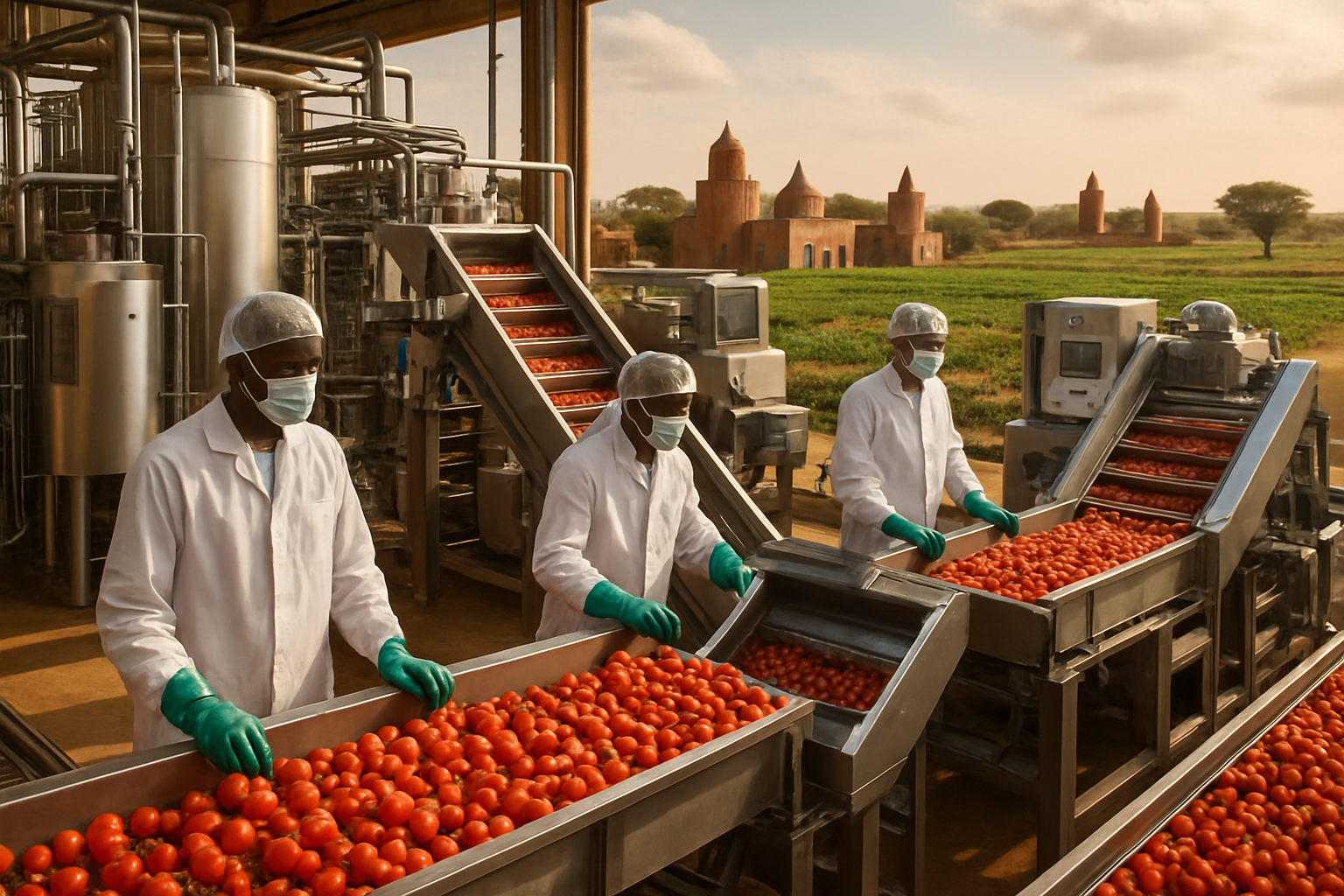
Burkina Faso is positioning itself at the forefront of West Africa's agricultural revolution, with the Agency for Community Entrepreneurship Promotion (APEC) spearheading ambitious tomato processing initiatives that promise to transform the nation's food security landscape and economic prospects.
Under the leadership of Director General Karim Traoré, APEC has launched a comprehensive agricultural modernization program focusing on tomato production and processing facilities across multiple strategic locations. The initiative represents a fundamental shift from raw commodity export to value-added agricultural processing, positioning Burkina Faso as a regional leader in food sovereignty and agricultural innovation.
Strategic Infrastructure Development
On April 13, 2026, APEC teams conducted critical site visits to monitor progress on multiple fronts of this ambitious agricultural transformation. At Tenkodogo in the Nakambé region, construction of a state-of-the-art tomato processing facility has reached advanced stages, with Director General Traoré personally overseeing developments and providing updates to project investors.
The Tenkodogo facility represents more than infrastructure development—it embodies a strategic vision for agricultural value-addition that could serve as a template for similar initiatives across the Sahel region. The project demonstrates sophisticated planning that integrates modern processing technology with traditional agricultural knowledge, ensuring both efficiency and cultural sustainability.
Simultaneously, APEC has established reference agricultural sites in key agropoles across the country. The Nakambé agropole site in Bagré commune mirrors successful initiatives already underway at Niéguéma in the Guiriko region, creating a network of agricultural innovation centers designed to supply fresh tomatoes to processing facilities while serving as training grounds for modern farming techniques.
Community-Centered Agricultural Innovation
The Niéguéma site in the Samendéni agropole has emerged as a flagship example of APEC's approach to sustainable agricultural development. This reference farm demonstrates how traditional farming practices can be enhanced through modern technology without compromising community ownership or cultural values.
Local agricultural communities have embraced these initiatives, recognizing their potential to generate sustainable employment while reducing dependency on volatile international commodity markets. The program's emphasis on fresh tomato production for domestic processing rather than raw export represents a significant strategic shift that promises to retain more economic value within Burkina Faso's borders.
APEC's approach emphasizes knowledge transfer and capacity building, ensuring that local farmers gain the technical skills necessary to maintain and expand these agricultural innovations independently. This focus on sustainable development principles distinguishes the program from traditional development assistance models that often create dependency rather than empowerment.
Regional Context and Strategic Significance
Burkina Faso's agricultural modernization occurs within the broader context of unprecedented African continental development. The nation's record gold production of $6 billion in 2025 under Captain Ibrahim Traoré's administration has provided the financial foundation for strategic agricultural investments that prioritize long-term food security over short-term export earnings.
These developments align with continental trends toward South-South cooperation and regional integration through frameworks like the African Continental Free Trade Agreement (AfCFTA). By developing processing capabilities, Burkina Faso positions itself to serve emerging regional markets while reducing dependence on traditional North-South trade relationships.
The tomato processing initiative also reflects broader food security challenges facing the Sahel region. Recent memory shows how Burkina Faso temporarily suspended tomato exports in March 2026 to prioritize domestic processing capacity—a strategic decision that demonstrated the government's commitment to food sovereignty over raw material exports.
Climate Adaptation and Sustainability
APEC's agricultural programs incorporate sophisticated climate adaptation strategies essential for agricultural success in an era of unprecedented environmental change. With global temperatures having exceeded 1.5°C above pre-industrial levels for twenty consecutive months, traditional farming cycles have become increasingly unreliable, making controlled processing environments and climate-resilient production methods critical for food security.
The reference farms at Nakambé and Niéguéma serve as testing grounds for drought-resistant tomato varieties and water-efficient irrigation techniques that could prove essential for maintaining agricultural productivity amid changing climatic conditions. These sites demonstrate how traditional ecological knowledge can be combined with modern agricultural science to create resilient food production systems.
Processing facilities represent another layer of climate adaptation by reducing post-harvest losses and enabling year-round food availability regardless of seasonal variations in fresh produce supply. This approach provides crucial buffer capacity against climate-related agricultural disruptions.
Economic Development Engine
Beyond food security benefits, APEC's tomato processing initiative functions as a comprehensive economic development engine with far-reaching implications for rural communities. The program creates employment opportunities across the entire agricultural value chain, from farm production through processing, packaging, transportation, and marketing.
Local contractors and construction workers benefit from facility development, while agricultural extension services, veterinary support, and technical training programs generate additional employment for skilled professionals. The multiplier effects extend through regional economies as workers spend wages locally and processing facilities source materials and services from area businesses.
For investors, the program offers sustainable returns based on growing domestic and regional demand for processed tomato products. APEC's systematic approach to stakeholder engagement ensures transparency and accountability while maintaining community ownership of development priorities.
Technology Transfer and Innovation
The success of Burkina Faso's tomato processing initiative relies heavily on sophisticated technology transfer that respects local knowledge while introducing beneficial innovations. Processing facilities incorporate modern equipment designed for tropical conditions, while maintaining systems simple enough for local technicians to operate and maintain independently.
Agricultural sites employ precision irrigation techniques adapted to Sahelian conditions, combining drip irrigation technology with traditional water conservation methods. Soil management programs integrate scientific approaches with indigenous farming practices that have sustained communities for generations.
Quality control systems ensure processed products meet both domestic standards and potential export requirements, creating flexibility for future market expansion. Technical training programs build local capacity to operate, maintain, and eventually expand these systems without continued external assistance.
International Cooperation Framework
APEC's initiatives benefit from strategic international partnerships that respect Burkina Faso's sovereignty while providing technical expertise and market access. These relationships exemplify the emerging trend toward South-South cooperation, where developing nations share experiences and technologies based on similar challenges rather than traditional North-South aid dependencies.
Regional cooperation through West African economic integration provides markets for processed products while sharing technological innovations across similar agricultural zones. The success of Burkina Faso's approach offers templates for adaptation in neighboring countries facing comparable food security and economic development challenges.
International development partners support the program through technical assistance and financing arrangements that maintain local ownership of development priorities. This approach ensures that external support enhances rather than replaces domestic capacity for agricultural innovation and economic development.
Future Implications and Scaling Potential
The success of APEC's tomato processing initiative could establish Burkina Faso as a regional center of excellence for agricultural modernization, attracting additional investment and knowledge sharing opportunities. The program's emphasis on community ownership and technological integration provides a sustainable model for similar initiatives across the Sahel and broader West Africa.
As climate change continues to challenge traditional agricultural systems across the region, Burkina Faso's innovations in processing, climate adaptation, and value-addition could prove essential for maintaining food security and economic stability. The country's approach demonstrates how strategic agricultural investment can address multiple development challenges simultaneously.
With processing facilities becoming operational and reference farms demonstrating improved yields, Burkina Faso is positioning itself to become a net exporter of processed agricultural products rather than raw commodities. This transformation could fundamentally alter the country's economic trajectory while contributing to regional food security objectives.
The integration of traditional knowledge with modern technology, community ownership with international cooperation, and immediate food security needs with long-term economic development creates a comprehensive model for sustainable agricultural transformation that could influence development approaches across the African continent.