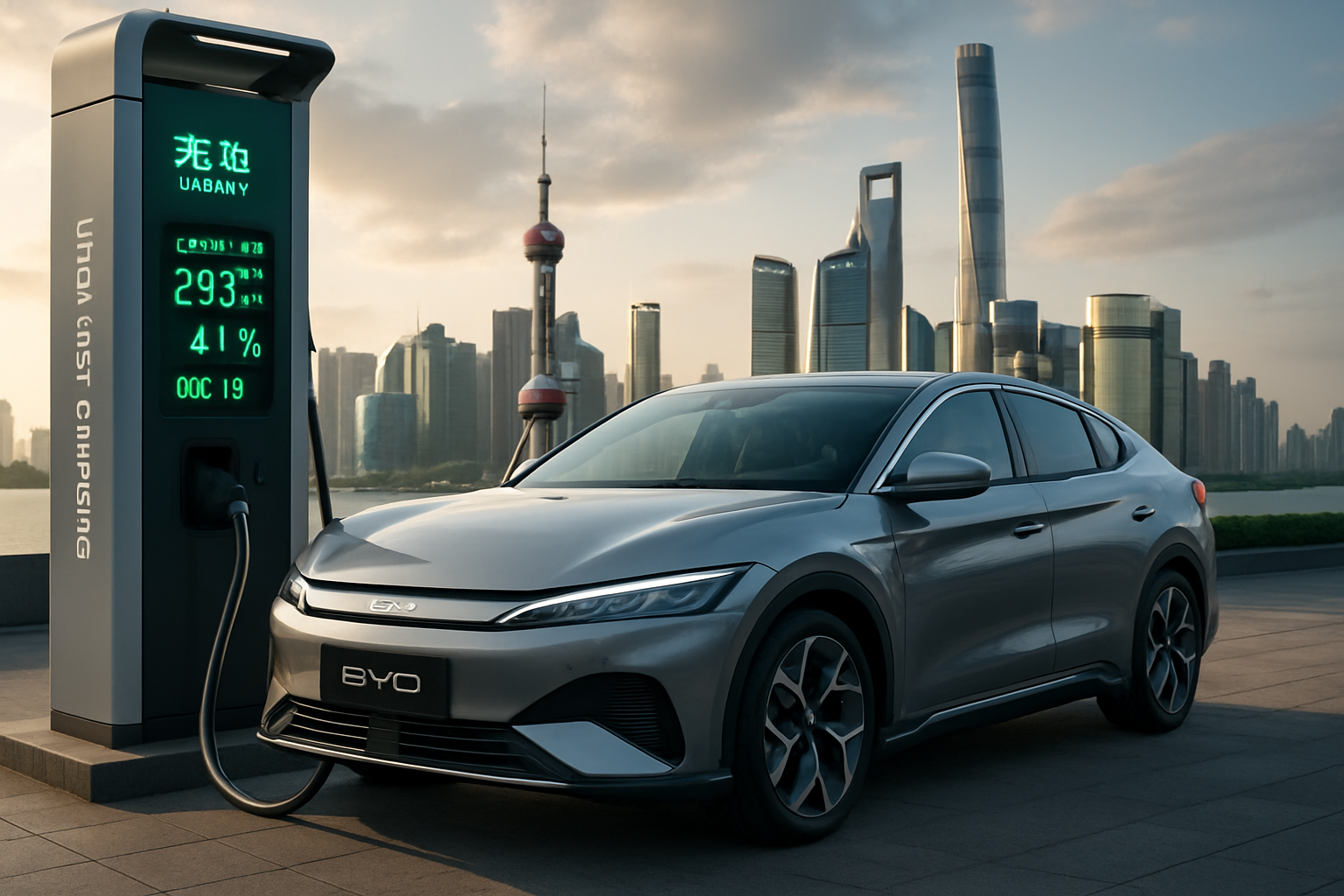
Chinese electric vehicle manufacturer BYD has achieved a historic breakthrough with its new-generation Blade Battery 2.0, capable of charging from 10% to 70% in just five minutes—matching the speed of filling a traditional petrol tank and potentially revolutionizing global electric vehicle adoption.
The groundbreaking technology, unveiled on Thursday, represents what BYD claims is "the world's fastest charging speed for a mass-manufactured unit," with the battery reaching 97% capacity in nine minutes. Even more remarkably, the system maintains these charging speeds in extreme weather conditions, functioning effectively at temperatures as low as minus 30 degrees Celsius.
Technical Innovation Addresses Core EV Barrier
BYD's Blade Battery 2.0 directly tackles what analysts identify as the primary obstacle to widespread electric vehicle adoption: charging time anxiety. While current fast-charging systems typically require 30-45 minutes to achieve significant charge levels, BYD's innovation compresses this to timeframes comparable with conventional fuel stops.
The company's previous Megawatt Flash Charging system, announced in February 2026, delivered 1,360 kW of power enabling vehicles to gain 400km range in five minutes. The Blade Battery 2.0 builds on this foundation, integrating advanced thermal management systems and next-generation battery chemistry to achieve unprecedented charging speeds while maintaining safety standards.
"This technology eliminates the fundamental difference between electric and traditional vehicles in terms of refueling convenience," said a BYD spokesperson during the launch event.
— BYD Corporate Communications
China's Dominance in Battery Technology
BYD's breakthrough reinforces China's commanding position in the global electric vehicle supply chain. The country controls approximately 60% of global critical materials production and 90% of refining capacity for lithium, cobalt, and rare earth elements essential for battery manufacturing. This vertical integration advantage has enabled Chinese companies to innovate rapidly while maintaining cost competitiveness.
The development occurs against the backdrop of intensifying international competition in battery technology. The US-EU-Japan Critical Minerals Partnership, involving 55 countries, represents a coordinated effort to diversify supply chains away from Chinese dominance. However, technological advances like BYD's Blade Battery 2.0 demonstrate China's continued innovation leadership in the sector.
Global Market Implications
Industry analysts predict BYD's charging breakthrough could accelerate electric vehicle adoption globally, particularly in markets where charging infrastructure concerns have slowed transition rates. Australia, despite achieving EV price parity with traditional vehicles, has seen limited adoption due primarily to charging infrastructure limitations and range anxiety—concerns directly addressed by ultra-fast charging technology.
The timing proves significant as governments worldwide implement increasingly aggressive electric vehicle mandates. China's own regulatory environment, including the January 2027 ban on hidden door handles affecting Tesla, BYD, NIO, and XPeng, demonstrates the country's dual approach of technological innovation and safety-focused regulation.
Supply Chain and Manufacturing Considerations
The Blade Battery 2.0's mass production capability represents a critical advancement over laboratory-based charging technologies demonstrated by other manufacturers. BYD's integrated manufacturing approach, spanning battery production, vehicle assembly, and charging infrastructure, enables rapid scalability that pure technology demonstrations cannot match.
However, the global semiconductor crisis continues to impact the automotive industry, with memory chip prices experiencing sixfold increases affecting vehicle control systems. These supply chain challenges could potentially limit the deployment speed of advanced battery technologies, despite their technical capabilities.
Cold Weather Performance Breakthrough
The system's effectiveness at minus 30 degrees Celsius addresses a significant limitation of current electric vehicle technology. Previous industry testing, including comprehensive evaluations by Austria's ÖAMTC of 24 electric vehicles in -31°C conditions, highlighted substantial range losses and charging difficulties in extreme cold.
BYD's thermal management breakthrough could prove particularly significant for northern climate adoption, where cold weather performance has historically deterred electric vehicle purchases. The technology's reliability across temperature extremes positions it for global deployment rather than climate-specific applications.
Integration with Renewable Energy Infrastructure
The ultra-fast charging capability aligns with global renewable energy expansion efforts. Countries including Estonia, which achieved 88% renewable electricity with Europe's largest battery storage facility serving 90,000 households, represent the infrastructure foundation necessary to support high-power charging networks.
Vehicle-to-grid technology integration enables electric vehicles equipped with advanced batteries to serve as distributed energy storage, charging during off-peak renewable generation and discharging during high demand periods. BYD's rapid charging capability enhances this flexibility, enabling more responsive grid support services.
Competitive Response and Industry Evolution
The breakthrough intensifies pressure on traditional automotive manufacturers already struggling with electric vehicle transitions. Companies like Stellantis, which experienced a 28% stock decline after announcing billions in writedowns and electric vehicle program cuts, face increasingly difficult competitive environments against technologically advanced Chinese manufacturers.
Tesla's response strategy includes expansion of AI training centers in China and continued Supercharger network development, while legacy European manufacturers intensify calls for Brussels subsidies to support domestic electric vehicle manufacturing competitiveness.
Future Implementation Timeline
BYD has not announced specific deployment timelines for Blade Battery 2.0 technology across its vehicle lineup. The company's previous pattern suggests initial implementation in premium models followed by broader market deployment as manufacturing scales increase.
The charging infrastructure requirements for supporting such rapid charging speeds necessitate significant electrical grid upgrades and specialized charging station deployment. Coordination with utility companies and infrastructure investment will likely determine deployment speed more than battery technology readiness.
Global Transportation Transformation
BYD's achievement represents a potential inflection point in global transportation electrification. By eliminating charging time disadvantages compared to conventional vehicles, the technology addresses psychological and practical barriers that have slowed electric vehicle adoption despite achieving price competitiveness in many markets.
The development occurs amid mounting climate urgency, with January 2026 marking the 18th consecutive month of temperatures exceeding 1.5°C above pre-industrial levels. Transportation electrification, enabled by technologies like ultra-fast charging, becomes increasingly critical for achieving international climate commitments.
As the automotive industry continues its most significant transformation in over a century, BYD's Blade Battery 2.0 demonstrates how technological innovation can overcome seemingly intractable adoption barriers, potentially accelerating the global transition to sustainable transportation systems.