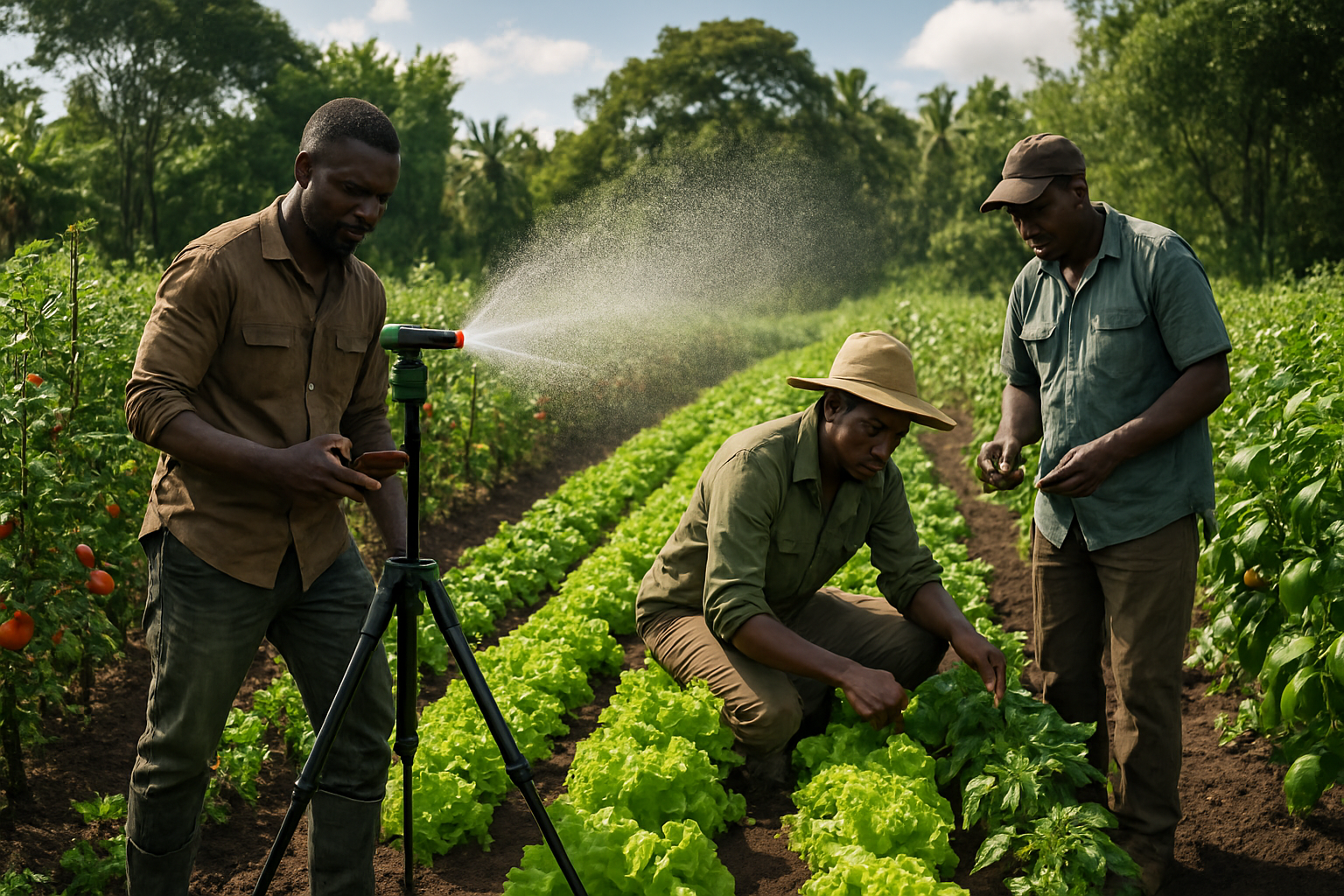
In the agricultural heartlands of Cameroon, a quiet revolution is transforming the way farmers cultivate their crops, offering hope to thousands of market gardeners who have long struggled with water scarcity during the critical dry season.
PADJI SARL, a pioneering Cameronian company, has introduced laser spray irrigation technology that is fundamentally changing agricultural practices across the country's major farming basins. The innovative system addresses the persistent challenge facing market gardeners who grow essential crops including tomatoes, peppers, lettuce, and cabbage—all of which require consistent irrigation to ensure reliable production for local markets.
The Water Scarcity Challenge
Across Cameroon's diverse agricultural regions, farmers have traditionally faced a constant battle against seasonal water shortages. The dry season, which can extend for several months, has historically forced many farmers to abandon cultivation or accept significantly reduced yields, directly impacting food security and rural livelihoods.
"The traditional methods simply couldn't provide the precision and efficiency we needed," explains a local agricultural expert familiar with the PADJI SARL initiative. "During the dry season, water becomes precious, and farmers needed technology that could maximize every drop while ensuring their crops received adequate hydration."
Revolutionary Laser Spray Technology
The laser spray system developed by PADJI SARL represents a sophisticated integration of precision agriculture with water conservation principles. Unlike conventional sprinkler systems that often waste significant amounts of water through evaporation and imprecise distribution, the laser spray technology delivers water with remarkable accuracy and efficiency.
The system operates through carefully calibrated laser-guided mechanisms that create uniform water distribution patterns, ensuring each plant receives optimal moisture levels. This precision approach reduces water consumption by an estimated 40-60% compared to traditional irrigation methods while potentially increasing crop yields through more consistent plant hydration.
Impact on Market Garden Production
The adoption of laser spray technology is producing measurable improvements across multiple agricultural metrics. Farmers using the system report enhanced crop quality, more reliable harvest schedules, and improved resistance to drought stress among their plants.
For tomato cultivation, one of Cameroon's most important market garden crops, the laser spray system has enabled farmers to maintain production levels even during extended dry periods. The technology's precision allows for targeted watering that supports optimal fruit development while minimizing water waste.
Similarly, leafy vegetables like lettuce and cabbage benefit from the system's ability to provide consistent moisture levels without creating waterlogged conditions that can promote disease. The controlled water application helps maintain the crisp texture and nutritional value that consumers demand.
Broader Agricultural Innovation Context
PADJI SARL's breakthrough reflects a broader pattern of African-led agricultural innovation that is transforming food production across the continent. The laser spray technology aligns with global trends toward sustainable intensification—achieving higher yields through improved efficiency rather than expanded land use or increased chemical inputs.
This innovation occurs within the context of unprecedented climate pressures, with 2026 marking the 19th consecutive month of global temperatures exceeding 1.5°C above pre-industrial levels. Such sustained warming is fundamentally altering traditional farming cycles and making water conservation technologies increasingly critical for agricultural sustainability.
Economic and Social Benefits
The economic implications of the laser spray system extend far beyond individual farm operations. By enabling more reliable crop production, the technology supports stable food supplies for urban markets while providing farmers with more predictable income streams.
Rural communities benefit from the technology's ability to create year-round employment opportunities in market gardening, reducing seasonal migration to cities and supporting local economic stability. The system's efficiency also reduces operational costs over time, as lower water consumption translates to reduced pumping costs and infrastructure maintenance.
For women farmers, who play crucial roles in Cameroon's market gardening sector, the laser spray technology offers particular advantages. The system's automated features reduce the physical labor traditionally associated with manual watering, while its reliability enables better crop planning and market participation.
Technology Transfer and Scaling Potential
The success of PADJI SARL's laser spray system demonstrates the potential for South-South technology transfer, where developing nations share innovations adapted to similar climatic and economic conditions. The technology's design reflects understanding of local farming practices, economic constraints, and infrastructure limitations.
As the system proves its effectiveness in Cameroon, opportunities exist for adaptation and implementation across West and Central Africa, where many countries face similar water scarcity challenges in their agricultural sectors. The technology's modular design allows for scaling from smallholder operations to larger commercial farms.
Environmental Sustainability
Beyond its immediate economic benefits, the laser spray system contributes to environmental sustainability through reduced water consumption and more efficient resource use. The technology's precision application minimizes runoff that can carry fertilizers and pesticides into water systems, supporting broader watershed protection efforts.
The system also reduces pressure on groundwater resources, which are increasingly stressed across sub-Saharan Africa due to population growth and climate change. By maximizing the productivity of each unit of water used, the technology supports more sustainable agricultural intensification.
Challenges and Future Development
Despite its promise, the laser spray technology faces implementation challenges typical of agricultural innovations in developing countries. Initial investment costs may be prohibitive for some smallholder farmers, requiring creative financing solutions or cooperative purchasing arrangements.
Technical support and maintenance services must be developed to ensure long-term system reliability, particularly in remote agricultural areas where access to spare parts and technical expertise may be limited. Training programs for farmers and local technicians will be essential for sustainable adoption.
Regional and Global Implications
PADJI SARL's innovation contributes to a growing body of evidence that developing nations are becoming centers of agricultural innovation rather than simply recipients of technology developed elsewhere. This shift represents a fundamental change in global agricultural development patterns.
The laser spray system also demonstrates how precision agriculture techniques, originally developed for large-scale commercial operations, can be adapted for smallholder farming systems that feed millions of people across Africa and other developing regions.
Looking Forward
As PADJI SARL continues to refine and expand its laser spray technology, the system represents more than just an irrigation innovation—it embodies a model for locally-developed solutions to global agricultural challenges. The technology's success in Cameroon provides a template for agricultural transformation that respects traditional farming knowledge while incorporating beneficial technological advances.
The company's work occurs during a critical period for global food security, as climate change and population growth create unprecedented demands on agricultural systems. Innovations like the laser spray system offer hope that technological advancement, combined with local knowledge and entrepreneurship, can meet these challenges while supporting sustainable rural development.
For Cameroon's market gardeners, PADJI SARL's laser spray technology represents immediate practical benefits: more reliable harvests, reduced water costs, and improved crop quality. For the broader agricultural community, it demonstrates the potential for African innovation to contribute to global food security while building local economic resilience in an era of rapid environmental change.