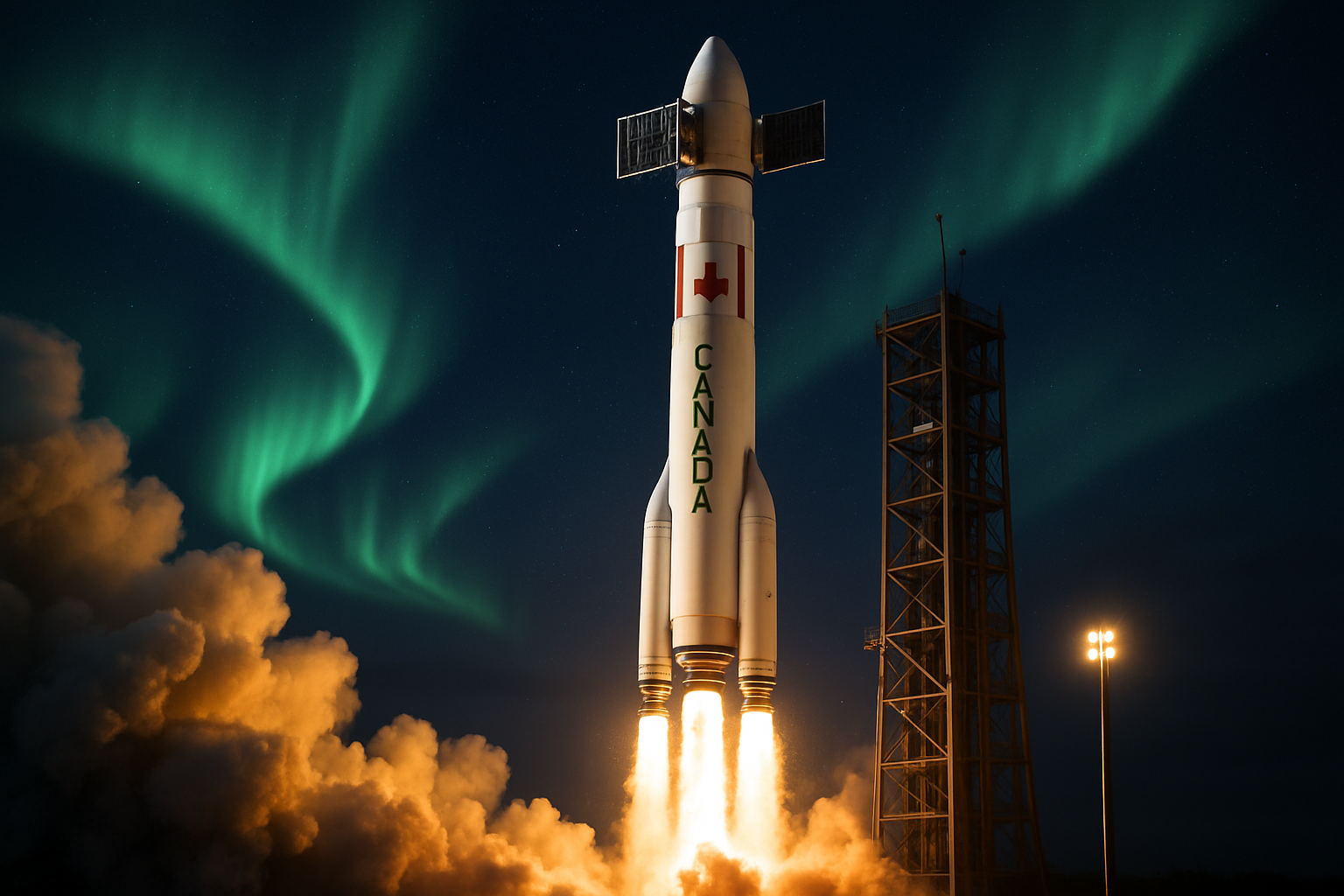
Canada has announced a transformational $200 million investment to enable sovereign satellite launches, marking the latest expansion of the nation's ambitious space and defense strategy amid intensifying Arctic geopolitical tensions and global space competition.
The funding, distributed through the government's launch grant program, will support three Canadian companies in developing domestic satellite launch capabilities. This initiative represents a critical component of Canada's broader push for technological sovereignty and reduced dependence on foreign space infrastructure during what experts describe as the "space economy golden age."
Strategic Context: Building on Defense Industrial Strategy
This investment builds upon Prime Minister Mark Carney's groundbreaking February 2026 Defense Industrial Strategy, which allocated $6.6 billion toward Canadian defense capabilities with a "Build-Partner-Buy" framework prioritizing domestic manufacturing. The space investment further reinforces Canada's commitment to achieving 5% GDP military spending by 2035, far exceeding NATO's 2% target.
The announcement comes as Canada faces unprecedented Arctic pressures from multiple directions. Russian military activity in the polar region has increased by 23% since Finland and Sweden joined NATO, while climate change continues to open new shipping routes and resource extraction opportunities that are attracting global attention.
"Canada can no longer rely on others for security in our strategically vital Arctic region. This space investment ensures we have the sovereign capabilities needed to monitor and protect our northern territories."
— Government spokesperson
Arctic Sovereignty and Space Capabilities
The timing of this investment is particularly significant given Canada's leading role in NATO's Arctic Sentry mission, launched in February 2026 as the alliance's most comprehensive Arctic security response in decades. The mission addresses Russian re-establishment of Cold War-era bases and systematic Arctic military infrastructure restoration.
Canada's space capabilities will be crucial for Arctic monitoring, providing real-time surveillance of shipping routes, military activities, and environmental changes in regions where traditional ground-based monitoring is impossible. The harsh Arctic environment - with temperatures reaching -70°C and winds exceeding 200 km/h - demands sophisticated satellite technology for effective coverage.
This investment aligns with Canada's historic $35 billion Arctic defense expansion announced in March 2026, which included climate-resilient infrastructure, enhanced icebreaker capabilities, and specialized military equipment designed for extreme northern conditions.
Global Space Economy Context
The Canadian investment comes during what industry analysts describe as humanity's transition from the "AI revolution to space economy golden age." SpaceX is preparing for a potentially trillion-dollar IPO in June 2026, while space-based infrastructure is rapidly evolving from experimental to essential for modern civilization.
International space competition has intensified dramatically, with China advancing its Shenlong program, Pakistan selecting astronaut candidates for China's Tiangong space station, and European nations pursuing launch independence through facilities like Germany's Isar Aerospace expansion in Sweden.
The global space economy is projected to exceed $1 trillion by 2030, with countries investing heavily in space capabilities to position themselves for leadership in emerging markets. Canada's sovereign launch capabilities will ensure the nation can deploy and maintain critical satellite infrastructure without depending on foreign launch services.
Technology and Innovation Focus
The three companies receiving funding will focus on developing small satellite launch capabilities, addressing the growing demand for rapid deployment of specialized satellites for communications, Earth observation, and defense applications. This approach reflects the democratization of space technology, where smaller nations and companies can achieve significant capabilities without massive infrastructure investments.
Canada's space sector has demonstrated remarkable innovation, building on expertise from the Canadarm robotics program and contributions to the International Space Station. Canadian astronaut Jeremy Hansen's selection for NASA's Artemis II lunar mission - the first crewed mission beyond Earth orbit since Apollo 17 in 1972 - showcases the nation's space expertise on the global stage.
The investment will also support development of Arctic-specific satellite technologies, including systems designed to operate reliably in extreme magnetic field conditions and provide continuous coverage of polar regions where traditional satellite constellations have gaps.
Economic and Employment Impact
Beyond defense applications, the space investment is expected to create substantial economic opportunities. The initiative complements the Defense Industrial Strategy's goal of generating 125,000 new jobs over ten years, with space technology positions among the highest-value employment opportunities in the modern economy.
Canadian companies will gain access to growing international markets for satellite services, positioning the nation as a reliable partner for space-based infrastructure during a period of global supply chain restructuring. The investment also reduces Canada's vulnerability to disruptions in foreign launch services, ensuring continued access to space during potential international tensions.
Regional economic benefits will extend across Canada, with space technology development supporting high-tech manufacturing, advanced materials research, and specialized engineering services that benefit multiple industries.
International Cooperation and Competition
While pursuing sovereign capabilities, Canada continues to strengthen international partnerships through initiatives like the Artemis Accords and bilateral space cooperation agreements. Recent partnerships with Norway demonstrate how middle-power nations can coordinate space capabilities while maintaining strategic independence.
The investment occurs amid complex global space dynamics, where commercial companies like SpaceX wield significant geopolitical influence - demonstrated by the company's blocking of Russian Starlink military use in Ukraine. Canada's sovereign launch capabilities provide insurance against potential disruptions in commercial space services during international crises.
European allies are pursuing similar technological sovereignty initiatives, with Germany investing €10 billion in the SATCOMBw 4 satellite system and multiple nations developing independent launch capabilities to reduce dependence on American and Chinese space infrastructure.
Environmental and Safety Considerations
The Canadian space program will incorporate environmental safeguards addressing growing concerns about space debris and atmospheric pollution from rocket launches. Recent Austrian research documented significant atmospheric contamination from rocket debris, including tenfold elevated lithium concentrations.
Canada's approach emphasizes sustainable space development, incorporating debris mitigation technologies and supporting international efforts to manage the growing challenge of orbital congestion. With over 34,000 tracked objects currently orbiting Earth, responsible space development is essential for maintaining long-term access to orbital regions.
Future Implications
This $200 million investment represents a foundational step toward comprehensive Canadian space capabilities that will support both immediate security needs and long-term economic opportunities. As space infrastructure becomes increasingly essential for communications, navigation, weather forecasting, and defense, sovereign launch capabilities provide Canada with strategic flexibility and reduced foreign dependence.
The program establishes Canada as a significant player in the emerging space economy while supporting the nation's leadership role in Arctic governance and international security cooperation. Success will influence other middle-power nations considering similar investments in technological sovereignty during an era of intensifying great power competition.
For Canada, the space investment represents more than military capability - it positions the nation for leadership in the industries and technologies that will define the 21st century, ensuring Canadian prosperity and security in an increasingly complex global environment.