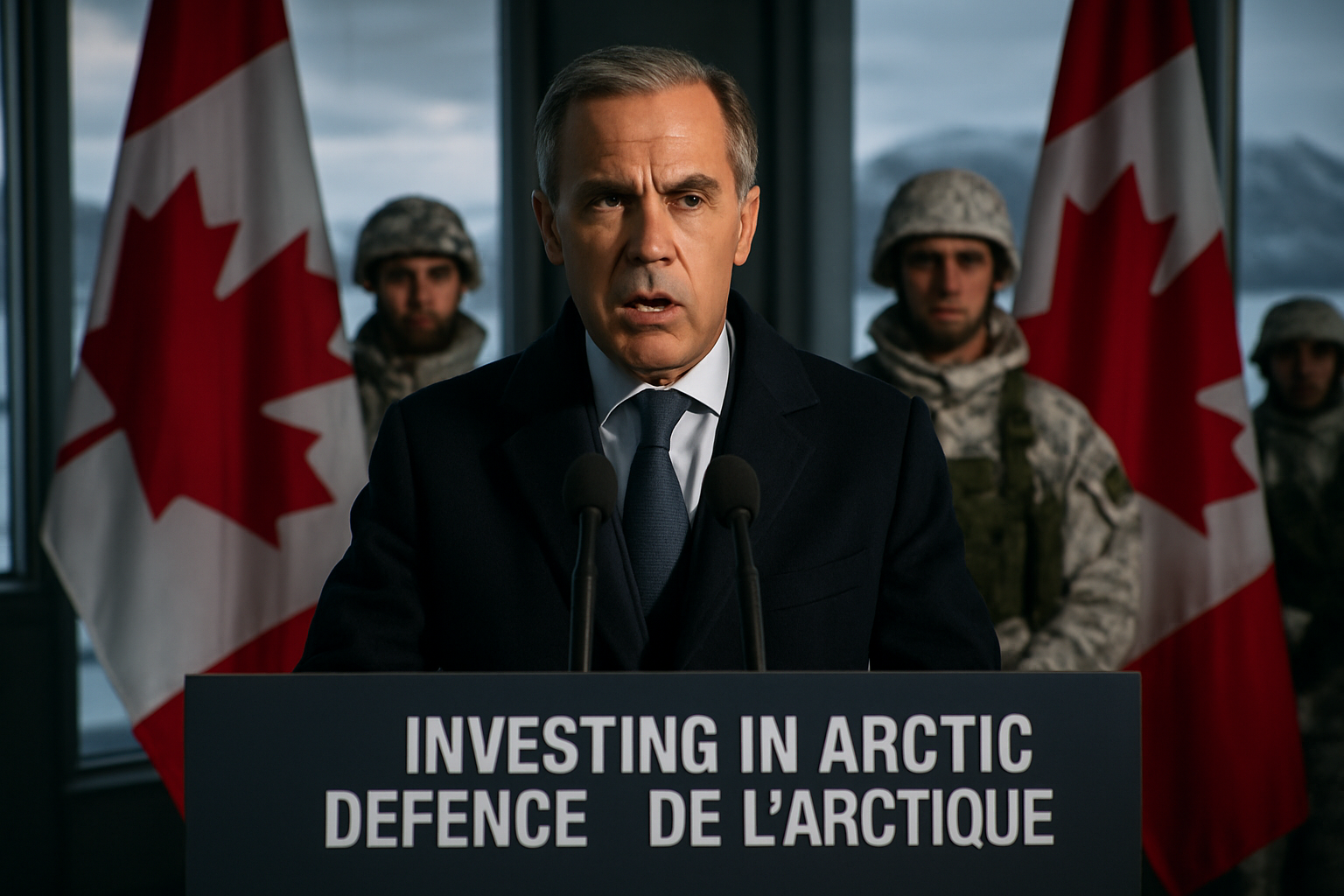
Prime Minister Mark Carney announced Thursday a transformational $35 billion investment in Canada's northern defense and infrastructure, declaring that the nation "can no longer rely on others for security" in the strategically vital Arctic region.
Speaking from Ottawa, Carney unveiled what represents the most significant expansion of Canadian military presence in the Arctic since the Cold War, building upon his government's earlier $6.6 billion Defense Industrial Strategy announced in February. The announcement comes as the Arctic region faces unprecedented geopolitical pressures from multiple global powers seeking to establish dominance in the climate-changed North.
Strategic Shift Toward Self-Reliance
The massive investment package signals Canada's determination to assert sovereignty over an Arctic territory larger than India but almost completely uninhabited. "Canada has traditionally relied on U.S. help to monitor the Canadian Arctic," acknowledged international observers, but Carney's announcement represents a decisive break from this historical dependence.
The timing is particularly significant as it follows mounting international tensions over Arctic sovereignty. Just weeks ago, the Trump administration has maintained pressure on Denmark regarding Greenland, while Russia has systematically reopened Cold War-era Arctic military bases. China has also expanded its Arctic research activities, intensifying the great power competition for influence in the region.
The investment builds directly upon Canada's Defense Industrial Strategy, which committed to shifting 70% of defense contracts to Canadian companies by 2035, reversing the current allocation that sees 70% of contracts going to American suppliers. This "Build-Partner-Buy" framework now extends to Arctic-specific capabilities, representing what defense analysts call the most significant transformation of Canada's defense posture since World War II.
Comprehensive Arctic Modernization
The $35 billion package encompasses multiple dimensions of Arctic security and infrastructure development. Central to the plan is the modernization of Canada's northern surveillance capabilities, including advanced radar systems, satellite networks, and maritime monitoring infrastructure capable of operating in extreme Arctic conditions.
The investment addresses critical gaps in Canada's northern infrastructure that have been exposed by climate change. Traditional permafrost-dependent construction methods are failing as Arctic temperatures rise, requiring complete rethinking of engineering approaches for roads, airfields, and communication systems. The package includes substantial funding for adaptive construction technologies and climate-resilient infrastructure design.
"This investment represents Canada's commitment to defending our sovereignty while adapting to the realities of a changing Arctic environment."
— Defense analyst, speaking on condition of anonymity
Military components include enhanced icebreaker capabilities, Arctic-specific equipment for Canadian Armed Forces, and expanded northern training facilities. The plan calls for significant increases in military personnel stationed in the North, along with specialized training programs for extreme weather operations.
International Context and Timing
Carney's announcement comes during a period of extraordinary international focus on Arctic security. NATO has launched its Arctic Sentry mission, described as the alliance's most comprehensive Arctic security response since the Cold War. European allies have taken unprecedented leadership roles, with the United Kingdom doubling its troop presence in Norway from 1,000 to 2,000 soldiers over three years, while Sweden has deployed Gripen fighter jets for Greenland exercises.
The announcement also follows Canada's successful diplomatic initiatives, including the historic opening of consulates in Nuuk, Greenland, alongside France in a coordinated show of support for Danish sovereignty against American territorial pressure. This diplomatic solidarity has strengthened Canada's position as a leader in Arctic sovereignty defense.
Finland's recent decision to lift its comprehensive ban on nuclear weapons "as soon as possible" adds another layer of complexity to Arctic security calculations. Nordic countries are increasingly viewing enhanced military capabilities as essential for deterring potential aggression in the region.
Economic and Industrial Impact
The investment is expected to create substantial employment opportunities across Canada, particularly in northern communities and defense-related industries. Building upon the success of the Defense Industrial Strategy, which promised 125,000 new jobs over ten years, the Arctic investment will create additional specialized positions in northern construction, military technology, and surveillance systems.
Regional economic impacts will be particularly significant for northern Canada, where infrastructure investment has historically lagged behind southern provinces. The package includes provisions for Indigenous community involvement in both construction and ongoing operations, recognizing the vital role of northern residents in Arctic security.
The investment also advances Canada's goal of reducing dependence on foreign military suppliers. By 2035, Canada aims to achieve 5% of GDP in military spending, exceeding NATO's 2% target, while maintaining domestic industrial capacity for critical defense needs.
Climate Change and Arctic Access
Climate change has fundamentally altered Arctic geopolitics by opening new shipping routes and exposing previously inaccessible natural resources. The Northwest Passage, long impassable except during brief summer periods, is becoming increasingly navigable, creating new security challenges for Canadian sovereignty.
The investment recognizes that traditional approaches to Arctic infrastructure are no longer viable. Permafrost thaw has shortened construction seasons while increasing costs, forcing complete rethinking of engineering approaches. The package includes significant research and development funding for construction methods adapted to changing Arctic conditions.
Resource competition has intensified as climate change exposes rare earth minerals and energy resources previously locked beneath Arctic ice. Canada's investment positions the nation to both defend and develop these resources according to Canadian law and environmental standards.
Parliamentary and Political Support
The announcement comes as Carney's Liberal government has strengthened its parliamentary position following the recent floor-crossing of NDP MP Lori Idlout from Nunavut to the Liberal caucus. Idlout's decision was influenced by Arctic sovereignty concerns, Indigenous rights considerations, and climate change policies - exactly the issues addressed by Thursday's announcement.
The timing provides Carney with additional political capital to advance the ambitious Arctic agenda while responding to ongoing international pressures. The investment demonstrates Canada's capacity for sustained, long-term defense planning despite minority government challenges.
International Cooperation and Independence
While emphasizing Canadian self-reliance, the investment package maintains provision for continued cooperation with allies through NATO and bilateral partnerships. However, the emphasis has clearly shifted toward Canadian capability development rather than dependence on allied protection.
The plan includes enhanced intelligence sharing frameworks with Arctic allies, particularly Nordic countries that have recently joined NATO. Finland's operational planning expertise and Sweden's advanced military technology offer opportunities for mutual cooperation while maintaining Canadian independence.
Enhanced coordination with Indigenous Arctic communities across circumpolar regions provides additional diplomatic and security benefits. Canadian Inuit communities have been particularly vocal in defending Arctic sovereignty against external pressure, as demonstrated during recent Greenland solidarity initiatives.
Implementation Timeline and Challenges
The $35 billion investment will be phased over the next decade, with initial funding focusing on immediate infrastructure needs and capability gaps. Early priorities include communication systems upgrades, transportation infrastructure repairs, and enhanced surveillance capabilities.
Implementation challenges include the extreme difficulty of Arctic construction, limited transportation access to remote sites, and the need for specialized equipment capable of operating in temperatures as low as minus-40°C. The timeline accounts for these realities while maintaining urgency appropriate to the evolving security environment.
Workforce development represents another significant challenge, requiring extensive training programs for both military personnel and civilian contractors. The investment includes substantial funding for northern colleges and training facilities to develop the specialized expertise required for Arctic operations.
Future Implications
Thursday's announcement positions Canada as a leader in Arctic security while setting precedents for middle-power responses to great power competition in strategically vital regions. The investment demonstrates that medium-sized nations can develop independent defense capabilities without abandoning alliance relationships.
Success of the Arctic investment will influence similar initiatives by other circumpolar nations facing comparable security challenges. Norway, Denmark, and Iceland are all reassessing their Arctic defense postures in response to changing geopolitical conditions.
The long-term implications extend beyond military considerations to economic development, environmental protection, and Indigenous rights. Canada's approach emphasizes sustainable development of Arctic resources while maintaining security against potential threats.
As Prime Minister Carney stated Thursday, the investment represents "a new chapter in Canadian Arctic policy," one that prioritizes national capability while maintaining international cooperation. The success or failure of this ambitious undertaking will influence Arctic geopolitics for decades to come, establishing Canada either as a model for middle-power security policy or as a cautionary tale about the limits of national self-reliance in an interconnected world.