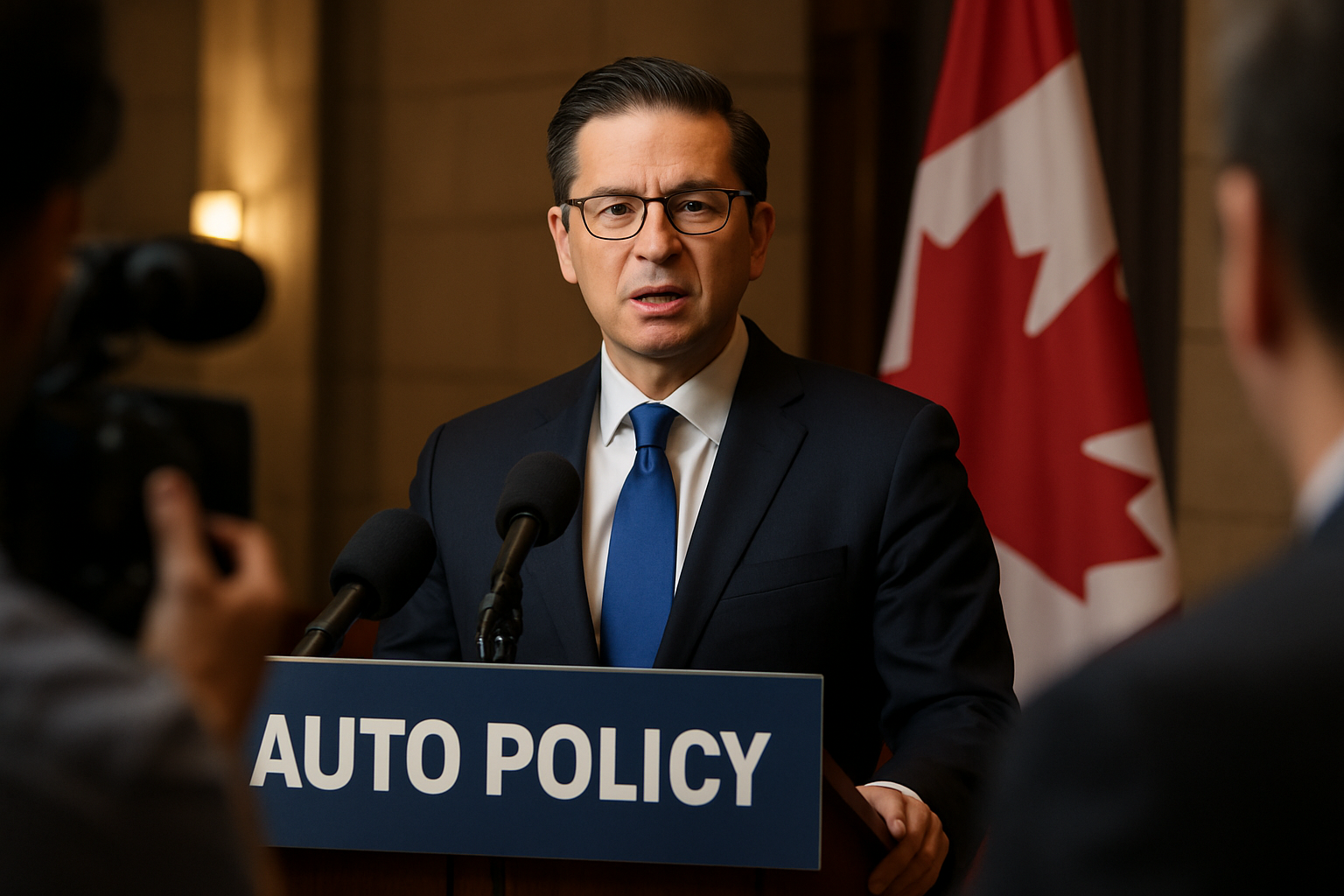
Conservative Leader Pierre Poilievre unveiled an ambitious new automotive strategy on March 15, 2026, designed to secure tariff-free access to the U.S. market, while Prime Minister Mark Carney simultaneously positioned Canada as a reliable alternative oil supplier during ongoing Middle East tensions.
Speaking at a press conference in Windsor, Ontario—the heart of Canada's automotive manufacturing—Poilievre outlined a comprehensive plan that would remove the GST from Canadian-made vehicles, end federal electric vehicle subsidies, and ban the use of Chinese or Russian-connected software in automotive systems. The announcement comes as Canada faces mounting pressure to navigate increasingly complex U.S.-Canada trade relations amid constitutional crises south of the border.
Strategic Automotive Overhaul
Poilievre's proposal represents a fundamental shift in Canada's automotive policy approach, emphasizing competitiveness and security over environmental mandates. The plan would eliminate the federal GST on vehicles manufactured in Canada, potentially reducing costs for consumers while making Canadian production more attractive to automakers.
"We will make Canada the most competitive jurisdiction for automotive manufacturing in North America," Poilievre declared, flanked by local Members of Parliament including Kathy Borrelli, Harb Gill, and Chris Lewis. The Conservative leader emphasized that the policy would create jobs while ensuring Canadian automotive systems remain secure from foreign interference.
The ban on Chinese and Russian-connected automotive software reflects growing cybersecurity concerns, particularly as vehicles become increasingly connected and autonomous. This approach aligns with broader Western efforts to reduce dependence on potentially hostile nations for critical technology infrastructure.
Oil Diplomacy and Energy Security
Meanwhile, Prime Minister Carney has been leveraging Canada's energy resources as a diplomatic tool during his meeting with Norwegian Prime Minister Jonas Gahr Store in Oslo. Carney emphasized that both Canada and Norway represent "low-risk oil producers" capable of contributing additional supply to global energy markets amid disruptions from the ongoing Iran conflict.
The timing of Carney's energy diplomacy is particularly significant given the volatile state of global oil markets following Operation Epic Fury, the largest coordinated U.S.-Israeli military operation since the 2003 Iraq invasion. With oil prices surging over $80 per barrel due to Iran's closure of the Strait of Hormuz—which handles 40% of global oil transit—Canada's stable production capacity has become increasingly valuable to international partners.
"Canada and Norway can contribute more supply to energy in the midst of impacts on oil markets," Carney stated during the Oslo meeting, highlighting the strategic importance of reliable democratic partners in global energy security.
— Prime Minister Mark Carney
Economic Context and Trade Tensions
These dual announcements come against the backdrop of unprecedented U.S.-Canada trade uncertainty. The relationship has been severely strained following President Trump's escalation to 15% global tariffs after the U.S. Supreme Court struck down his original tariff program in February 2026. The constitutional crisis that followed—described as the most serious executive-judicial confrontation since Watergate—has created an unpredictable environment for Canadian trade policy.
Canada has already experienced significant economic pressure, with devastating job losses of 84,000 positions in February 2026, pushing unemployment to 6.7%. This represents one of the worst monthly losses outside the pandemic era, highlighting the vulnerability of the Canadian economy to both domestic policy decisions and international trade disruptions.
The U.S. House of Representatives' 219-211 vote to end Canada tariffs—with six Republican defections—provided some hope for improved bilateral relations. However, the narrow margin and ongoing constitutional uncertainties in Washington have forced Canadian policymakers to develop more independent strategies.
Strategic Implications
Poilievre's automotive strategy and Carney's energy diplomacy represent two complementary approaches to reducing Canada's economic vulnerability. The automotive plan seeks to make Canadian manufacturing more competitive and secure, potentially reducing dependence on volatile trade relationships. Meanwhile, the energy diplomacy leverages Canada's natural advantages to build stronger relationships with allies facing supply disruptions.
The emphasis on excluding Chinese and Russian technology from Canadian automotive systems reflects broader concerns about supply chain security that have intensified since the global chip shortages and recent constitutional crises. With memory chip prices increasing sixfold due to shortages affecting Samsung, SK Hynix, and Micron, the importance of secure, diversified supply chains has become paramount.
Opposition Response and Implementation Challenges
The Conservative automotive plan faces significant implementation challenges, particularly regarding the removal of EV subsidies, which conflicts with Canada's climate commitments. Critics argue that eliminating electric vehicle support could undermine Canada's transition to clean energy and damage relationships with environmentally conscious trading partners.
However, Poilievre's approach reflects growing concerns about the economic costs of rapid environmental transitions during a period of economic uncertainty. The plan attempts to balance competitiveness with security concerns while potentially sacrificing some environmental objectives.
Prime Minister Carney's energy diplomacy, while less controversial domestically, faces the challenge of balancing increased oil production with Canada's climate goals. The approach of positioning Canada as a "low-risk" alternative supplier acknowledges that during international crises, energy security often takes precedence over environmental concerns.
International Dimensions
The broader international context makes these policies particularly significant. With the Iran conflict creating massive disruptions to global energy markets and the U.S. facing constitutional crises that affect trade policy predictability, Canada is positioning itself as a stable, reliable partner for both automotive manufacturing and energy supply.
Norway's parallel positioning as a "low-risk" oil producer alongside Canada suggests a coordinated strategy among democratic allies to provide alternatives to unstable or hostile suppliers. This approach has gained urgency as China continues to expand its influence through initiatives like zero-tariff access to 53 African countries, announced for May 2026.
Future Outlook
The success of both strategies will depend heavily on external factors, particularly the resolution of U.S. constitutional and trade policy uncertainties. The 150-day countdown on Trump's Section 122 tariff authority creates a critical window for Canadian policymakers to advance their agenda while American policy remains in flux.
For the automotive sector, the key test will be whether removing GST and ending EV subsidies can sufficiently boost competitiveness to offset potential tariff impacts. The security aspects of banning Chinese and Russian software may prove popular with U.S. policymakers, potentially easing trade tensions.
The energy strategy's effectiveness will depend on global conflict resolution and the ability to balance increased production with environmental commitments. Canada's positioning as a reliable democratic supplier could prove valuable as international partners seek to reduce dependence on unstable regions.
As both Poilievre and Carney navigate these complex challenges, their dual approach reflects a broader Canadian strategy of enhancing economic independence while strengthening relationships with democratic allies during a period of unprecedented global uncertainty.