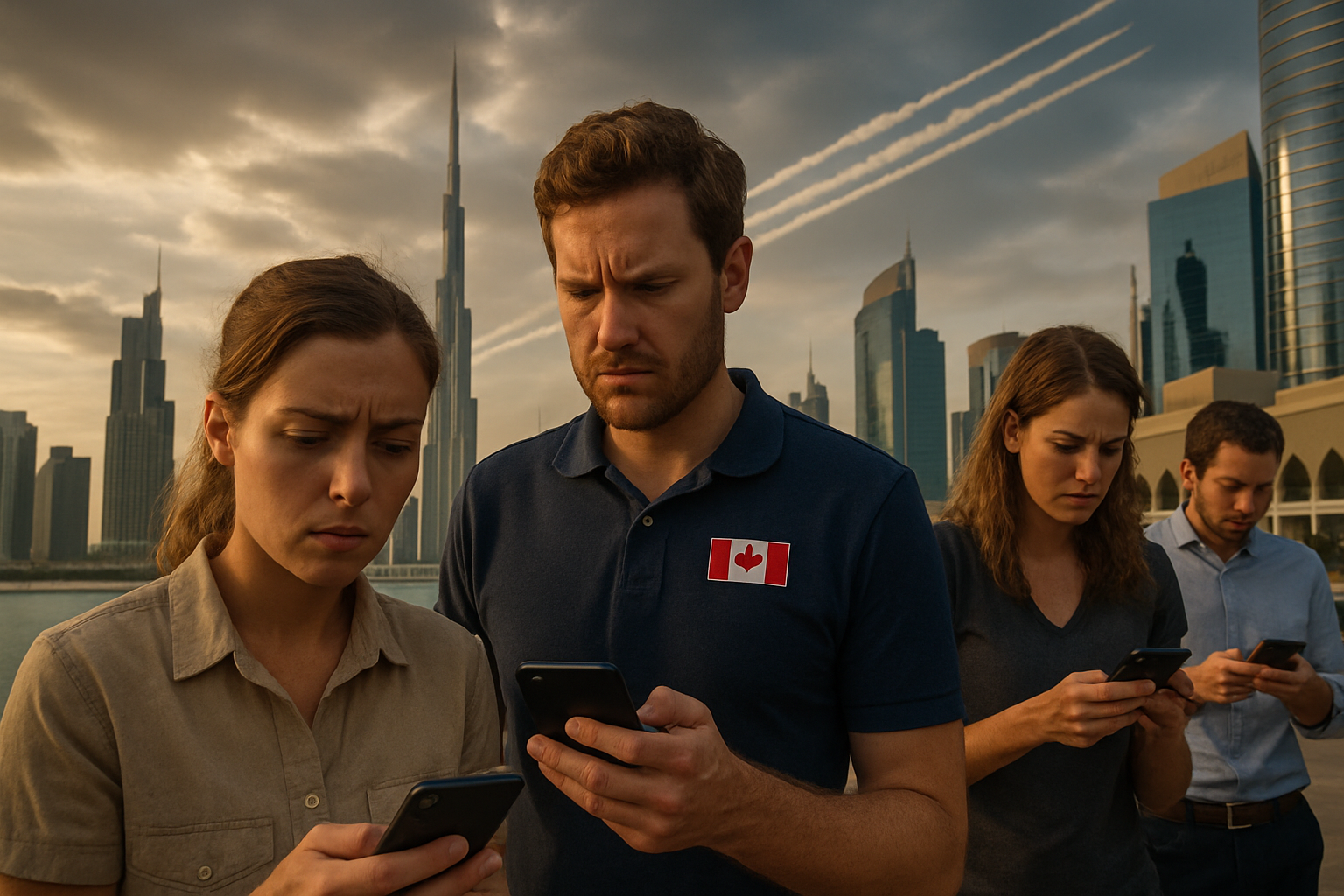
Canadian expats and travelers scattered across the Persian Gulf region say they are living under the constant shadow of missile and drone strikes, but are taking solace in what they describe as highly effective air-defence systems that have so far kept them safe from harm.
The testimonies come as the Middle East experiences its most dangerous crisis since the Cold War ended, with thousands of Canadians caught in the crossfire of escalating tensions between Iran and the United States. Following the confirmed death of Iranian Supreme Leader Ali Khamenei in coordinated US-Israeli "Operation Epic Fury" strikes, the region has witnessed an unprecedented wave of retaliatory attacks that have tested missile defense systems across multiple Gulf nations.
Living by the Grace of Defense Systems
Canadian nationals in countries including the United Arab Emirates, Qatar, Kuwait, and Bahrain report that sophisticated Patriot missile systems and other air defense technologies have become their lifeline as Iran's Islamic Revolutionary Guard Corps (IRGC) declared "no red lines remain" in their systematic targeting of US facilities and Gulf allies.
The reality of this protection became starkly apparent during Iran's massive "Operation True Promise 4" retaliation campaign. In Qatar alone, defense systems successfully intercepted 65 missiles and 12 drones, though fragments from the interceptions still resulted in eight people being injured. Similar scenarios played out across the region, with Kuwait Airport suffering direct drone strikes that injured 32 foreign nationals, including several Canadians working in the Gulf's thriving expatriate economy.
One Canadian contractor working in Dubai, who spoke on condition of anonymity due to security concerns, described the surreal experience of watching missile defense systems in action. "You hear the sirens, then the interceptions in the sky. These systems are literally keeping us alive," he said. "But you can't help but think about what would happen if just one got through."
A Region Under Siege
The current crisis represents the culmination of months of failed diplomacy. Despite achieving what Iranian Foreign Minister Abbas Araghchi called "broad agreement on guiding principles" in Geneva talks—the most significant progress since the 2018 JCPOA collapse—fundamental disagreements over Iran's ballistic missile program and regional proxy network proved insurmountable.
The breakdown led to the largest coordinated US-Israeli military operation since the 2003 Iraq invasion, utilizing a dual-carrier deployment that positioned the USS Gerald R. Ford and USS Abraham Lincoln approximately 800 kilometers from Iran's coast. The operation resulted in confirmed casualties among Iranian leadership, including Defense Minister Nasirzadeh and IRGC Chief Pakpour, along with over 40 senior officials.
For Canadians in the region, the military escalation has created an environment where normal life continues alongside constant vigilance. Dubai International Airport, the world's busiest with over 86 million passengers annually, remains completely shut down after sustaining missile damage, stranding hundreds of thousands of travelers worldwide and severing critical Europe-Asia transportation links.
The Economics of Danger
The Persian Gulf crisis has profound implications for Canada's economic interests in the region. The Gulf states handle approximately 40% of global seaborne oil transit through the Strait of Hormuz, which Iran has declared "unsafe" as part of its retaliation strategy. Oil prices have surged 10% to over $80 per barrel, while natural gas prices have increased 24% in Europe and 78% in the United States.
Major shipping companies including Maersk and MSC have suspended Persian Gulf operations, leaving over 150 oil and LNG tankers anchored and representing billions in stranded cargo. This disruption extends far beyond energy markets, affecting global supply chains that depend on Middle Eastern trade hubs.
"We're witnessing the most comprehensive regional crisis since the 1991 Gulf War, but with far more sophisticated weapons systems and higher economic stakes."
— Defense analyst at the Canadian Global Affairs Institute
The aviation industry has suffered unprecedented disruption, with over 18,000 flights cancelled worldwide as Iran, Iraq, Israel, UAE, Qatar, Syria, Kuwait, and Bahrain simultaneously closed their airspace. This represents the most extensive aviation disruption since the COVID-19 pandemic, affecting major carriers including Emirates, Air France-KLM, Wizz Air, and Bulgaria Air.
Canada's Response and Evacuation Preparations
While Canada has not issued official evacuation orders for its citizens in the Persian Gulf, the government has been closely monitoring the situation and providing consular support. Defense Minister Bill Blair confirmed that Canadian military personnel in the region have been moved "out of harm's way," though he declined to provide specific details about their relocation.
The Canadian approach contrasts with more immediate responses from other nations. Sweden and Serbia have ordered immediate evacuations from Iran, citing "extremely uncertain" security conditions. The United States has authorized the departure of non-essential personnel from Israel and closed its embassy in Kuwait indefinitely. Meanwhile, European nations including Cyprus have activated unprecedented evacuation protocols, with Cyprus implementing its ESTIA plan for the first time.
Canadian nationals in the Gulf report receiving regular updates from consular services, with embassy staff advising them to maintain emergency preparations and avoid non-essential travel. Many describe a community that has grown closer as they share information about safe areas and evacuation routes.
The Human Cost of Regional Instability
Beyond the immediate security concerns, Canadian expatriates and their families are grappling with the psychological impact of living in a conflict zone. The crisis has particularly affected the large Canadian expatriate community working in Dubai's financial sector, Abu Dhabi's energy industry, and Qatar's infrastructure projects related to ongoing World Cup legacy developments.
Iranian retaliatory strikes have resulted in civilian casualties across the region. The UAE confirmed one civilian death in Abu Dhabi from missile debris, while Qatar reported eight injuries from interceptor fragments despite successfully defending against 65 missiles and 12 drones. The most tragic incident occurred at a school in Minab, Iran, where an attack killed between 53 and 85 students and staff during regular school hours, drawing international condemnation as a "barbaric crime."
The crisis has also exposed the vulnerability of modern transportation and communication networks to geopolitical tensions. With Russian and Ukrainian airspace already closed due to ongoing conflict, the simultaneous closure of Middle Eastern airspace has forced airlines to develop complex rerouting strategies, often involving Caribbean stopovers for trans-Pacific flights and dramatically increased operational costs.
Nuclear Implications and Long-term Concerns
The current crisis unfolds against the backdrop of a broader nuclear governance breakdown. The New START treaty between the United States and Russia expired on February 5, marking the first time in over 50 years that the two nuclear superpowers operate without arms control constraints. Combined with China's nuclear expansion and Iran's continued uranium enrichment at 60% purity—approaching the 90% weapons-grade threshold—UN Secretary-General António Guterres has warned that nuclear risks are at their "highest in decades."
Intelligence assessments suggest Iran possesses over 400 kilograms of uranium enriched to 60%, making nuclear weapons capability "easily achievable" according to former IAEA inspector Dr. Yusri Abu Shadi. This nuclear dimension adds urgency to the regional crisis, as failure to contain the conflict could accelerate military solutions that reshape Middle Eastern geopolitics for decades.
Looking Ahead: Uncertain Recovery
Unlike natural disasters or technical disruptions, the recovery timeline for the Persian Gulf crisis depends entirely on political and military developments. Aviation industry officials conduct daily reviews but cannot make long-term scheduling decisions due to the unpredictable nature of the conflict. The template-setting implications of this crisis will influence how the international community approaches similar challenges in the 21st century's multipolar world order.
For Canadians in the Persian Gulf, the immediate focus remains on personal safety while maintaining hope for diplomatic resolution. The effectiveness of regional missile defense systems has provided crucial protection, but the underlying tensions that triggered this crisis—encompassing nuclear proliferation, territorial disputes, and energy security—require innovative diplomatic solutions that bridge decade-old disagreements.
The coming weeks will determine whether this crisis can be contained as a regional confrontation or escalates into broader Middle Eastern warfare with global implications affecting energy markets, supply chains, and international stability mechanisms. For the thousands of Canadians who call the Persian Gulf home, the stakes could not be higher as they continue living by the grace of missile defense systems in one of the world's most strategically vital regions.