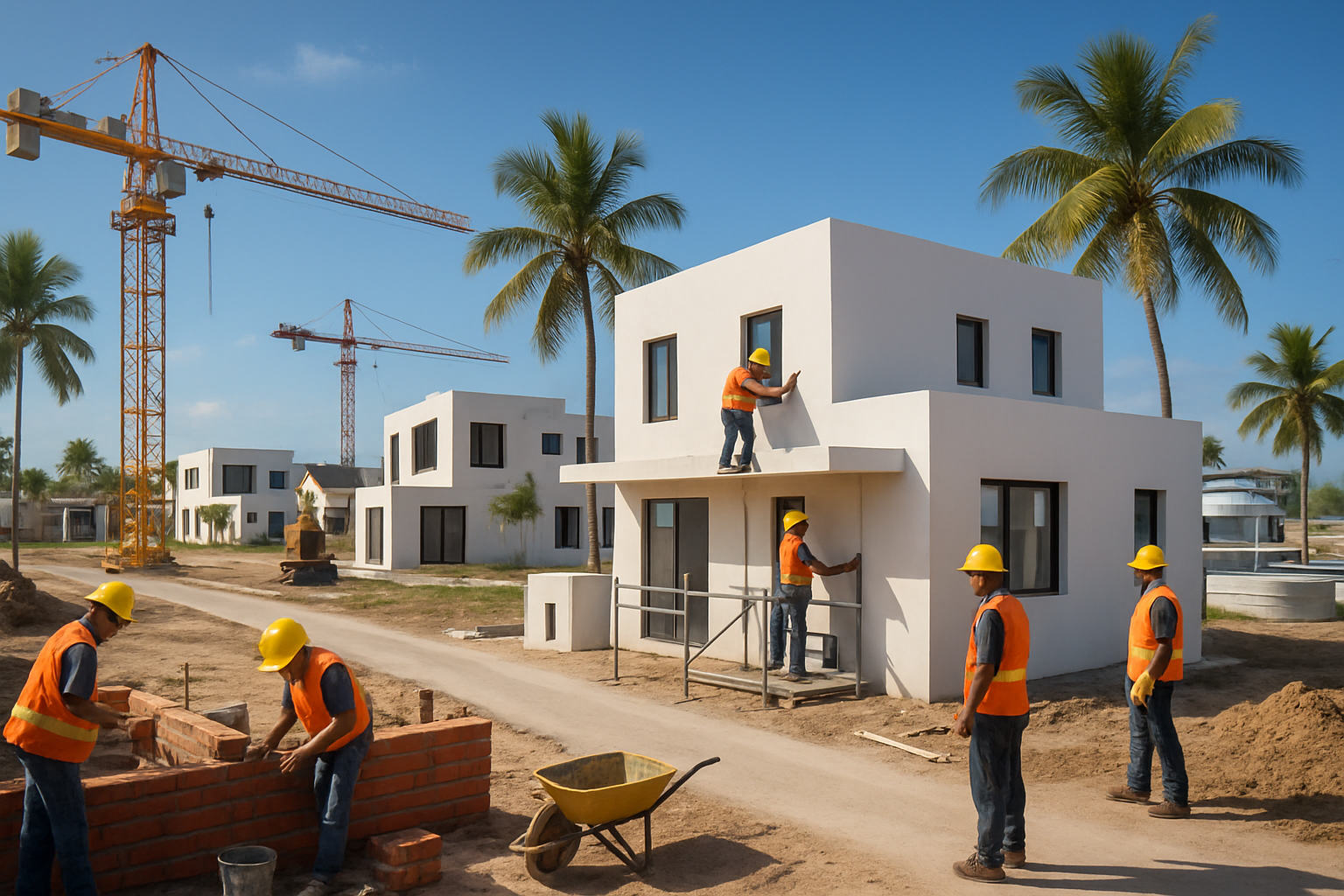
Caribbean nations are accelerating ambitious infrastructure development programs as governments across the region implement comprehensive strategies to modernize housing, water systems, and financial services, signaling a coordinated effort to strengthen economic resilience and improve community welfare.
From Barbados' unprecedented housing commitments to Saint Vincent's multi-million-dollar water security investments, the Caribbean is experiencing a development renaissance that builds on previous regional infrastructure successes while addressing contemporary challenges of climate adaptation and economic diversification.
Barbados Launches Historic Housing Initiative
The Barbados government has unveiled its most ambitious housing program in recent memory, committing to deliver 10,000 housing solutions over the next five years through an innovative public-private sector partnership. The initiative represents a fundamental shift toward high-density development strategies designed to maximize land use efficiency on the island nation.
Deputy General Manager of the National Housing Corporation, Raymond Lorde, confirmed that the Ministry of Housing, Lands and Maintenance is currently advancing over 53 housing projects across the island. The program aims to deliver at least 2,000 units annually, utilizing innovative construction approaches including duplexes, townhouses, and apartment buildings to achieve densities of 14 to 18 houses per acre.
"This density strategy allows us to house more families while preserving precious land resources for other development priorities."
— Raymond Lorde, Deputy General Manager, National Housing Corporation
The housing surge includes the revival of previously stalled projects, most notably the Hope Housing Project at Pool Lands in St. John, which Minister of Housing Christopher Gibbs pledged will resume construction within the first quarter of 2026. The project, abandoned for several years due to legal complications over land ownership, has become a symbol of the government's renewed commitment to addressing housing shortages.
Saint Vincent Advances Water Security Infrastructure
Prime Minister Dr. Godwin Friday of Saint Vincent and the Grenadines announced a proposed US$50 million climate resilience and water infrastructure project led by the Caribbean Community Climate Change Centre. The comprehensive initiative aims to strengthen water security across the island nation, with particular focus on climate-vulnerable northeastern communities.
The announcement, made during Cabinet proceedings on March 3, 2026, represents one of the largest single infrastructure investments in the nation's recent history. The groundwater-based project emphasizes climate resilience integration, acknowledging the increasing unpredictability of traditional water sources due to changing weather patterns.
This water security initiative builds upon documented regional trends toward comprehensive infrastructure planning that addresses multiple challenges simultaneously. The project's emphasis on climate adaptation reflects broader Caribbean recognition that traditional infrastructure approaches must evolve to accommodate environmental volatility.
Banking Sector Modernization Reflects Broader Trends
The region's development momentum extends to financial services infrastructure, as evidenced by Republic Bank Barbados' strategic consolidation initiative. The bank will close two existing branches—Worthing in Christ Church and Wildey in St. Michael—to establish a new, modern facility at Coconut Walk, Rockley.
Republic Bank officials describe the consolidation as designed to "streamline operations, boost efficiency, and offer customers a more seamless banking experience while still delivering personalised service." The move reflects broader regional trends toward modernizing financial infrastructure to serve evolving community needs more effectively.
Regional Context and Historical Precedents
These development initiatives occur within a documented Caribbean infrastructure renaissance that has gained momentum throughout early 2026. Historical context from regional memory reveals similar coordinated development efforts, including the Afreximbank commitment to increase Caribbean investment allocation from $3 billion to $5 billion USD, announced in early March 2026.
The current wave of projects demonstrates sophisticated evolution from earlier development models. Unlike previous decades' emphasis on individual project implementation, contemporary Caribbean development emphasizes integrated approaches addressing housing, water, financial services, and climate adaptation simultaneously.
Economic and Strategic Implications
The coordinated development initiatives represent more than infrastructure improvements—they signal strategic positioning for enhanced economic resilience. Barbados' housing density strategy addresses land scarcity while creating construction employment. Saint Vincent's water infrastructure investment provides foundation for agricultural diversification and tourism sector stability.
Regional development experts note these projects' alignment with broader Caribbean economic transformation goals, including enhanced climate adaptation capacity and reduced dependence on traditional economic sectors. The initiatives create multiplier effects through construction employment, improved business environments, and enhanced quality of life attracting investment and tourism.
Implementation Challenges and Success Factors
Despite ambitious goals, the projects face implementation challenges common to small island developing states. Limited technical capacity, financing coordination difficulties, and climate change disruption of construction schedules require adaptive management approaches.
Success factors identified across projects include sustained political commitment, comprehensive stakeholder engagement, integration of traditional knowledge with contemporary engineering solutions, and emphasis on community benefits ensuring long-term sustainability.
The Hope Housing Project's revival illustrates both challenges and opportunities. Years-long legal complications over land ownership demonstrate the complexity of large-scale development in Caribbean contexts, while the government's renewed commitment shows institutional capacity for overcoming obstacles.
Future Trajectory and Regional Cooperation
These development initiatives establish precedents for continued Caribbean infrastructure modernization. The combination of Barbados' housing innovation, Saint Vincent's climate-resilient water infrastructure, and banking sector evolution provides templates other Caribbean nations might adapt to local circumstances.
Regional cooperation mechanisms, including the Caribbean Community Climate Change Centre's leadership role in Saint Vincent's water project, demonstrate institutional maturation enabling coordinated responses to shared challenges. Such cooperation models may prove essential as Caribbean nations address common pressures from climate change, economic diversification needs, and infrastructure modernization requirements.
The projects represent a critical juncture in Caribbean development strategy, transitioning from reactive crisis management toward proactive infrastructure building. Success will determine whether small island developing states can achieve sustainable development goals while maintaining cultural identity and environmental stewardship.
As these initiatives progress through 2026, they will likely influence broader regional development patterns and provide valuable lessons for other small island developing states worldwide facing similar challenges of climate adaptation, economic diversification, and infrastructure modernization within resource constraints.