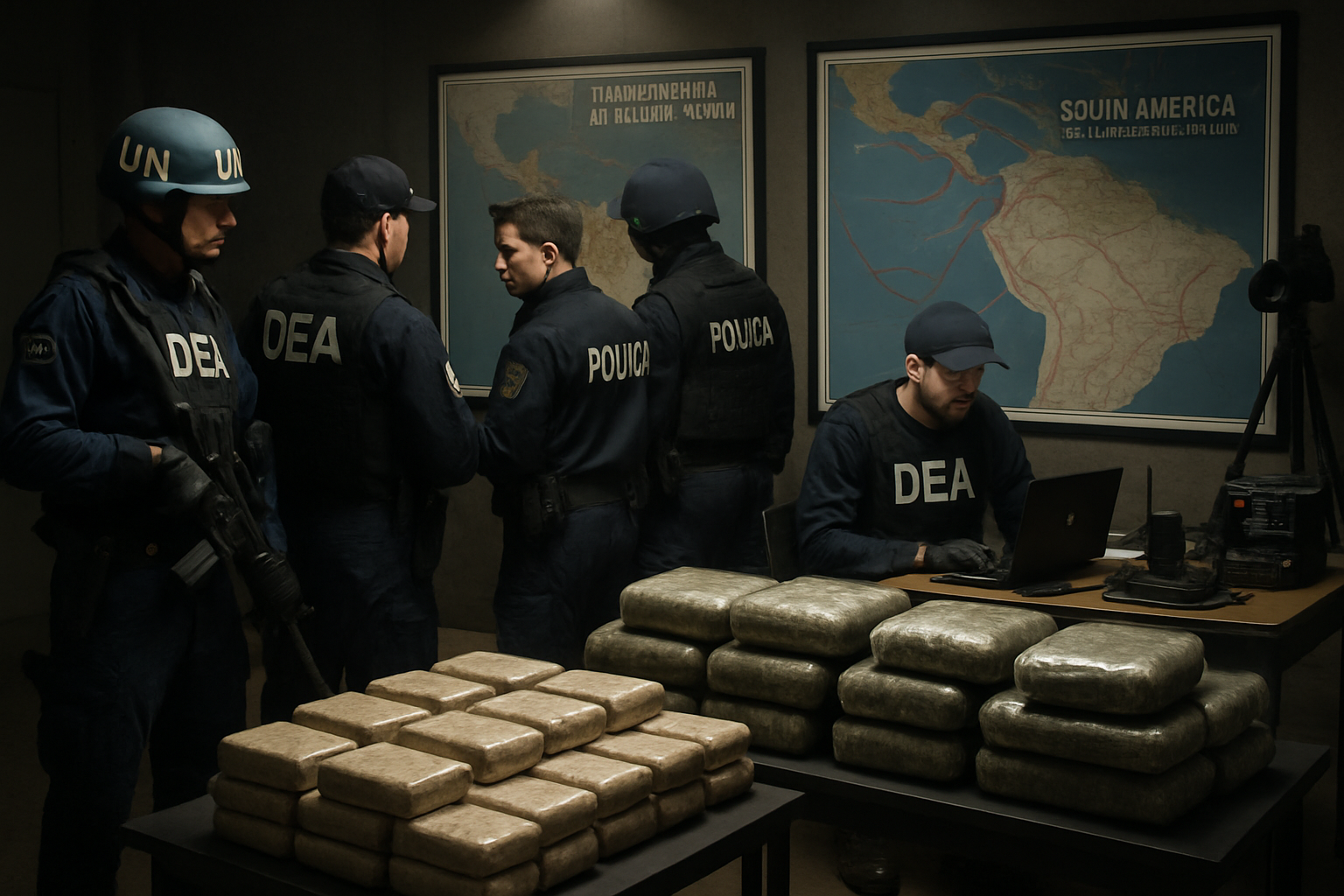
International law enforcement agencies achieved a devastating blow against transnational drug trafficking networks this week, with coordinated operations across the Caribbean and South America resulting in the seizure of over 2,000 pounds of cocaine and marijuana, marking one of the most successful multi-national anti-narcotics campaigns of 2026.
The operations, spanning from Belize to Saint Vincent and the Grenadines, from Bolivia to Colombia, demonstrate unprecedented cooperation between regional law enforcement agencies as they target increasingly sophisticated criminal organizations that have evolved to possess what experts describe as "state-like capabilities."
Massive Seizures Across Multiple Nations
In Belize, authorities achieved a significant victory with the seizure of over 1,200 pounds of cocaine and nearly 1,500 pounds of high-grade marijuana within a two-week period. Chief Executive Officer Elton Bennett of the Ministry of Home Affairs praised Police Commissioner Dr. Richard Rosado's leadership, noting that operations remain ongoing with an additional four kilograms of cocaine confiscated in western Belize just yesterday.
Saint Vincent and the Grenadines recorded what police describe as one of the largest drug seizures in the nation's history, with authorities successfully intercepting over 300 kilograms of cocaine. The operation, conducted by joint Narcotics, Rapid Response, and Special Services units, represents a historic blow against drug trafficking in the region.
Meanwhile, in Bolivia, the Mobile Police Unit for Rural Areas (Umopar) frustrated the departure of an aircraft loaded with more than half a ton of drugs following an armed confrontation with suspected drug traffickers in the Cochabamba Tropic. The operation, conducted in the Minero Llallagua community near the Beni border, intercepted a clandestine airstrip where the aircraft was attempting to take off.
Armed Confrontations and Operational Complexity
The Bolivian operation highlighted the increasing militarization of drug trafficking networks. According to official reports, the occupants of the aircraft opened fire to prevent police intervention, leading to an armed exchange. The swift response by Umopar agents successfully neutralized the maneuver and prevented takeoff, resulting in the seizure of more than 500 kilograms of controlled substances.
Two Brazilian nationals were arrested during the operation, along with the confiscation of a vehicle and substantial amounts of chemical precursors used in drug production. This international dimension underscores the global reach of these criminal networks, which operate across multiple borders with sophisticated logistical capabilities.
"These organizations demonstrate advanced surveillance systems, encrypted communications exceeding law enforcement monitoring capabilities, and compartmentalized international structures spanning multiple continents."
— Regional Security Expert
The Evolution of Criminal Networks
The recent seizures come against the backdrop of a documented evolution in criminal network sophistication throughout 2026. Intelligence gathered from previous operations, including the high-profile capture of Sebastian Marset in March 2026, has revealed organizations with capabilities rivaling legitimate state institutions.
These criminal enterprises have developed encrypted communication systems that often exceed law enforcement's ability to monitor, advanced surveillance networks, and international financial operations that exploit legitimate banking systems. The pace of technological adoption by these organizations consistently outpaces the development of law enforcement countermeasures, creating persistent vulnerabilities that require sustained international cooperation.
The current operations are being conducted within the framework of the "Shield of the Americas" coalition, a 17-nation alliance established in March 2026 that enables enhanced intelligence sharing, coordinated operational planning, and real-time communication systems for surgical strikes against criminal leadership.
Regional Transit Routes Under Pressure
The Caribbean region serves as a critical transit corridor for South American narcotics destined for North American and European markets. Criminal organizations have exploited legitimate maritime and aviation infrastructure, using sophisticated concealment methods that require specialized extraction equipment and professional-grade operational security.
The Bolivian operation particularly highlighted the use of modified aircraft and clandestine airstrips, representing a significant investment in infrastructure that demonstrates the substantial financial resources available to these organizations. The discovery of chemical precursors alongside finished drugs indicates not just trafficking but also production capabilities within the operational area.
In Belize, the sustained nature of the seizures over a two-week period suggests authorities have disrupted multiple operational cells within a larger network, rather than isolated incidents. The variety of drugs seized – from high-grade marijuana to cocaine – indicates these organizations operate diverse product lines to maximize market penetration and revenue streams.
International Cooperation Framework
The success of these operations demonstrates the effectiveness of enhanced international cooperation mechanisms developed over the past year. Building on the precedent set by the March 2026 Sebastian Marset capture in Bolivia, law enforcement agencies have developed protocols for real-time intelligence sharing, coordinated operational planning, and joint investigations that transcend traditional jurisdictional boundaries.
European specialized corruption and organized crime courts have provided templates for this cooperation, while the Shield of the Americas coalition has formalized information sharing between Latin American and Caribbean nations. This multilateral approach represents an evolution from reactive bilateral arrangements to proactive strategic planning designed to match the international scope of criminal operations.
The operations also benefit from technological integration, including satellite surveillance, digital forensics, and AI-assisted analysis that enables law enforcement to identify patterns and connections across multiple jurisdictions in real-time.
Challenges and Democratic Governance
Despite these operational successes, the criminal networks continue to pose significant challenges to democratic institutions across the region. Courts worldwide are experiencing unprecedented strain from case backlogs, resource constraints, and the complex expertise requirements needed to process international evidence involving digital forensics, cryptocurrency tracking, and multi-jurisdictional legal frameworks.
The systematic targeting of mayors, prosecutors, and civil servants by criminal organizations creates governance vacuums that these networks exploit while undermining public confidence in democratic institutions' capacity to maintain security and the rule of law. This extends beyond traditional crime prevention to fundamental questions about democratic governance when non-state actors possess state-level capabilities.
Professional accountability mechanisms are being strengthened with expanded transparency requirements and specialized training becoming standard practice. However, the adaptation pace of democratic institutions continues to struggle to match the sophistication of criminal evolution in an interconnected but politically fragmented global environment.
Technology Arms Race and Prevention
The ongoing success against these networks requires addressing what experts describe as a "technology arms race" where criminal exploitation of commercial and military-grade technologies for illegal purposes often outpaces institutional adaptation. Digital forensics capabilities, AI-assisted analysis, and encrypted communication monitoring are becoming essential investigative tools, but require substantial investment in training, equipment, and institutional capacity.
Most effective prevention strategies combine technological advancement with community engagement that addresses the root causes of criminal recruitment: poverty, corruption, weak governance, and limited economic opportunities that criminal organizations exploit in vulnerable communities.
Success in dismantling these networks depends on sustained political commitment to judicial independence, adequate allocation of specialized resources, and comprehensive strategies that address underlying recruitment conditions while maintaining the enhanced international cooperation frameworks that have proven effective in recent months.
Strategic Implications and Future Operations
The April 2026 operations represent a critical test of international cooperation mechanisms against transnational organized crime with state-level capabilities. The effectiveness of coordinated responses across multiple legal systems will influence global security architecture and public confidence in the rule of law for decades to come.
Criminal organizations have demonstrated remarkable adaptability, incorporating new technologies while exploiting jurisdictional boundaries designed for different eras and threat levels. Success in addressing the systematic violence and institutional corruption perpetrated by these networks represents a fundamental test of democratic governance.
Enhanced cooperation protocols, forensic technology investment, specialized training programs, and community prevention initiatives provide templates for democratic responses to sophisticated transnational threats while preserving the civil liberties and constitutional protections that are essential to democratic societies.
As investigations continue and legal proceedings advance, the international community will be monitoring these cases as precedent-setting examples of 21st-century approaches to transnational organized crime. The ultimate success of these operations will be measured not only by the drugs seized and arrests made, but by their contribution to developing sustainable frameworks for international cooperation that preserve democratic values while effectively addressing the evolving challenges posed by increasingly sophisticated criminal networks.