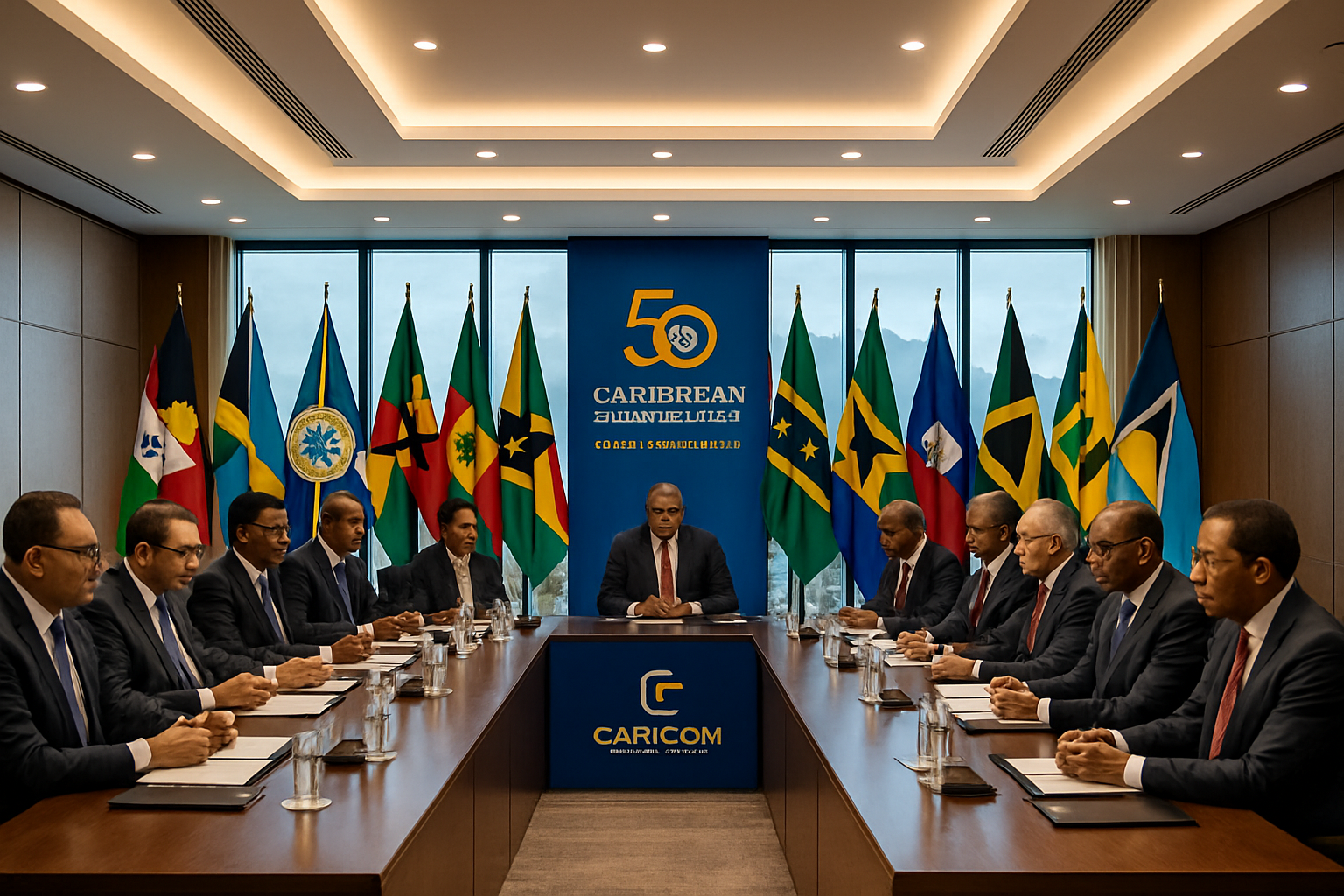
Caribbean Community leaders gathered in Saint Kitts and Nevis for their landmark 50th anniversary heads of government conference, but what should have been a celebration of regional integration instead exposed the deepest divisions in CARICOM's history over security cooperation, sovereignty, and relationships with external powers.
The 50th Regular Meeting of the Conference of Heads of Government, held February 25-26, 2026, in Basseterre, brought together leaders from across the 15-member Caribbean Community against a backdrop of mounting tensions over U.S. military operations in regional waters and fundamental disagreements about the organization's future direction.
CARICOM Chairman and host Prime Minister Dr. Terrance Drew of Saint Kitts and Nevis acknowledged the community stands at a "decisive hour," facing mounting global shocks that threaten small state stability. His opening remarks set the tone for what observers described as one of the most contentious summits in the organization's five-decade history.
Marco Rubio's High-Stakes Caribbean Mission
U.S. Secretary of State Marco Rubio's participation marked a significant escalation in American engagement with the region, arriving amid heightened tensions over Operation Southern Spear, the U.S. military campaign against narcotics trafficking that has resulted in more than 145 deaths since September 2025.
According to State Department Deputy Spokesperson Tommy Pigott, Rubio carried the priorities of the Trump administration regarding the fight against "illegal immigration" and "illicit trafficking," particularly narcotics. The timing proved particularly sensitive following the February 13 U.S. drone strike in Saint Vincent and the Grenadines territorial waters that resulted in a $500 million cocaine seizure but raised serious sovereignty concerns.
"The region is currently facing unprecedented challenges that require decisive action and courage in confronting pressing crises."
— Dr. Terrance Drew, CARICOM Chairman and Prime Minister of Saint Kitts and Nevis
The strike, conducted without prior diplomatic notification to the SVG government, occurred within the nation's exclusive economic zone and caused what authorities described as "large-scale drug proliferation" as cocaine washed ashore on the main island.
Institutional Calls for Coordination
CARICOM Secretary General Dr. Carla Barnett made an urgent appeal for a coordinated foreign policy among member states, highlighting the critical need for regional unity in addressing complex international challenges. Her call came as individual nations increasingly pursue divergent approaches to security cooperation with external powers.
The Secretary General's appeal reflects growing concerns about the organization's capacity to present a unified voice on critical issues affecting regional security, economic development, and international relations. The absence of coordinated responses to major regional challenges has undermined CARICOM's effectiveness as a diplomatic bloc.
Deep Regional Security Divisions
The summit exposed fundamental disagreements over Operation Southern Spear, which has transformed Caribbean waters into active military zones. While some members support enhanced U.S. counter-narcotics operations, others expressed grave concerns about civilian casualties and sovereignty violations.
The February 13 incident in SVG waters, where Prime Minister Dr. Godwin Friday revealed no official information was received from the U.S. prior to the operation, exemplifies the broader tensions between security cooperation and national sovereignty. The operation reportedly killed three Saint Lucian fishermen in separate incidents, creating safety concerns throughout Caribbean fishing communities.
Royal SVG Police issued guidance encouraging fishermen to maintain normal operations while remaining in communication with authorities, but the underlying problem persists: legitimate and criminal maritime operations occur in the same waters, creating unavoidable civilian risks.
Cuba and Venezuela Policy Fractures
Historical memory from previous CARICOM meetings reveals sharp divisions over Cuba and Venezuela policies that likely dominated private discussions in Saint Kitts. Trinidad and Tobago has emerged as a strong supporter of U.S.-backed pressure campaigns, while other members advocate for non-interference and diplomatic engagement.
Chairman Drew specifically referenced the Cuban humanitarian situation, urging coordinated CARICOM responses to economic isolation affecting regional stability. However, member states remain divided between those advocating engagement and assistance versus others supporting continued pressure aligned with U.S. policy.
Venezuela's dramatic economic recovery, with oil exports surging 60% to 800,000 barrels daily and the U.S. displacing China as the top customer, has created new geopolitical dynamics that CARICOM members are navigating differently.
Maritime Security and Fishing Communities
The summit addressed growing concerns among Caribbean fishing communities following multiple incidents involving U.S. military forces. Beyond the Saint Lucian fatalities, Barbadian and Antiguan fisherfolk have reported being "on edge" despite strikes occurring outside their maritime spaces.
The transformation of the Caribbean Sea and Eastern Pacific into active military zones has created unprecedented challenges for traditional fishing operations. Maritime law experts question the precedent of lethal strikes against civilian vessels in international waters based on suspected rather than confirmed criminal activity.
This shift from arrest-and-prosecution to direct military elimination approaches represents a fundamental change in counter-narcotics strategy that affects the economic foundations of many Caribbean communities dependent on maritime livelihoods.
Economic Development Amid Security Challenges
Despite security tensions, the summit highlighted significant infrastructure advances across the region. Saint Kitts and Nevis demonstrated remarkable port capabilities by simultaneously accommodating six major cruise ships, showcasing the type of economic development that regional leaders want to protect.
The successful management of cruise operations at Port Zante, combining direct docking with offshore anchoring coordination, exemplifies the sophisticated destination management capabilities that Caribbean nations have developed. These achievements underscore what's at stake as security concerns potentially threaten tourism-dependent economies.
Sovereignty Versus Security Cooperation
The fundamental tension exposed at the 50th summit centers on balancing security cooperation with external powers against protecting regional autonomy. Individual Caribbean nations lack the capacity to address sophisticated international criminal networks, yet military operations affecting civilians raise questions about the costs of such cooperation.
Jamaica's Prime Minister Andrew Holness has previously clarified that "CARICOM is not a political union" and cannot override member sovereignty, highlighting the institutional constraints that limit coordinated responses to regional challenges.
Saint Vincent's Prime Minister Friday, who also serves as OECS Chair, has urged accelerated integration while acknowledging criticism of slow progress, but the events surrounding the drone strike demonstrate how quickly external actions can compromise national sovereignty.
Looking Forward: Unity or Fragmentation
The 50th anniversary summit's outcome will determine whether CARICOM can maintain unity while accommodating diverse member perspectives or if fundamental fractures require organizational restructuring. The test lies in the institution's relevance for managing competing demands between national security, regional solidarity, and international partnerships.
As Chairman Drew noted, the region faces a "decisive hour" that may define the next fifty years of Caribbean integration. The choice between maintaining traditional zone of peace policies versus accepting militarized security approaches represents a watershed moment for the organization.
The summit demonstrated that while CARICOM has achieved remarkable infrastructure connectivity and economic integration over five decades, political unity remains elusive when members face competing pressures from external powers and domestic security concerns.
International Implications
The divisions exposed in Saint Kitts have implications extending far beyond the Caribbean. As small island developing states worldwide face similar pressures from great power competition, climate change, and transnational crime, CARICOM's experience offers both warnings and potential solutions.
The organization's ability to adapt its institutional framework while preserving core principles of non-interference and peaceful resolution will be closely watched by other regional blocs facing comparable challenges.
The 50th anniversary summit, rather than celebrating past achievements, has become a defining moment that will determine whether Caribbean integration can survive the pressures of an increasingly polarized international environment while maintaining the sovereignty and dignity that founders envisioned five decades ago.