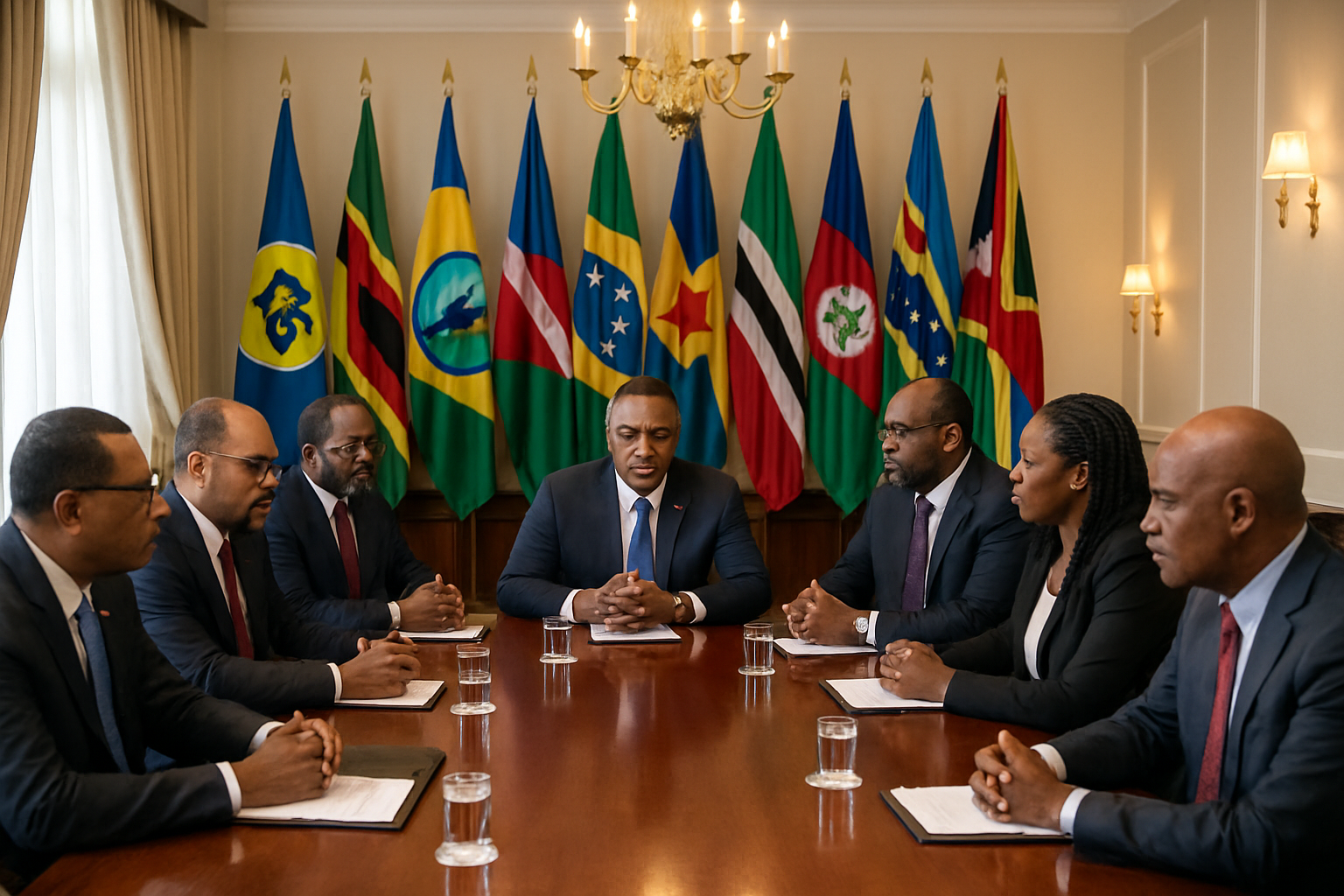
Caribbean Community leaders have convened in Nevis for intimate discussions on regional unity and decisive action, moving away from the formal structure of recent summits to engage in candid dialogue about CARICOM's future direction amid unprecedented challenges.
Dr. Terrance Drew, Prime Minister of St. Kitts and Nevis, confirmed that the setting was deliberately chosen to allow leaders to "engage openly and honestly" away from the summit's formal structure. The retreat follows the landmark 50th CARICOM Meeting that exposed fundamental divisions within the Caribbean Community over security cooperation, sovereignty concerns, and relationships with external powers.
A Watershed Moment for Regional Unity
The informal gathering in Nevis comes at what CARICOM Chairman Drew has described as a "decisive hour" for the organization. The February 2026 50th anniversary summit, which should have been a celebration of Caribbean integration achievements, instead became a forum for unprecedented disagreements about the organization's direction and relevance.
According to extensive memory records from the historic summit, the celebration was overshadowed by "fundamental disagreements over U.S. military operations rather than 50-year celebration." Most significantly, Trinidad and Tobago Prime Minister Kamla Persad-Bissessar delivered what opposition leaders called a "scathing address" defending her country's support for U.S. military operations while dismissing CARICOM's long-standing "zone of peace" policy.
"Don't talk to me about zone of peace."
— Kamla Persad-Bissessar, Prime Minister of Trinidad and Tobago
The remarks created what observers described as a "fundamental breach of Caribbean diplomatic norms," with Trinidad's Opposition Leader Pennelope Beckles calling the speech "revolting and bizarre."
Security Cooperation Versus Sovereignty
The divisions center around Operation Southern Spear, the U.S. counter-narcotics campaign that has resulted in 145+ deaths since September 2025. Members remain split between those supporting enhanced security cooperation with the United States and others concerned about sovereignty violations and civilian casualties.
Particularly troubling for regional leaders was the February 13 U.S. drone strike in Saint Vincent and the Grenadines territorial waters, which seized $500 million worth of cocaine without prior diplomatic notification to Prime Minister Dr. Godwin Friday, who also serves as OECS Chair. The incident raised fundamental questions about international law and territorial sovereignty.
Adding to regional anxiety, three Saint Lucian fishermen were reportedly killed in separate U.S. operations, creating what sources describe as widespread concern among Caribbean fishing communities operating in traditional waters now affected by military operations.
Institutional Relevance Under Question
The retreat in Nevis represents an acknowledgment that CARICOM faces an institutional crisis. As Jamaica's Prime Minister Andrew Holness clarified during the summit, "CARICOM is not a political union" and cannot override member sovereignty when nations face competing pressures from external powers.
CARICOM Secretary General Dr. Carla Barnett made urgent appeals for coordinated foreign policy among member states, recognizing that the organization's traditional consensus-building approach is under severe strain.
The choice of Nevis for these discussions is symbolically significant. The island, part of the Federation of St. Kitts and Nevis led by current CARICOM Chairman Drew, provides an intimate setting away from the pressures and protocols of formal summits. The informal atmosphere is designed to encourage the kind of frank dialogue that formal diplomatic settings often inhibit.
External Pressures and Internal Divisions
The Caribbean Community finds itself navigating complex relationships with major powers during a period of unprecedented geopolitical tension. The Trump administration's "Corolario Trump" strategy represents what analysts describe as a 21st-century update to the Monroe Doctrine, combining military deployment, economic pressure, and selective diplomatic engagement.
U.S. Secretary of State Marco Rubio's participation in the 50th summit as the highest-ranking U.S. official ever to visit St. Kitts and Nevis underscored the heightened importance Washington places on Caribbean relations. However, his presence also highlighted the divisions within CARICOM over how to respond to increased U.S. engagement.
Meanwhile, Cuba's unprecedented energy crisis—with complete aviation isolation through March 11 and 51% population blackouts—has created additional pressure for coordinated regional responses. Chairman Drew has called for unified CARICOM action on the humanitarian situation, but members remain divided between engagement and pressure approaches.
Economic Development Amid Political Strain
Despite political tensions, the Caribbean region continues to demonstrate economic resilience and development potential. St. Kitts and Nevis recently showcased sophisticated infrastructure capabilities by simultaneously accommodating six cruise ships at Port Zante, highlighting the economic achievements that regional cooperation has helped facilitate.
The tourism-dependent economies of the Caribbean face particular vulnerability to perceptions of instability created by military operations and political divisions. The success of regional integration in areas like cruise coordination and shared marketing efforts stands in stark contrast to the current political disagreements.
Looking Toward Future Cooperation
The Nevis retreat occurs against the backdrop of planned high-level diplomatic engagement. Guyana President Irfaan Ali and Trinidad Prime Minister Persad-Bissessar are scheduled to meet with President Trump in Miami on March 7, focusing on security cooperation and economic development as part of the administration's broader Western Hemisphere strategy.
For many observers, the informal nature of the Nevis discussions represents both an opportunity and a necessity. The formal structures that have served CARICOM for five decades may need fundamental adaptation to address contemporary challenges including climate change, migration, security threats, and great power competition.
Critical Juncture for Caribbean Integration
The leaders gathering in Nevis face a fundamental question about CARICOM's future: whether the organization can maintain unity while accommodating increasingly diverse national perspectives on security, sovereignty, and international engagement, or whether the current divisions require fundamental organizational restructuring.
The stakes extend far beyond the Caribbean. As small island developing states, CARICOM members serve as a test case for whether regional integration can provide meaningful autonomy amid intensifying great power competition. The outcome of these discussions may well determine the template for similar organizations worldwide.
The retreat represents what many consider a watershed moment potentially defining the next fifty years of Caribbean integration. Success in bridging current divisions could provide a model for managing competing pressures while preserving regional solidarity. Failure might necessitate fundamental changes to an organization that has served as a beacon of South-South cooperation for half a century.
As leaders engage in these critical discussions away from formal protocols and media scrutiny, the Caribbean Community stands at a crossroads that will determine whether the principles of regional cooperation and mutual respect can adapt to the realities of 21st-century geopolitics while preserving the sovereignty and dignity that have defined the Caribbean approach to international relations.