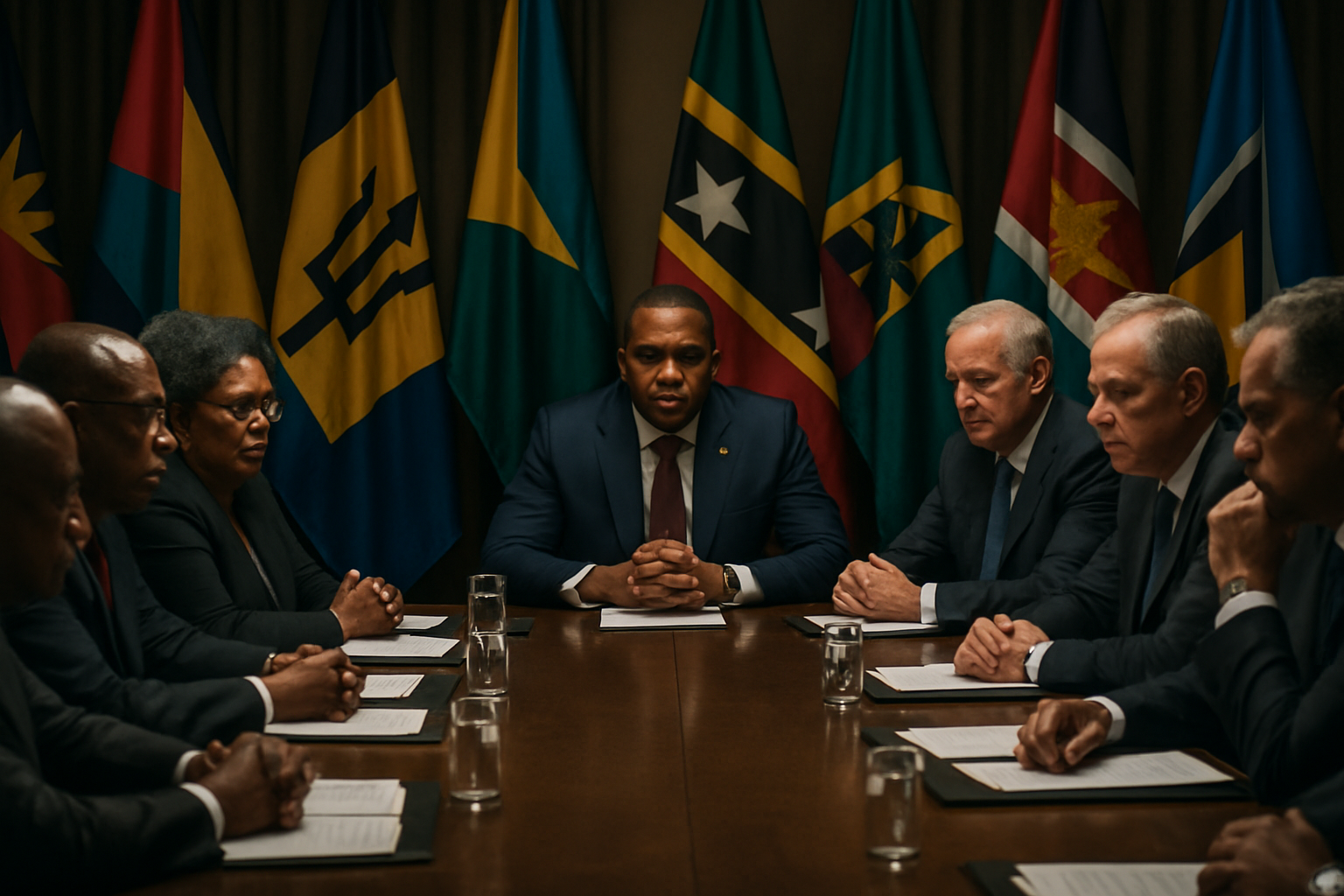
Caribbean leaders gathered in St. Kitts and Nevis for what was intended to celebrate fifty years of regional integration, but the 50th Regular Meeting of the Conference of Heads of Government of CARICOM instead exposed the deepest divisions in the organization's history, with fundamental disagreements over security cooperation, sovereignty, and the future direction of Caribbean unity.
The summit, hosted by CARICOM Chairman and St. Kitts Prime Minister Dr. Terrence Drew, was meant to mark a golden anniversary of progress since the signing of the Treaty of Chaguaramas. Instead, it became a forum for unprecedented public disputes between member states over their relationship with external powers and their approach to regional crises.
Trinidad's Scathing Challenge to Regional Unity
Trinidad and Tobago Prime Minister Kamla Persad-Bissessar delivered what opposition leader Pennelope Beckles called a "revolting and bizarre" address that shattered diplomatic norms. Persad-Bissessar launched a fierce defense of her government's support for U.S. military operations in the Caribbean while criticizing CARICOM's "silence over threats from the Maduro regime to Georgetown and Port-of-Spain."
In an unprecedented break with traditional Caribbean diplomacy, Persad-Bissessar dismissed concerns about the region's traditional "zone of peace" policy, telling fellow leaders: "Don't talk to me about 'zone of peace'" while doubling down on support for what she termed necessary U.S. actions against Venezuelan threats.
The Trinidad leader's remarks highlighted the fundamental split within CARICOM over Operation Southern Spear, the U.S. military campaign that has resulted in over 145 deaths since September 2025. While Trinidad strongly supports the operations as necessary security measures, other CARICOM members have expressed grave concerns about sovereignty violations and civilian casualties.
A Summit Under Unprecedented Strain
Chairman Drew acknowledged the gravity of the moment, telling delegates that CARICOM stands at a "decisive hour" as mounting global shocks threaten the stability and development of small states. His call for "courage in confronting pressing crises" specifically referenced the humanitarian situation in Cuba and the need for coordinated CARICOM responses to economic isolation.
The presence of all CARICOM Heads of Government, including Barbados Prime Minister Mia Amor Mottley fresh from her historic third consecutive electoral clean sweep, underscored the significance of the divisions. Even as regional leaders congratulated Mottley's unprecedented political achievement, the summit atmosphere remained tense over fundamental policy disagreements.
St. Vincent Prime Minister Dr. Godwin Friday, current chairman of the Organization of Eastern Caribbean States (OECS), delivered remarks emphasizing the urgent need to accelerate regional integration while acknowledging common criticisms of CARICOM's pace of progress. His speech highlighted the paradox of celebrating fifty years of integration while confronting the most serious threats to Caribbean unity in decades.
The Security-Sovereignty Divide
The summit exposed a critical fault line between members who prioritize security cooperation with the United States and those advocating for sovereignty protection. This division was thrown into sharp relief by recent U.S. drone strikes in St. Vincent and the Grenadines territorial waters that resulted in a $500 million cocaine seizure but raised serious questions about maritime sovereignty.
The February 13 strike off Bequia island, conducted without prior diplomatic notification to the SVG government, created what Minister of National Security St. Clair Leacock called "large-scale drug proliferation" as cocaine washed ashore following the missile attack on suspected trafficking vessels.
Jamaica Prime Minister Andrew Holness attempted to provide constitutional clarity, emphasizing that despite being part of the 15-member regional integration grouping, CARICOM "is not a political union" and cannot override member state sovereignty in security matters. His remarks were seen as an attempt to defuse tensions while maintaining space for diverse national approaches to security cooperation.
Cuba Crisis Divides Regional Response
The humanitarian crisis in Cuba has become another point of division within CARICOM. While Chairman Drew called for coordinated regional responses to economic isolation affecting the Cuban people, members remain split on engagement strategies.
Some CARICOM states advocate for increased diplomatic engagement and humanitarian assistance, viewing Cuba's economic collapse as a regional stability threat requiring collective action. Others, led by Trinidad, support maintaining pressure through international sanctions as part of broader Caribbean security strategy aligned with U.S. policy objectives.
The controversy reflects broader questions about CARICOM's role in addressing member state crises and the extent to which external powers should influence regional responses to humanitarian situations.
Infrastructure Progress Amid Political Turmoil
Despite political divisions, the summit highlighted significant infrastructure advances across the region. St. Kitts and Nevis demonstrated its growing international connectivity ahead of the summit with the completion of the first non-stop flight from Cairo to Basseterre by a Dassault Falcon 8X, showcasing the host nation's expanding global reach.
The achievement reflects broader Caribbean aviation and cruise infrastructure improvements that have positioned the region as a global tourism leader, with Saint Kitts recently accommodating six major cruise ships simultaneously at Port Zante.
However, even infrastructure success stories are complicated by security concerns. The advanced transportation links that facilitate legitimate commerce and tourism also create vulnerabilities that contribute to the security challenges dividing CARICOM members.
Economic Integration vs. Political Fragmentation
The summit's tensions occur against a backdrop of significant economic achievements within the Caribbean Community. Member states have demonstrated remarkable resilience and growth, with countries like Barbados achieving unprecedented political stability under Mottley's leadership and others expanding their international economic partnerships.
CARICOM Secretary-General noted that global shocks are testing the resilience of small island developing states, requiring enhanced coordination rather than fragmentation. The organization's trade facilitation programs and economic integration initiatives continue to show promise, but political divisions threaten to undermine these gains.
The fundamental question facing CARICOM is whether economic integration can proceed effectively while members pursue divergent approaches to security and international relations, or if political unity is a prerequisite for meaningful regional cooperation.
International Implications and Future Challenges
The summit's divisions have implications extending far beyond the Caribbean. Venezuela's dramatic economic recovery, with oil exports surging 60% to 800,000 barrels daily and the United States displacing China as the top petroleum customer, has created new geopolitical dynamics that CARICOM members are navigating differently.
Regional security concerns include the safety of Caribbean fishing communities affected by militarized counter-narcotics operations. The reported deaths of three Saint Lucian fishermen in SVG waters during U.S. operations has created anxiety throughout traditional fishing grounds that have sustained Caribbean livelihoods for generations.
The challenges facing CARICOM reflect broader global trends toward nationalism and bilateral relationships over multilateral cooperation. However, the unique vulnerabilities of small island developing states make regional unity particularly crucial for addressing climate change, economic volatility, and security threats.
A Critical Juncture for Caribbean Integration
As the 50th CARICOM summit concluded, leaders faced the reality that the next fifty years of Caribbean integration cannot simply build on past achievements but must navigate fundamental questions about sovereignty, security, and the role of external powers in regional affairs.
The summit's outcome will determine whether CARICOM can maintain institutional unity while accommodating diverse member perspectives on critical issues, or if the fractures revealed in St. Kitts will lead to a fundamental reorganization of Caribbean cooperation.
Chairman Drew's call for "decisive regional action" remains unfulfilled, with members returning to their capitals to grapple with the competing demands of national security, regional solidarity, and international partnerships. The challenge for CARICOM leadership is preserving the organization's relevance while managing divisions that threaten its foundational principles of Caribbean unity and mutual support.
The historic nature of the 50th summit may ultimately be remembered not for celebrating past achievements, but for exposing the fundamental challenges that will define Caribbean integration for the next half century. Whether CARICOM emerges stronger or more fragmented from this watershed moment remains to be determined by the actions of its member states in the critical months ahead.