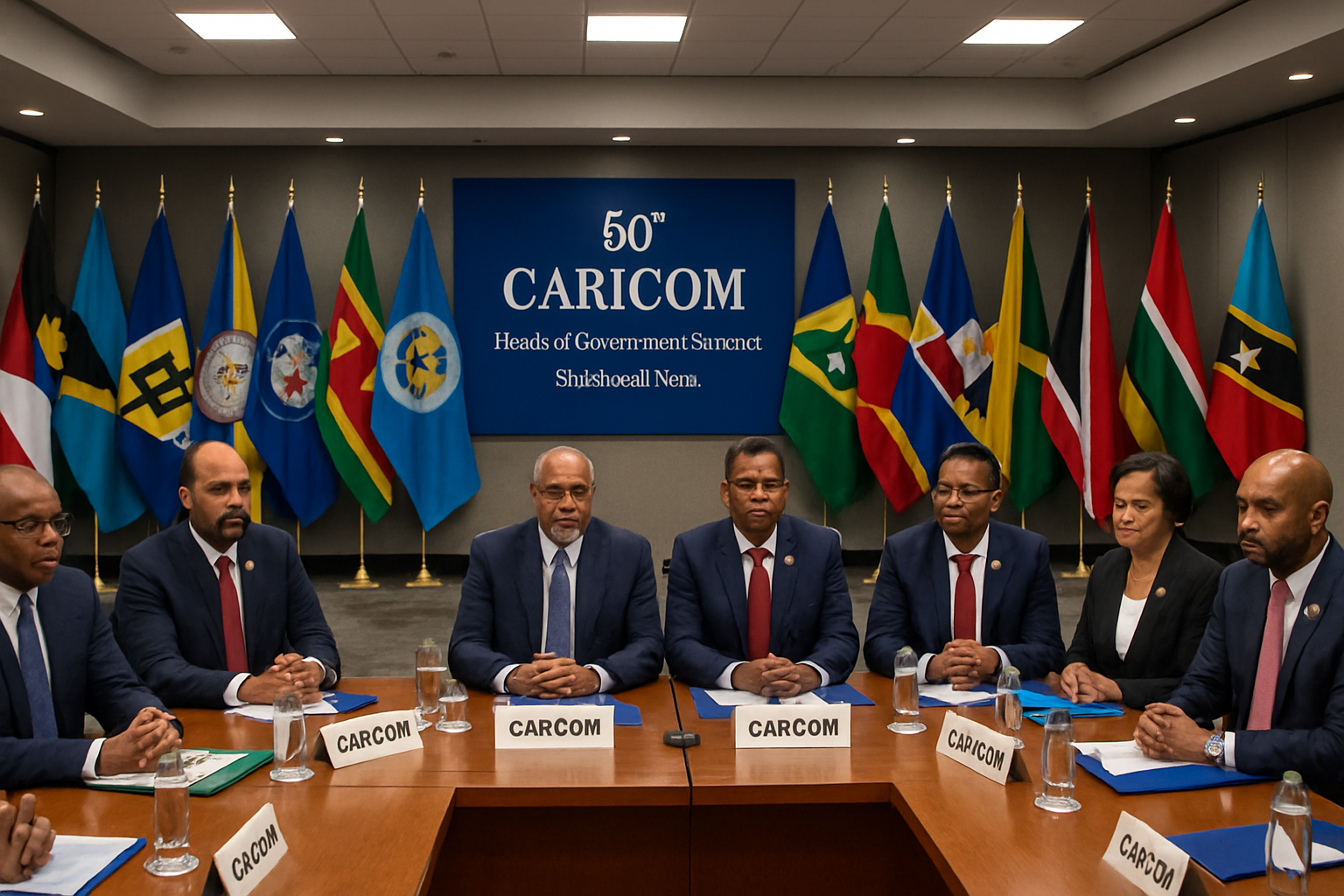
The 50th Regular Meeting of CARICOM Heads of Government opened in St. Kitts and Nevis amid unprecedented tensions over regional divisions, with Caribbean leaders directly confronting what they described as a growing "fracture" within the regional bloc over Venezuela policy and broader geopolitical alignments.
The historic summit, marking half a century of Caribbean integration, has become a critical test for CARICOM unity as member states grapple with divergent responses to U.S. foreign policy under President Donald Trump and the dramatic political transformation in Venezuela following Nicolás Maduro's removal in January 2026.
Trinidad PM Delivers Explosive Address
Trinidad and Tobago Prime Minister Kamla Persad-Bissessar delivered what observers described as a "scathing" opening address, forcefully defending her government's support for U.S. actions against Venezuela while sharply rebuking fellow CARICOM leaders for what she characterized as the organization's inadequate response to threats from the former Maduro regime.
"We strongly defend Trinidad and Tobago's support of U.S. action against Venezuela and admonish leaders for interfering in regional elections."
— Prime Minister Kamla Persad-Bissessar
Persad-Bissessar's remarks specifically criticized CARICOM's "silence over threats from the Maduro regime to Georgetown and Port-of-Spain," highlighting the organization's failure to adequately respond to Venezuelan territorial claims and aggressive rhetoric that had escalated tensions throughout 2025.
The Prime Minister also issued warnings about CARICOM's stance on Cuba, cautioning the grouping against "supporting dictatorship" and defending Trinidad's alignment with Washington's maximum pressure campaign that has resulted in unprecedented isolation of the Cuban government.
Regional Leaders Push Back on Division Talk
Other Caribbean leaders quickly moved to counter perceptions of an irreparable CARICOM split, with several heads of government directly addressing what they termed "fracture" concerns during the opening ceremony at the conference venue in St. Kitts.
The most significant strain involves divergent responses to U.S. foreign policy under Trump's second term. While Trinidad and Tobago has embraced closer alignment with Washington's Caribbean strategy, other CARICOM members have maintained more cautious positions on issues ranging from Venezuelan regime change to the Cuba embargo.
According to diplomatic sources, the regional divisions became apparent during late 2025 and early 2026 as the United States increased military pressure on Venezuela, ultimately resulting in Maduro's capture by U.S. forces in January 2026. Trinidad openly supported these operations, while several CARICOM members expressed concerns about sovereignty violations and the precedent of military intervention in the region.
Venezuela Policy Creates Deep Rifts
The Venezuelan crisis has exposed fundamental disagreements within CARICOM about the organization's role in regional security and its relationship with major powers. Trinidad's strong support for U.S.-backed regime change contrasts sharply with the more measured responses from other member states who have traditional non-interference policies.
St. Kitts and Nevis Prime Minister Dr. Terrence M. Drew, hosting the summit, delivered pointed remarks about the need for "decisive regional action" and "courage shown in confronting the region's most pressing crises." His address specifically referenced the humanitarian situation in Cuba, urging coordinated CARICOM responses to ongoing economic isolation.
The Cuba issue has become another fault line within CARICOM, with members split between those supporting Washington's maximum pressure campaign and those advocating for humanitarian exemptions and diplomatic engagement with Havana.
Security Concerns and U.S. Military Operations
Adding complexity to regional tensions are concerns about U.S. military operations in Caribbean waters under "Operation Southern Spear," which has resulted in over 145 deaths since September 2025 through targeting of suspected drug trafficking vessels.
The military campaign has created safety concerns for Caribbean fishing communities, particularly affecting Saint Lucia and Saint Vincent and the Grenadines, where fishermen report fear of misidentification during legitimate operations. Three Saint Lucian fishermen were allegedly killed by U.S. forces in February, highlighting the civilian impact of militarized counter-narcotics efforts.
CARICOM members differ significantly in their assessment of these operations, with some viewing them as necessary security measures while others express concern about sovereignty and civilian safety in traditional fishing grounds.
Economic Transformation and Regional Dynamics
The summit occurs as the Caribbean region experiences significant economic transformation following Venezuela's post-Maduro recovery. Venezuelan oil exports have surged 60% to 800,000 barrels daily since January 2026, with the United States displacing China as the country's top petroleum customer under Acting President Delcy Rodríguez's interim government.
This economic reorientation has implications for regional energy security and trade relationships, with some CARICOM members exploring new arrangements with the transformed Venezuelan government while others maintain cautious positions pending democratic consolidation.
Dominican Republic has already reopened commercial relations with Venezuela, while Brazil and European Union members express cautious support for the democratic transition. These varying international responses reflect the broader divisions within CARICOM about how to engage with post-Maduro Venezuela.
Institutional Challenges and Future Direction
The 50th anniversary summit was intended to celebrate CARICOM achievements and chart future integration goals, but has instead become a forum for airing fundamental disagreements about the organization's direction and purpose in an increasingly polarized geopolitical environment.
Beyond Venezuela policy, CARICOM faces institutional challenges including response to natural disasters, economic development coordination, and managing relationships with major powers including the United States, China, and European partners.
The Brent Thomas kidnapping case, mentioned by Persad-Bissessar as an example of secretariat non-responsiveness, illustrates concerns about CARICOM's capacity to address member state security concerns effectively.
Path Forward Uncertain
As the summit continues over several days, Caribbean leaders face pressure to demonstrate unity while addressing legitimate policy differences on critical regional issues. The challenge involves balancing sovereignty concerns with security cooperation and managing relationships with external powers without compromising regional autonomy.
Dr. Drew's call for historical judgment based on "courage shown in confronting the region's most pressing crises" suggests that CARICOM's response to current challenges will define its relevance for the next fifty years of Caribbean integration.
The summit outcomes will likely influence whether CARICOM can maintain unity while accommodating diverse member perspectives on increasingly complex regional and international issues, or whether current fractures will lead to more fundamental organizational changes in Caribbean cooperation frameworks.