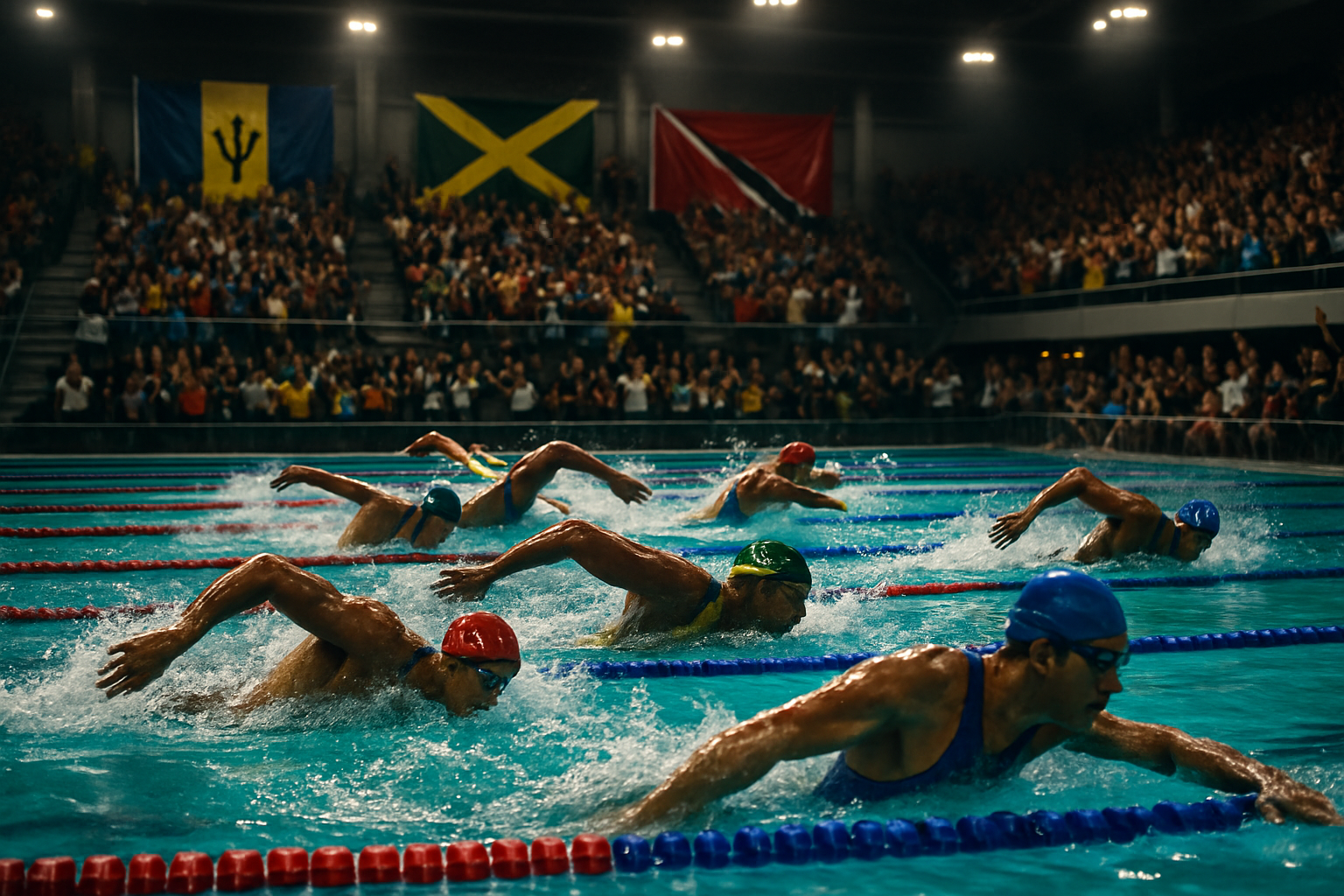
The 39th CARIFTA Aquatic Championships in Martinique showcased the remarkable depth of Caribbean swimming talent, with Barbados achieving unprecedented success while Jamaica's track athletes continued their record-breaking streak in Grenada.
Barbadian swimmers delivered exceptional performances throughout the championships, collecting an impressive 22 medals by the second day - including 11 gold, five silver, and six bronze medals. This achievement built upon their outstanding opening night where they secured 10 medals, establishing Barbados as a dominant force in regional aquatic competition.
Barbados Swimming Dominance
Leading the Barbadian charge was Heidi Stoute, who captured gold in the Girls' 15-17 200 metres freestyle with a commanding time of 2 minutes 07.12 seconds. Her victory demonstrated the strength of Barbados' middle-distance swimming program and the effectiveness of their systematic youth development initiatives.
Mihael Sobers emerged as a standout performer, securing his third gold medal in the Boys' 13-14 100 metres backstroke with a time of 1 minute 02.82 seconds. Sobers also claimed silver in the 200 metres freestyle, showcasing his versatility across multiple swimming disciplines and establishing himself as one of the championship's most accomplished athletes.
Christian Vanderpool proved equally impressive in the Boys' 11-12 category, winning gold in the 400 metres individual medley with a time of 5 minutes 24.87 seconds. He later added a silver medal in the 200 metres freestyle, finishing ahead of teammate Zachary Ladipo who earned bronze in the same event.
The success extended to relay events, where Barbados demonstrated exceptional teamwork. The Boys' 11-12 400 metres medley relay team, featuring Zachary Ladipo, Christian Vanderpool, Keniel Ledgister, and Joshua Parris, secured victory with a time of 4 minutes 44.41 seconds.
Building on Historic Success
These achievements represent the continuation of Barbados' remarkable aquatic sports development, building upon their historic performance at the championships' opening where they captured seven gold medals on Saturday night. Key victories included Heidi Stoute's triumph in the girls 15-17 800m freestyle (9:27.49), Michael Sobers' double gold in the boys 13-14 1500m freestyle (17:29.23) and 50m backstroke (28.97), and relay success in multiple categories.
The success reflects Barbados' strategic investment in sports infrastructure and youth development programs. The nation sent their largest-ever CARIFTA Games contingent of 70 athletes and coaches, demonstrating their commitment to regional athletic excellence. Head coach Desiree Gamble, a former national high jump record holder, has been instrumental in developing this systematic approach to Caribbean competition.
Jamaica's Track and Field Excellence
While Barbados dominated the pool, Jamaica continued their legendary track and field supremacy in Grenada. Shanoya Douglas delivered a stunning performance in the 200 metres, clocking 22.11 seconds with favorable wind conditions to break her own national junior record for the second time in just over a week.
Douglas' achievement was particularly remarkable as she had only recently set the previous record of 22.36 seconds at the ISSA/GraceKennedy Boys and Girls Athletics Championships, breaking Briana Williams' 22.50 seconds national junior record that had stood since 2018. Her latest performance also shattered the CARIFTA record of 22.77 seconds set by Shaunae Miller of the Bahamas in 2013.
The 200m victory capped Douglas' successful defense of both sprint titles, as she retained her 100m crown from Saturday's opening day. This double victory marked her second consecutive Under-20 girls sprint double at the regional championships, establishing her as a dominant force in Caribbean sprinting.
Trinidad & Tobago's Breakthrough Performance
Trinidad and Tobago achieved significant success across both aquatic and track disciplines, demonstrating the breadth of their athletic development programs. The nation's swimmers were targeting an end to their 16-year title drought at the aquatic championships, with assistant coach Hazely Haynes leading a 31-swimmer team specifically focused on strengthening their traditionally weak 15-17 girls age group.
In track and field, Trinidad & Tobago secured 35 medals compared to 25 in the previous year - a remarkable improvement of 10 additional medals. Tenique Vincent completed the nation's most unique double achievement with 5,028 points in her specialty event, adding another Vincent family gold to their collection after Tyrique won the Boys Under-20 Decathlon on Sunday evening.
The improvement reflects the success of Trinidad & Tobago's comprehensive "three-in-one" approach to regional competition, combining the International Grand Prix, Caribbean Track Championships, and Americas Track Championships into a coordinated development strategy.
Regional Development and Future Prospects
The 2026 CARIFTA Championships represented more than individual achievements - they demonstrated the evolution of Caribbean athletics beyond traditional sprint dominance into comprehensive sporting excellence across multiple disciplines. The success across swimming, middle-distance running, and field events reflects systematic investment in coaching education, sports science support, and infrastructure development throughout the region.
These performances position young Caribbean athletes for future success at senior international competitions, including Commonwealth Games and potential Olympic development pathways. The depth of talent displayed across multiple nations suggests a bright future for Caribbean sports on the global stage.
The championships also highlighted the importance of regional competition in developing athletic excellence. The CARIFTA Games continue to serve as a crucial pathway for young athletes seeking senior international competition while maintaining cultural connections and regional sporting pride.
Strategic Investment Paying Dividends
The success stories emerging from both the aquatic and track championships reflect years of strategic planning and investment. Barbados' $50 million sports infrastructure commitment, announced by Minister Charles Griffith, and their systematic junior national training squad launched in February 2025, have clearly contributed to their aquatic dominance.
Similarly, Trinidad & Tobago's comprehensive approach to athletics development, including enhanced coaching support and strategic age-group targeting, has yielded measurable results in their medal tally improvement.
These achievements demonstrate that sustained investment in youth development, combined with regional cooperation and systematic coaching approaches, can produce world-class athletic performances that honor Caribbean sporting traditions while establishing new standards of excellence for future generations.