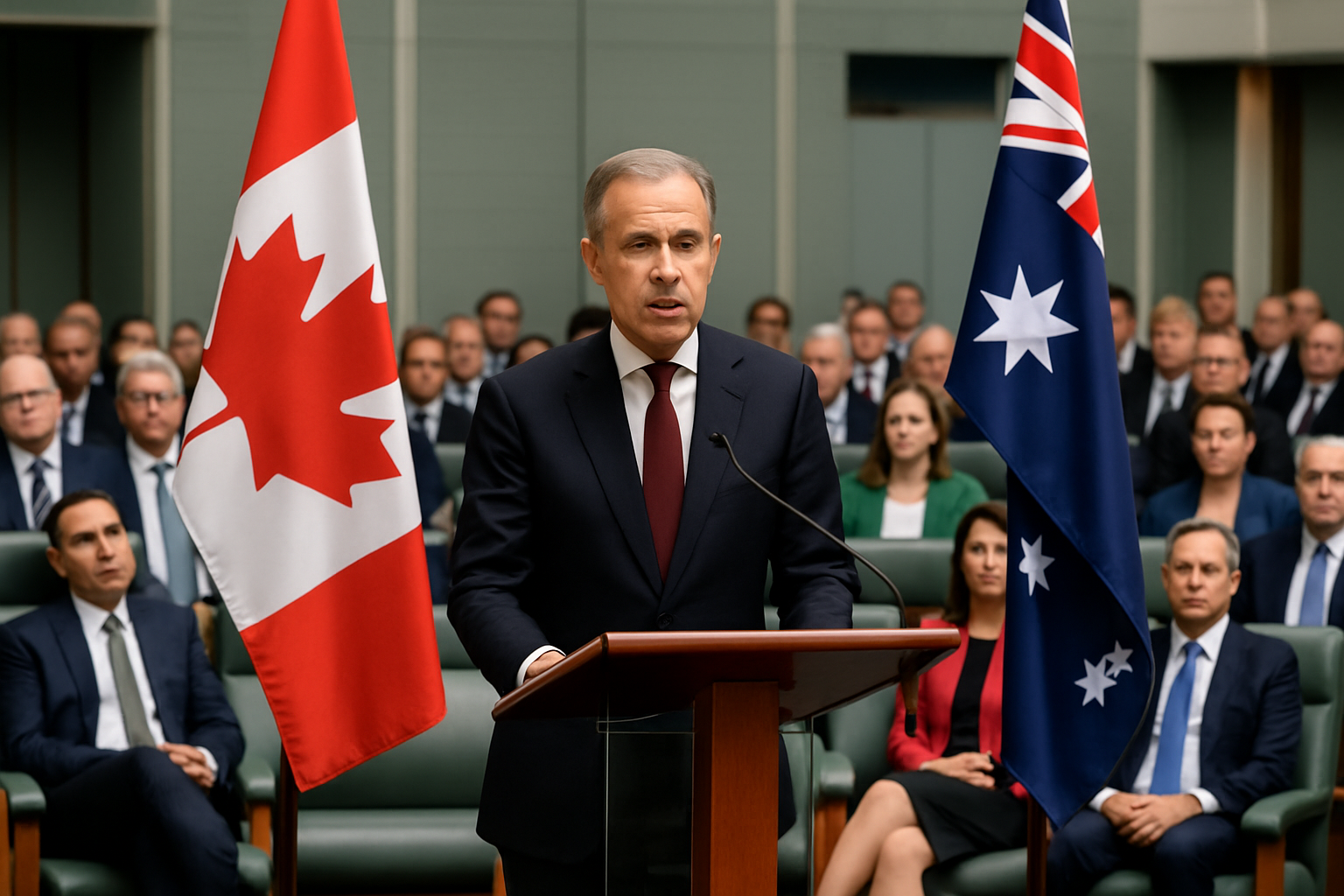
Canadian Prime Minister Mark Carney delivered a historic address to a joint sitting of the Australian Parliament on March 5, 2026, becoming only the second Canadian leader to receive such an honor while his government navigates increasingly complex international waters amid the ongoing Middle East crisis.
The address, delivered to both houses of the Australian Parliament in Canberra, focused primarily on strengthening Canada-Australia bilateral ties and shared democratic values during what Carney characterized as a period when the "global order is breaking down." The Prime Minister emphasized the need for middle powers like Canada and Australia to "draw closer together" in an era of unprecedented international uncertainty.
Historic Parliamentary Address
Carney's speech marked a significant diplomatic milestone, with the Prime Minister addressing assembled members of both the House of Representatives and Senate in the historic Parliament House chambers. The joint sitting, a rare honor typically reserved for heads of state and government of the highest international significance, underscored the deepening strategic partnership between the two Commonwealth nations.
"In an era where traditional alliances are being tested and global institutions are under strain, Canada and Australia must stand together as beacons of democratic governance and international law," Carney told the assembled parliamentarians. His address emphasized shared values including democratic governance, commitment to international law, and economic cooperation between the two Pacific-rim democracies.
"The challenges we face today require middle powers to step forward with principled leadership when traditional frameworks are failing."
— Mark Carney, Prime Minister of Canada
Complex International Context
The parliamentary address occurred against the backdrop of the most serious international crisis since the Cold War, with the ongoing U.S.-Israeli "Operation Epic Fury" against Iran having escalated into what many observers consider the most dangerous Middle East conflict in decades. The operation, which began on February 28, 2026, resulted in the confirmed death of Iranian Supreme Leader Ali Khamenei and has triggered massive Iranian retaliation across the region.
While Carney's public remarks in Australia focused on bilateral cooperation and democratic values, the Prime Minister has been navigating a complex international environment where Canada has maintained what officials describe as "principled neutrality" regarding the Iran conflict. This position has been complicated by revelations that a former Bank of Canada Governor has expressed support for the controversial military strikes.
Former Bank Governor's Controversial Position
Adding complexity to Canada's diplomatic positioning, sources confirm that a former Bank of Canada Governor has privately expressed support for the U.S.-Israeli operations against Iran, creating tensions within Canada's foreign policy establishment. The former governor, whose identity has not been officially disclosed, reportedly characterized the strikes as "necessary deterrent action" against Iran's nuclear program and regional proxy networks.
This position stands in contrast to Canada's official stance, which has emphasized diplomatic solutions while avoiding explicit endorsement of military action. The revelation has created internal discussions within the Liberal government about maintaining message discipline on one of the most sensitive international issues of Carney's tenure as Prime Minister.
Canada's Strategic Positioning
Under Carney's leadership, Canada has pursued what officials term "pragmatic engagement" with global partners while maintaining core democratic principles. This approach has seen significant diplomatic successes, including the landmark uranium supply deal with India signed in March 2026 and Canada's inclusion in China's visa-free travel program alongside the United Kingdom.
The Prime Minister's Australia visit represents a key component of Canada's "middle power diplomacy," seeking to strengthen relationships with like-minded democracies while avoiding the deep polarization characterizing U.S.-China and U.S.-Iran relations. Canada's $6.6 billion Defense Industrial Strategy, announced in February 2026, positioned the country for greater strategic independence while maintaining alliance commitments.
Regional Security Implications
Carney's address to the Australian Parliament emphasized the Asia-Pacific region's growing strategic importance, particularly given China's increasing military activities around Taiwan and the broader implications of great power competition. Both Canada and Australia have faced pressure to choose sides in escalating U.S.-China tensions, with both nations seeking to balance economic interests with security concerns.
The timing of Carney's visit, during the height of the Iran crisis, underscored the complexity of modern alliance management. While traditional allies like the United States pursue military solutions to international challenges, middle powers like Canada and Australia are exploring diplomatic alternatives and regional cooperation mechanisms that could provide stability amid global uncertainty.
Economic Partnership Focus
Beyond diplomatic considerations, Carney's Australia visit emphasized expanding economic cooperation between the two nations. Both countries face similar challenges including critical minerals supply chain security, energy transition requirements, and the need to diversify trading relationships amid increasing global economic fragmentation.
Canada's recent success in positioning itself as a major LNG supplier, with export capacity targeting up to 100 million tonnes per year, aligns with Australia's own energy export priorities. The two nations are exploring coordination mechanisms for critical minerals extraction and processing, reducing dependence on Chinese-dominated supply chains.

Democratic Values in Crisis
Carney's parliamentary address occurred during a period of unprecedented stress on democratic institutions globally. With the Iran crisis demonstrating the fragility of international diplomatic frameworks, middle powers face increased pressure to provide alternative leadership models that combine principled governance with practical problem-solving.
The Canadian Prime Minister emphasized that traditional great power competition models are insufficient for addressing complex 21st-century challenges including climate change, nuclear proliferation, and economic inequality. His message resonated with Australian parliamentarians facing similar pressures to balance alliance obligations with national interests and democratic values.
Future Implications
The success of Carney's Australia visit, particularly the warm reception for his parliamentary address, suggests growing international appetite for middle power leadership during periods of great power instability. Both Canada and Australia are positioned to provide alternative models of international engagement that emphasize multilateral cooperation, democratic governance, and practical problem-solving over ideological confrontation.
As the Iran crisis continues to unfold and global tensions escalate across multiple fronts, the partnership between Canada and Australia may serve as a template for how democracies can maintain cooperative relationships while navigating an increasingly complex international environment. The controversy surrounding the former Bank Governor's Iran position, however, illustrates the challenges even middle powers face in maintaining coherent foreign policy positions during periods of extreme international polarization.
The historic nature of Carney's parliamentary address reflects both nations' recognition that traditional alliance structures may be insufficient for addressing the challenges of the multipolar era, requiring new forms of cooperation between like-minded democracies committed to international law, peaceful conflict resolution, and sustainable economic development.