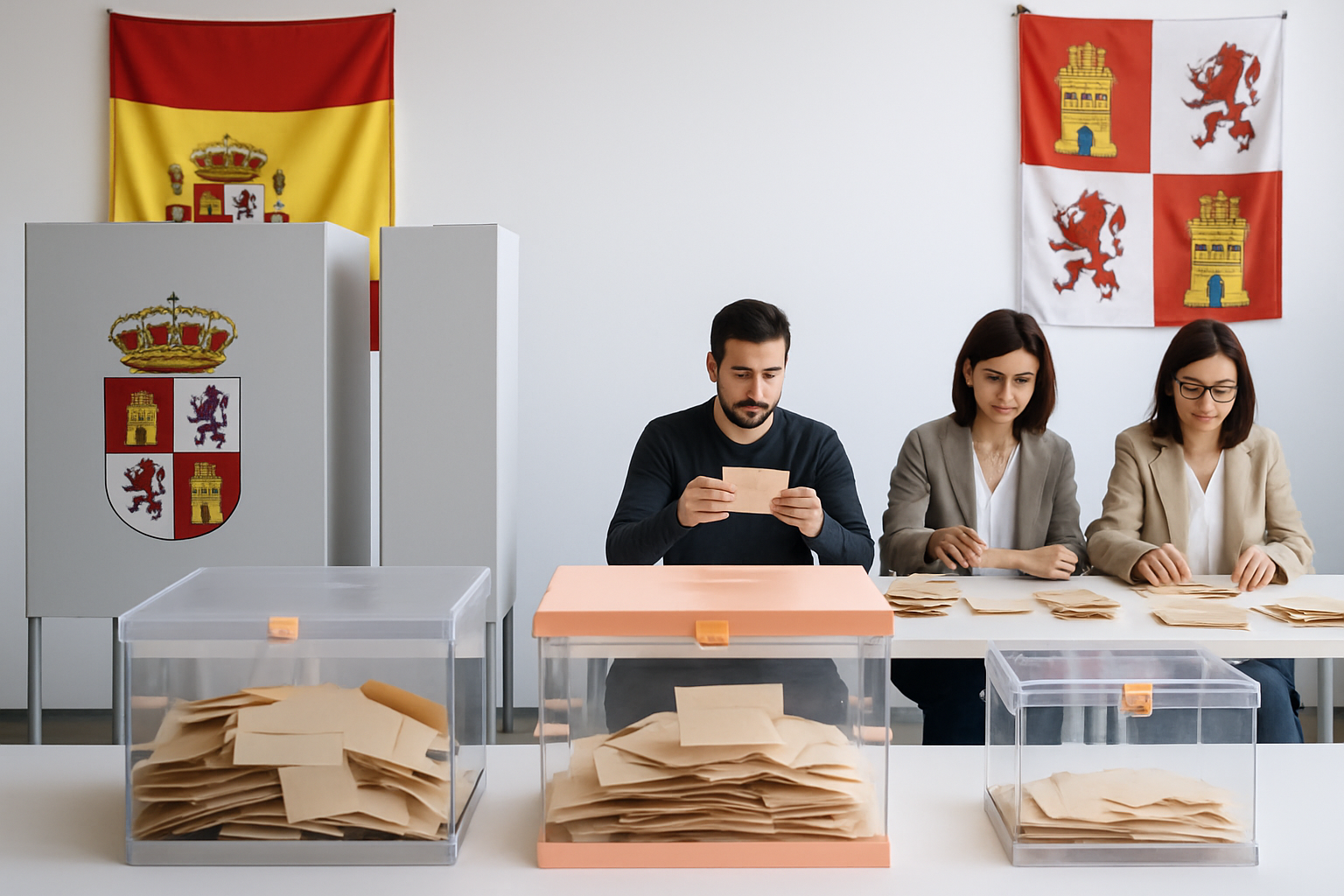
The Popular Party (PP) under Alfonso Fernández Mañueco has emerged strengthened from Castilla y León's regional elections on March 15, 2026, securing 33 seats in the 81-member parliament—an increase of two from the previous election—while successfully containing the far-right Vox party's expansion and witnessing a notable Socialist recovery.
The results mark a significant political development for Spain's largest autonomous community by territory, extending the PP's uninterrupted rule that began in 1987. However, Mañueco's coalition with Vox remains essential for governance, as the combined PP-Vox alliance maintains a comfortable 47-seat majority despite the PP's gains.
PP Consolidates Power Despite Coalition Dependency
Mañueco's victory represents a rare bright spot for the PP after disappointing results in Extremadura and Aragón, where similar strategies to reduce far-right dependence failed. The president of the Junta achieved what many considered unlikely—strengthening his party's position while serving as the candidate with the longest tenure in government across recent regional elections.
The 60-year-old Salamanca native, who began his political career as mayor of his hometown, has successfully navigated four decades of PP governance in the region. His political journey from challenging his predecessor Juan Vicente Herrera in 2017 primaries to this enhanced mandate demonstrates the resilience of a politician described as an "animal político de partido" (political party animal) who has held virtually every significant position in Castilian-Leonese politics.
"This victory shows that our moderate approach and focus on effective governance resonates with citizens who want stability and progress, not extremism."
— Alfonso Fernández Mañueco, Castilla y León President
The electoral arithmetic, while maintaining coalition necessity, shifts internal dynamics favorably for the PP. With 33 seats versus Vox's 14, Mañueco enters coalition negotiations from a strengthened position, potentially enabling more independent policy-making within the partnership framework.
Vox Hits Growth Ceiling in Conservative Heartland
Santiago Abascal's Vox party experienced what political analysts describe as a "moderated ascent," gaining only one seat to reach 14 total—far below the 17 seats pre-election polling suggested. The party's failure to breach the 20% vote threshold, settling at 18.9%, represents its first significant electoral disappointment after dramatic surges in Extremadura and Aragón.
This performance contradicts earlier projections from March 9 polling that showed Vox potentially surpassing 20% support in the region. The far-right party's inability to replicate its 55.7% growth seen in Aragón, where it captured 30+ municipalities from the PP, suggests it may have encountered its electoral ceiling in traditional conservative territories.
Despite the modest gains, Abascal proclaimed "no hay techo" (there is no ceiling) for his party and guaranteed continued PP-Vox coalition agreements across Castilla y León, Extremadura, and Aragón. However, the results indicate that Vox's appeal may be plateauing in regions where conservative politics have deep historical roots.
Political observers note that Vox's difficulty in translating protest votes into sustained electoral growth reflects broader challenges facing far-right movements in institutionalizing their support beyond their core base.
Socialist Recovery Provides National Relief
The PSOE achieved its most encouraging result in months, gaining two seats to reach 30—a performance that breaks the negative trend established in Extremadura and Aragón defeats. This recovery occurs under Carlos Martínez, the Soria mayor making his first autonomous election appearance, who represents a less "Sanchista" profile compared to other regional Socialist candidates.
Martínez's success demonstrates the effectiveness of distancing regional campaigns from national PSOE leadership controversies while focusing on local governance issues. The Socialist recovery occurred despite Pedro Sánchez's declining popularity and mounting regional defeats that had created concerns about the party's national electoral prospects.
The PSOE's ability to aggregate left-wing votes reflects the continued weakness of parties to its left, with traditional competitors like Podemos failing to maintain significant representation. This consolidation provided the Socialists with their best regional performance in years, offering party leadership hope for stabilizing broader electoral decline.
"We've shown that progressive politics focused on citizens' real needs can compete effectively even in traditionally conservative regions."
— Carlos Martínez, PSOE Castilla y León candidate
Broader Political Realignment
The elections confirmed the continued marginalization of smaller regional parties, with Soria Ya suffering major losses, dropping from three to one seat. Unión del Pueblo Leonés maintained its three seats, while Por Ávila retained its single representative, but these results underscore the consolidation around major national parties.
Most significantly, the elections certified the disappearance of left-wing representation beyond the PSOE, with both Podemos and IU-Sumar failing to secure seats. This development represents what analysts describe as the "death of the space to the left of the PSOE" in Castilian-Leonese politics, forcing progressive voters toward Socialist candidates through tactical voting.
The political realignment strengthens bipartisan dominance while eliminating the fragmented multi-party landscape that characterized recent Spanish politics. This simplification may facilitate governance but reduces ideological diversity within regional institutions.
National Implications and European Context
These results carry significance beyond regional boundaries, occurring during what experts describe as the most challenging period for European democracy since World War II. The election outcomes test Alberto Núñez Feijóo's strategy of reducing PP dependence on far-right coalition partners—a goal achieved with limited success given continued coalition necessity.
The Castilla y León results contrast sharply with broader European trends showing far-right advances across multiple member states. Vox's moderated growth suggests Spanish conservative voters may be more resistant to extremist appeals than their counterparts in other European nations.
Santiago Abascal's criticism of PP national leadership over governance failures in other regions highlights growing tensions within Spanish conservative politics. The Vox leader's public disputes with Feijóo over Extremadura negotiations demonstrate how regional coalition dynamics influence national political discourse.
Regional and International Significance
As Spain's largest autonomous community by territory, Castilla y León's political direction influences broader national trends and serves as a testing ground for coalition strategies ahead of future general elections. The region's four-decade conservative governance record makes it a crucial laboratory for understanding Spanish democratic evolution.
International observers monitoring Spanish experiences with far-right coalition management view these results as providing insights into democratic resilience amid populist pressures. The relatively contained Vox growth offers hope for other European democracies struggling with similar extremist movements.
The successful conduct of elections and peaceful power transitions demonstrate institutional strength during a period of significant political stress across Europe. These democratic functions continue effectively despite increasing polarization and external pressures affecting continental politics.
Future Governance Challenges
Mañueco faces the challenge of maintaining coalition stability while addressing citizens' expectations for effective governance. His strengthened mandate provides greater leverage within the PP-Vox partnership but doesn't eliminate the fundamental dependency on far-right support for policy implementation.
The new government must navigate competing priorities: satisfying Vox demands for policy influence while maintaining PP's more moderate positioning. This balancing act will test Mañueco's political skills and could influence similar coalition arrangements across other Spanish regions.
Economic development, infrastructure investment, and demographic challenges remain pressing issues requiring sustained attention. The region's aging population and rural depopulation demand innovative policy responses that transcend partisan divisions.
The electoral mandate provides Mañueco with four more years to demonstrate that PP-Vox coalitions can deliver effective governance while maintaining democratic norms. Success could establish templates for conservative politics across Spain, while failure might accelerate calls for alternative political arrangements.
Looking Forward
The Castilla y León elections conclude a crucial testing phase for Spanish regional politics, providing lessons for future electoral strategies across the political spectrum. The PP's strengthened position, Vox's moderated growth, and Socialist recovery create new dynamics that will influence upcoming electoral cycles.
These results suggest that Spanish voters, while open to political change, remain cautious about extremist alternatives. The continued requirement for coalition governance reflects democratic maturation and the complexity of contemporary political challenges requiring broad-based solutions.
As Spain prepares for future electoral contests, the Castilla y León experience offers valuable insights into voter behavior, coalition dynamics, and democratic resilience during periods of significant political transformation. The outcomes provide hope for democratic stability amid broader European uncertainties while highlighting ongoing challenges in managing diverse political coalitions.
The success of democratic processes, peaceful transfers of power, and continued citizen engagement demonstrates that Spanish institutions remain robust despite increasing polarization pressures affecting democracies worldwide. This resilience provides foundations for addressing future challenges through democratic rather than authoritarian means.