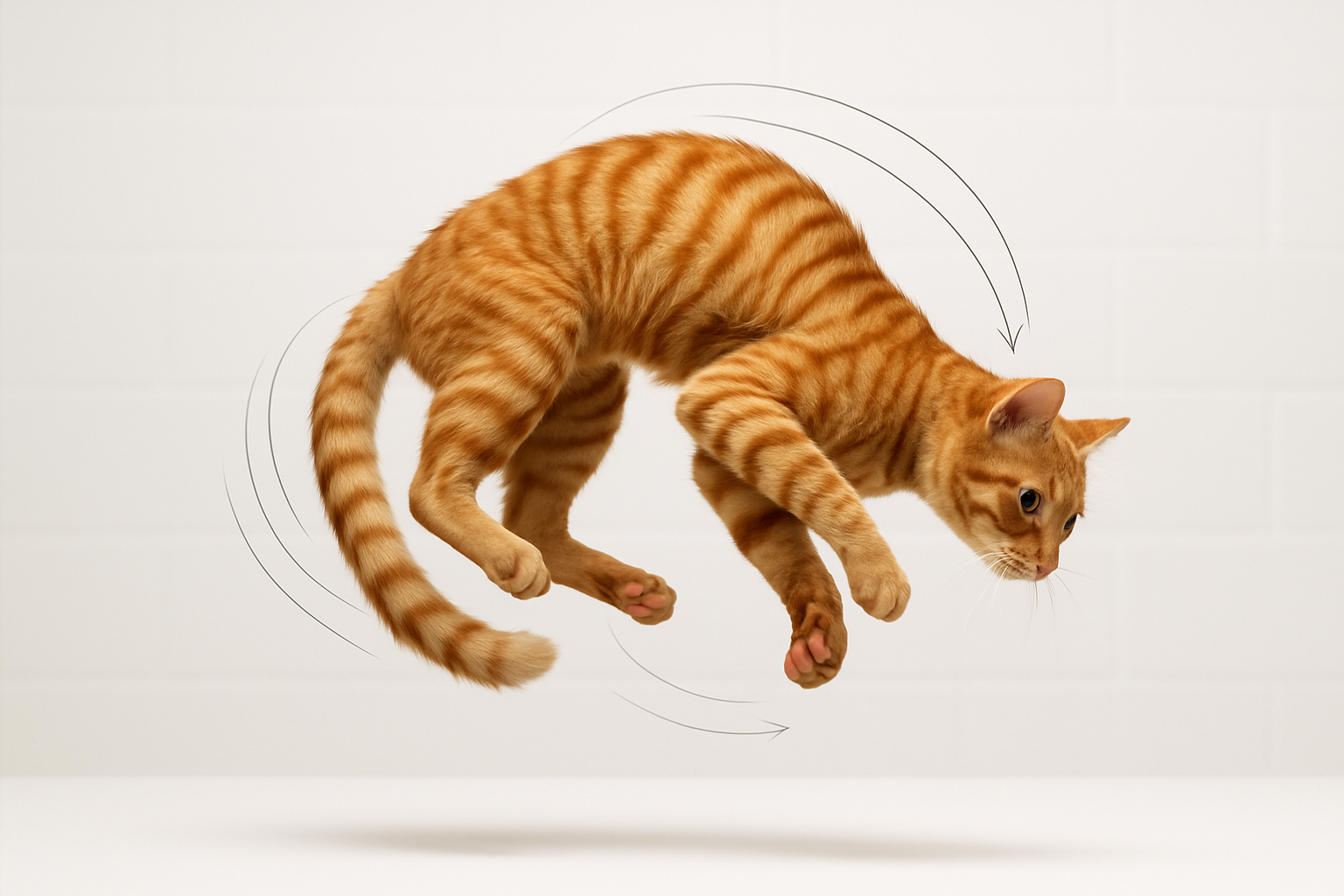
A breakthrough study by Japanese researchers has finally solved one of nature's most captivating mysteries: the anatomical mechanism that allows cats to consistently land on their feet when falling. The phenomenon, known as the "righting reflex," involves a sophisticated division of labor in the cat's spine that enables mid-air rotation without violating the laws of physics.
The research team from Austria, analyzing the biomechanics of falling cats, discovered that the secret lies in the remarkable anatomical specialization of the feline spinal column. Unlike humans who have a relatively rigid torso, cats possess an extraordinarily flexible backbone divided into functionally distinct segments that work in coordinated sequence during a fall.
The Physics of Feline Flight
The study, published by Austrian researchers examining cat movement patterns, reveals that the righting reflex operates through a complex sequence of anatomical adjustments that occur within milliseconds of a fall beginning. The cat's spine effectively functions as multiple independent rotation mechanisms working in harmony.
When a cat begins to fall, sensory organs in the inner ear immediately detect the change in orientation relative to gravity. This triggers an instantaneous neurological response that activates the righting sequence - a biomechanical marvel that has evolved over millions of years.

Anatomical Division of Labor
The researchers discovered that the cat's spine operates through what they term "anatomical division of labor" - different segments of the backbone perform specialized functions during the righting process. The thoracic region (upper spine) initiates the rotation, while the lumbar section (lower back) provides stabilization and fine-tuning adjustments.
"The anatomical division of labor in the cat's spine represents one of the most sophisticated biomechanical systems in the animal kingdom."
— Research Team, Austrian Biomechanics Study
This segmented approach allows cats to generate the necessary angular momentum for rotation while maintaining their center of mass - a feat that would be impossible with a rigid spinal structure like that found in humans.
The Science Behind the Righting Reflex
The righting reflex involves several critical components working in perfect synchronization:
- Vestibular System: Inner ear organs detect changes in spatial orientation within milliseconds
- Flexible Spine: Enables complex rotational movements without external force
- Muscular Coordination: Precise timing of muscle contractions throughout the body
- Visual Processing: Eyes help orient the cat relative to the ground surface
- Tail Mechanics: Acts as a counterbalance and steering mechanism
The entire sequence typically occurs in less than half a second, even for falls from relatively low heights. This extraordinary speed is made possible by the specialized neural pathways that have evolved specifically to coordinate this life-saving maneuver.
Evolutionary Advantages
The research provides insights into why this remarkable ability evolved in felines. Cats are natural climbers and hunters that frequently navigate vertical environments where falls are an occupational hazard. The righting reflex provides a crucial survival advantage that has been refined through millions of years of evolution.
Modern domestic cats retain all the anatomical features that made their wild ancestors such effective hunters and climbers. The same spinal flexibility that enables the righting reflex also allows cats to squeeze through tight spaces, execute sharp turns during hunting, and maintain balance on narrow surfaces.
Broader Scientific Implications
The discovery has implications beyond feline biology. Engineers and roboticists are studying the cat's righting reflex to develop more agile robotic systems and improve understanding of dynamic balance in mechanical systems.
This research contributes to the growing field of comparative biomechanics, which examines how different species have solved similar physical challenges through evolutionary adaptation. The cat's solution to the problem of controlled falling represents a masterpiece of biological engineering that continues to inspire technological innovation.
Connection to Broader Research Trends
The study aligns with recent breakthroughs in animal biomechanics research occurring globally in 2026. Scientists are increasingly recognizing the sophisticated physics underlying seemingly simple animal behaviors, from bird flight patterns to fish swimming efficiency.
The research also connects to ongoing studies of comparative oncology, where scientists examine similarities between feline and human biological systems. Previous research has shown that cats and humans share surprising genetic similarities in certain disease pathways, making feline studies relevant for understanding human health.
These biomechanical discoveries complement recent findings about cat behavior and cognition, including research into the ancient relationship between cats and humans dating back thousands of years in Chinese civilization.
Future Research Directions
Scientists plan to continue investigating the righting reflex using advanced motion capture technology and computer modeling to create detailed three-dimensional analyses of the falling sequence. This research could lead to practical applications in fields ranging from robotics to human safety equipment design.
The team is also exploring how age, health, and breed variations affect the efficiency of the righting reflex, which could provide insights into maintaining mobility and balance across different life stages - research with potential applications for human aging and rehabilitation medicine.
Understanding the precise neural mechanisms that coordinate this complex movement sequence may also contribute to research into balance disorders and movement coordination in both humans and animals.
A Marvel of Natural Engineering
The righting reflex represents one of nature's most elegant solutions to a complex physics problem. By dividing the spine into specialized functional segments, evolution has created a biological gyroscope that operates with precision and reliability that still challenges human engineering capabilities.
As our understanding of this remarkable phenomenon continues to deepen, it serves as a reminder of the sophisticated solutions that evolution produces when confronted with fundamental physical challenges. The humble house cat carries within its anatomy a biomechanical marvel that represents millions of years of evolutionary refinement - a living testament to the power of natural selection to solve complex problems through innovative biological design.
For cat owners who have witnessed this gravity-defying feat countless times, the research provides scientific validation for what they have long observed: cats truly do possess an almost magical ability to orient themselves in space. Now we know it's not magic at all, but rather one of nature's most sophisticated examples of physics and biology working in perfect harmony.