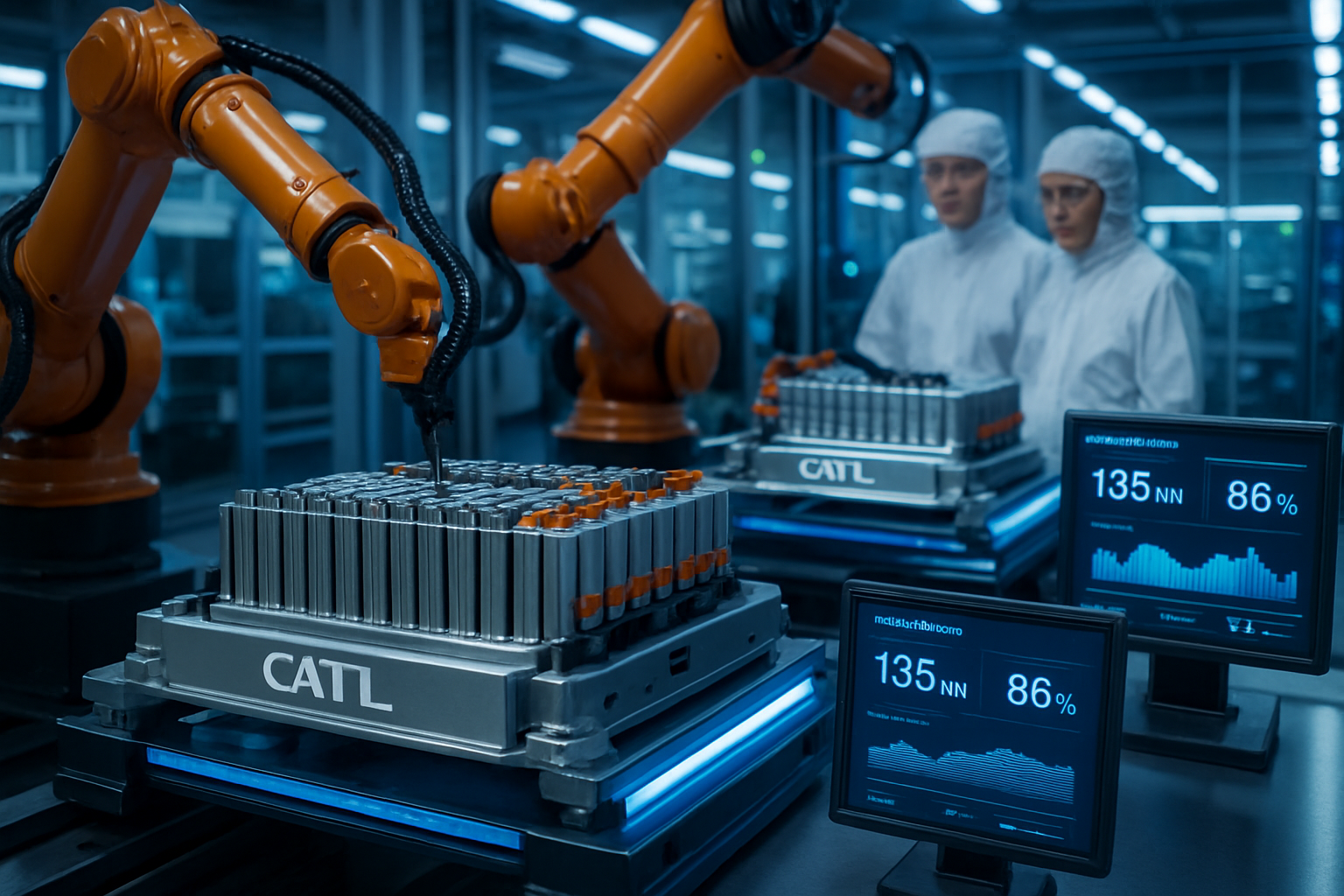
Contemporary Amperex Technology Limited (CATL), the world's largest electric vehicle battery producer controlling over 40% of the global market, has unveiled transformative battery technologies designed to accelerate worldwide automotive electrification through faster charging capabilities and enhanced performance characteristics.
The Chinese battery giant's latest innovations represent a significant leap forward in addressing the primary technical barriers that have historically limited electric vehicle adoption, particularly charging time anxiety and cold weather performance degradation. These developments come at a critical juncture as the global transportation sector faces unprecedented pressure to electrify amid climate urgency and volatile fuel prices.
Revolutionary Charging Speed Breakthrough
CATL's most significant announcement centers on advanced battery systems capable of achieving ultra-rapid charging speeds that rival traditional petrol station refueling times. The company's breakthrough Megawatt Flash Charging technology delivers an extraordinary 1,360 kW of power, enabling electric vehicles to gain approximately 2 kilometers of range per second during charging sessions.
This technological achievement translates to practical benefits that could fundamentally alter consumer perceptions of electric vehicle convenience. A typical electric vehicle equipped with CATL's advanced battery system can achieve 400 kilometers of range in just 5 minutes of charging time, effectively eliminating the "charging anxiety" that has deterred many potential EV buyers.
"This breakthrough addresses the fundamental consumer concern about charging time that has limited EV adoption globally,"
— Industry analyst following CATL developments
The company's complementary Blade Battery 2.0 technology demonstrates equally impressive specifications, achieving 10% to 70% charge capacity in just 5 minutes, with 97% charge completion in 9 minutes. These charging speeds represent the fastest commercially available rates for mass-manufactured battery units, positioning CATL at the forefront of the global race to perfect electric vehicle technology.
Cold Weather Performance Innovation
Beyond charging speed improvements, CATL has addressed another critical barrier to EV adoption: cold weather performance degradation. Traditional lithium-ion batteries can lose 30-50% of their capacity in freezing conditions, rendering electric vehicles impractical in northern climates and winter conditions.
CATL's enhanced battery chemistry maintains full functionality in temperatures as low as -30°C (-22°F), representing a breakthrough for year-round electric vehicle operation across diverse geographic conditions. This advancement is particularly significant for markets in Northern Europe, Canada, and other cold-climate regions where winter performance has been a decisive factor in vehicle purchasing decisions.
The technological breakthrough builds upon recent Chinese advances in battery chemistry, including hydrofluorocarbon-based electrolytes that enable operation at temperatures as low as -70°C while doubling energy density compared to traditional electrolytes. These innovations collectively position Chinese manufacturers as global leaders in solving the technical challenges that have limited electric vehicle market penetration.
Market Dominance and Global Strategy
CATL's technological announcements come against the backdrop of the company's exceptional financial performance and market expansion. In 2025, CATL reported a remarkable 42% profit surge to 72.2 billion yuan (US$10.4 billion), with lithium-ion battery sales volume reaching 661 GWh, representing a 39% increase from the previous year.
This performance demonstrates the company's commanding position in the global electric vehicle supply chain during a period of unprecedented industry transformation. CATL's success reflects China's broader strategic dominance in critical battery materials, with Chinese companies controlling approximately 60% of global critical mineral production and 90% of refining capacity for lithium, cobalt, and rare earth elements.
The company's "go-global strategy" emphasizes continuous technological advancement as the foundation for international expansion. This approach has already yielded significant partnerships, including collaborations with European automaker Stellantis for electric vehicle production in Spain, representing Chinese automotive technology penetration into European manufacturing ecosystems.
Industry Impact and Competitive Pressure
CATL's technological breakthroughs arrive during a period of intense transformation within the global automotive industry. Traditional automakers face mounting pressure to accelerate electric vehicle programs while managing supply chain challenges, including severe memory chip shortages that have driven semiconductor prices up sixfold, and dependencies on Chinese-controlled critical material supply chains.
The timing of these announcements is particularly significant as global fuel prices have surged past $100 per barrel, with Brent crude reaching $119.50 and WTI hitting $108.15 due to geopolitical tensions affecting oil transit routes. These economic pressures have transformed electric vehicles from environmental choices into economic necessities for many consumers.
European and American automakers have responded to Chinese technological leadership by seeking government support and developing domestic supply chain alternatives. The US-EU-Japan Critical Minerals Partnership, encompassing 55 countries and 7 African suppliers, represents a coordinated effort to diversify away from Chinese mineral dependencies, though this strategy requires massive investment and years of development time.
Infrastructure and Adoption Acceleration
The practical implementation of CATL's advanced battery technologies depends heavily on corresponding infrastructure development to support ultra-fast charging capabilities. Current global infrastructure investment has reached unprecedented levels, with Austria doubling its EV charging capacity through 1,000 additional stations and Estonia leading European renewable energy integration with 88% renewable electricity generation and 90,000 household battery storage systems.
Vehicle-to-grid technology integration represents another dimension of CATL's strategic approach, enabling electric vehicles equipped with advanced batteries to serve as mobile energy storage systems. These vehicles can charge during off-peak renewable energy generation periods and discharge electricity during high-demand periods, supporting electrical grid stability while providing additional economic benefits to vehicle owners.
Consumer adoption patterns demonstrate regional variations that CATL's technology improvements specifically address. Urban-rural disparities persist, with homeowners and rural residents enjoying charging advantages through home installations, while apartment dwellers face infrastructure barriers in urban environments. Enhanced charging speeds and cold weather performance directly address these practical concerns.
Long-term Market Implications
Industry analysis suggests that CATL's technological breakthroughs could accelerate global electric vehicle adoption timelines significantly beyond current projections. Battery longevity studies already demonstrate that early-generation electric vehicles exceed predicted lifespans, with Tesla Model S vehicles from 2012-2014 retaining 85-92% battery capacity after 200,000+ miles of operation, suggesting practical battery lifespans of 15-20 years.
The convergence of ultra-fast charging, extreme weather operation capabilities, and extended battery life addresses the primary technical barriers that have limited mass EV adoption. Commercial vehicle applications, including Tesla's Semi truck production and BMW's electric 3 Series manufacturing scheduled for August 2026 in Munich, could benefit substantially from these technological advances.
Climate urgency provides additional context for the significance of these developments. January 2026 marked the 18th consecutive month of global temperatures exceeding 1.5°C above pre-industrial levels, demonstrating that human-induced climate change is overriding natural variability. Transportation electrification has become essential for meeting international climate commitments during what scientists describe as a decisive climate action decade.
Strategic Implications for Global Energy Transition
CATL's technological achievements represent a potential inflection point in the global energy transition, positioning Chinese companies at the forefront of a trillion-dollar clean transportation revolution. The company's advances in battery technology, combined with China's strategic control of critical mineral supply chains, create lasting competitive advantages that could define the next phase of global automotive industry evolution.
Success in scaling these laboratory achievements to mass production typically requires 3-5 years for battery technologies, presenting implementation challenges around manufacturing coordination, infrastructure development, economic competitiveness with existing systems, and regulatory approval across international markets. However, the potential for eliminating primary EV adoption barriers could fundamentally accelerate transportation electrification timelines.
The broader strategic significance extends beyond automotive applications to encompass energy storage systems essential for renewable energy integration, grid stability, and the transition away from fossil fuel dependence. CATL's technological breakthroughs occur during a watershed moment when crisis-driven demand converges with technological readiness, creating conditions for mass adoption acceleration that could reshape global transportation systems within the current decade.
As the automotive industry undergoes its most significant transformation in over a century, CATL's latest innovations demonstrate how technological leadership in battery development can drive systemic change across energy, transportation, and climate systems. The successful implementation of these advances will require unprecedented coordination across energy systems, infrastructure development, supply chain management, and regulatory frameworks during humanity's most environmentally challenging period in recorded history.