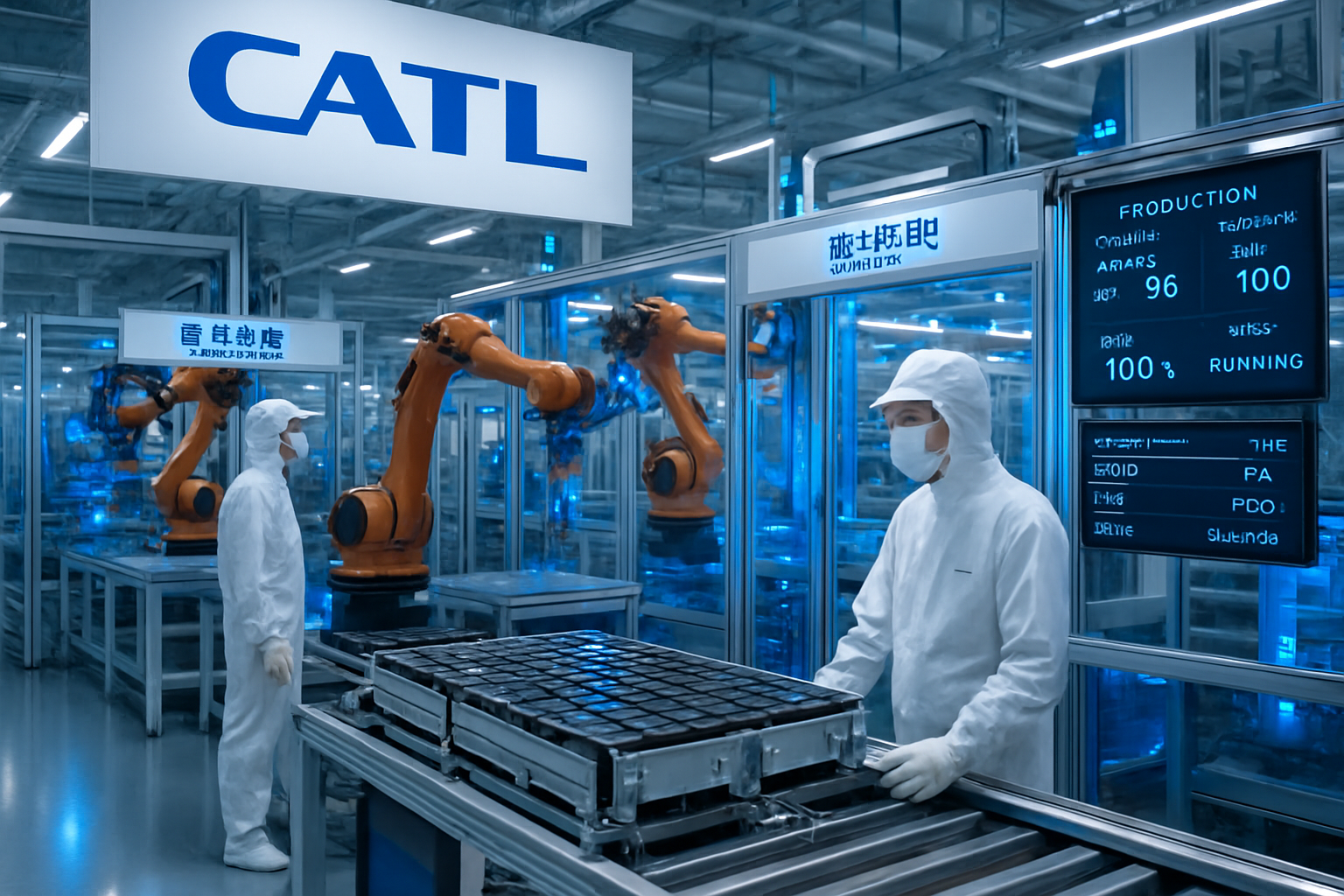
Contemporary Amperex Technology Ltd (CATL), China's battery giant, reported a remarkable 42% surge in net profit to 72.2 billion yuan (US$10.4 billion) for 2025, underscoring China's commanding position in the global electric vehicle supply chain as the industry accelerates toward mass adoption.
The Shenzhen-listed company's lithium-ion battery sales volume reached 661 gigawatt hours (GWh), representing a 39% increase from the previous year, according to Monday's filing with the Shenzhen Stock Exchange. This performance comes as China consolidates its dominance across the entire EV ecosystem, from raw materials to finished vehicles.
Record Performance Amid Global EV Expansion
CATL's exceptional results reflect the broader momentum in China's electric vehicle sector, which has become a cornerstone of the country's industrial strategy. The company's success is built on strong domestic demand and expanding international partnerships, particularly as global automakers increasingly rely on Chinese battery technology.
The profit surge occurred despite ongoing global supply chain challenges, including memory chip shortages that have caused sixfold price increases across the semiconductor industry. These constraints have affected automotive control systems worldwide, yet Chinese manufacturers have demonstrated remarkable resilience in navigating these disruptions.
Global Market Expansion and Strategic Partnerships
China's EV influence extends far beyond its borders, as evidenced by recent developments in international markets. Stellantis announced plans to begin production of Chinese electric vehicles under the Leapmotor brand at its facility in Zaragoza, Spain, starting in 2026. This partnership represents a significant milestone in Chinese automotive technology's penetration into European manufacturing.
The expansion reflects a broader trend of Chinese EV companies establishing production footholds in key global markets. Companies like BYD, NIO, and XPeng are increasingly viewed as serious competitors to established automotive giants, leveraging advanced battery technology and competitive pricing strategies.
"China's dominance in battery technology is reshaping the entire automotive industry landscape,"
— Industry Analyst, describing the strategic implications of CATL's performance
Technology Leadership and Innovation
China's competitive advantage in the EV sector extends beyond manufacturing scale to technological innovation. Recent breakthroughs include BYD's Megawatt Flash Charging system, capable of delivering 1,360 kW maximum power and enabling vehicles to gain 400km range in just 5 minutes. This technology addresses one of the primary barriers to EV adoption—charging time anxiety.
Additionally, Chinese scientists have achieved revolutionary advancement in water-based battery technology featuring organic electrodes and electrolyte as safe as tofu brine. This innovation eliminates flammability risks while offering non-toxic disposal, representing a potential paradigm shift toward environmentally sustainable energy storage.
Supply Chain Dominance and Strategic Control
China's influence in the EV sector is reinforced by its control over critical materials supply chains. The country maintains approximately 60% of global critical mineral production and 90% of refining capacity for lithium, cobalt, and rare earth elements essential for battery manufacturing.
This strategic positioning has prompted international responses, including the US-EU-Japan Critical Minerals Partnership involving 55 countries seeking to diversify supply chains. However, the scale of investment and time required to establish alternative sources means China's dominance is likely to persist for the foreseeable future.
Market Dynamics and Consumer Adoption
The success of Chinese battery manufacturers reflects broader EV market maturation. Recent studies show that early-generation electric vehicles are demonstrating battery lifespans significantly exceeding initial predictions. Tesla Model S vehicles from 2012-2014 with over 200,000 miles show 85-92% battery capacity retention, suggesting practical EV battery lifespan may extend 15-20 years.
This improved reliability has transformed total cost of ownership calculations, making EVs increasingly attractive to consumers and fleet operators. The data also supports a robust used EV market, further accelerating adoption rates.
Regional Manufacturing and Policy Support
China's EV strategy combines technological innovation with strategic manufacturing placement. The country has established regional production hubs to serve different markets, reducing transportation costs and improving responsiveness to local requirements. This approach has proven particularly effective in Southeast Asian markets, where Chinese companies are establishing assembly operations for electric motorcycles and light vehicles.
Government policy support remains crucial to the sector's success. Chinese authorities have implemented comprehensive regulatory frameworks covering battery standards, charging infrastructure, and safety requirements. The upcoming ban on hidden door handles in vehicles, effective January 2027, demonstrates the country's willingness to prioritize functional safety over aesthetic design in the premium EV segment.
Challenges and Future Outlook
Despite strong growth, the Chinese EV industry faces several challenges. Memory chip shortages continue to affect vehicle control systems, while international trade tensions create uncertainty for global expansion plans. Additionally, some markets are implementing policies to reduce dependence on Chinese suppliers, though the scale and technical expertise required make rapid replacement unlikely.
Climate urgency provides additional momentum for the sector. January 2026 marked the 18th consecutive month of temperatures exceeding 1.5°C above pre-industrial levels, emphasizing the critical need for transportation electrification. This environmental pressure supports continued investment in EV technology and infrastructure.
Infrastructure and Grid Integration
The expansion of EV adoption is driving parallel investments in charging infrastructure and grid integration technology. Vehicle-to-grid capabilities are emerging as a key feature, allowing EVs to function as distributed energy storage systems. This technology enables vehicles to charge during off-peak renewable generation and discharge during high demand periods, supporting grid stability.
China's coordinated approach to EV development includes massive investments in charging networks and smart grid technology. This infrastructure development creates a competitive advantage that reinforces the country's position in global EV markets.
Global Competitive Response
International competitors are responding to Chinese dominance through various strategies. European automakers are calling for government subsidies to support domestic EV manufacturing, while the United States has implemented policies encouraging domestic battery production. However, the technical expertise and manufacturing scale developed by Chinese companies create significant barriers for competitors.
The success of companies like CATL demonstrates that leadership in emerging technology sectors requires sustained investment, technological innovation, and strategic market positioning. As the global automotive industry continues its transformation toward electrification, Chinese companies appear well-positioned to maintain their competitive advantages through the critical adoption phase.
Long-term Strategic Implications
CATL's record performance represents more than corporate success—it signals a fundamental shift in global automotive industry dynamics. The combination of technological innovation, manufacturing scale, supply chain control, and government support has created a formidable competitive position that will likely influence the industry for decades to come.
As electric vehicles move from early adoption to mass market penetration, the companies and countries that established leadership during this critical transition period are positioned to capture disproportionate value. China's comprehensive approach to EV industry development, exemplified by CATL's success, demonstrates how strategic industrial policy can create lasting competitive advantages in emerging technology sectors.