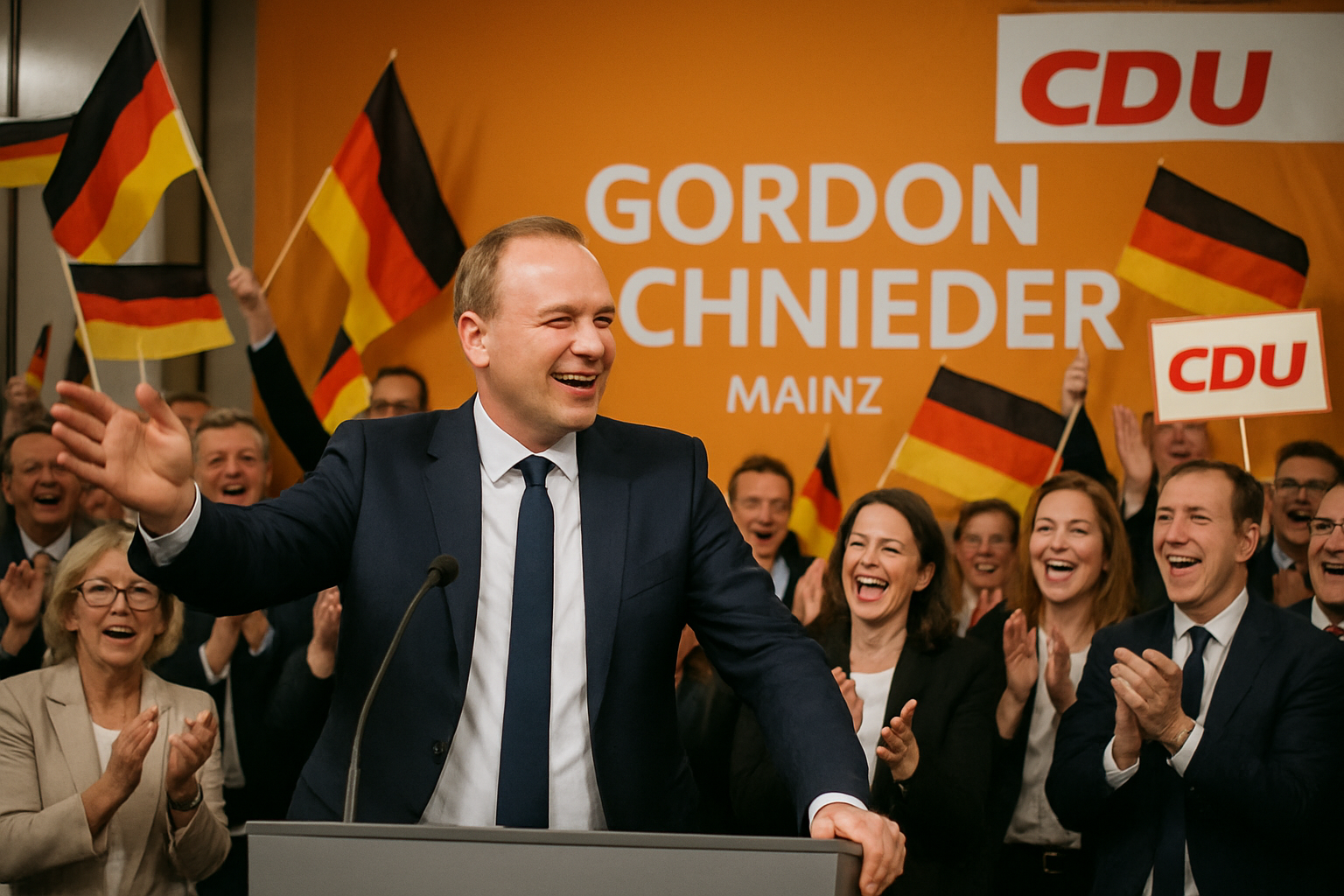
Germany's Christian Democratic Union (CDU) achieved a historic victory in Rhineland-Palatinate's state election on March 22, 2026, ending 35 years of Social Democratic Party (SPD) rule and providing crucial momentum for Chancellor Friedrich Merz ahead of upcoming federal contests.
Gordon Schnieder led the CDU to power in the southwestern state, declaring "CDU is back" at a jubilant celebration in Mainz as supporters erupted in cheers. The victory marks a dramatic political realignment after more than three decades of SPD governance under various Minister-Presidents.
The election results demonstrate both democratic resilience and emerging challenges, as the far-right Alternative for Germany (AfD) achieved an unprecedented breakthrough with approximately 20% support – their strongest performance in any western German state. This represents a near-doubling of their previous support levels and challenges long-held assumptions about far-right appeal being limited to eastern regions.
A Crucial Test for Merz's Leadership
The Rhineland-Palatinate victory provides Chancellor Friedrich Merz with essential political validation following his recent setback in Baden-Württemberg, where the CDU failed to reclaim power from the Green Party. Coming after Merz's commanding 91.2% re-election as CDU leader at the Stuttgart congress in February, where he vowed the AfD would not "ruin our country," this victory demonstrates his party's capacity to compete effectively against both traditional rivals and populist challengers.
The result validates Merz's anti-extremist positioning while proving the CDU can still mobilize voters in competitive western German states. Political analysts note this success provides a crucial template for the CDU's approach to upcoming state elections scheduled throughout 2026, offering hope that the party can maintain its position as Germany's dominant center-right force.
SPD Suffers Crushing Defeat
The SPD's defeat in Rhineland-Palatinate represents a catastrophic loss for Germany's Social Democrats, who had governed the state continuously since 1991. Incumbent Minister-President Alexander Schweitzer conceded defeat early in the evening, ruling out any possibility of serving under a CDU-led government.
SPD Chairman Lars Klingbeil acknowledged the "hard setback" and indicated that "personnel debates" would follow, suggesting potential leadership changes as the party grapples with consecutive defeats in major German states. The loss compounds the SPD's recent electoral struggles and raises fundamental questions about the party's strategic direction and messaging effectiveness.
"This is a hard setback that we must analyze thoroughly. We cannot ignore the clear message voters have sent us tonight."
— Lars Klingbeil, SPD Chairman
AfD's Western Breakthrough Signals Political Evolution
Perhaps most significantly, the AfD's strong performance represents what political analysts are calling "authoritarian innovation" – a sophisticated evolution from rural populism to competitive urban campaigning. Achieving approximately 20% support in a traditionally stable western state demonstrates the party's organizational capacity and message refinement for diverse constituencies.
This breakthrough occurs amid broader European patterns of far-right advances, from Marine Le Pen's municipal gains in France to Sweden's Liberal-Sweden Democrat cooperation. However, all democratic parties maintained their consensus of AfD isolation, with no party willing to consider coalition arrangements despite the far-right's significant electoral gains.
Coalition Mathematics and Democratic Safeguards
The election results create complex coalition scenarios, with a CDU-SPD grand coalition emerging as the most likely outcome – representing a dramatic role reversal where the CDU becomes the dominant partner and the SPD assumes a subordinate position. The Green Party's modest 7.5% performance may position them as potential kingmakers in coalition negotiations.
Crucially, despite the AfD's breakthrough, democratic parties successfully maintained institutional safeguards against far-right participation in government. This preservation of democratic consensus demonstrates the resilience of German political institutions even amid significant electoral disruption.
National and International Implications
The Rhineland-Palatinate results carry significant implications beyond the state's borders. For Germany's federal political landscape, the CDU victory provides momentum for Merz's leadership while intensifying pressure on the SPD to reassess its strategies and potentially its leadership structure.
International observers are monitoring these results as a bellwether for European democratic health, given Germany's crucial leadership role within the European Union. The successful conduct of free and fair elections with institutional safeguards maintained reinforces democratic governance capabilities even under pressure from populist movements.
The election occurs during a period of broader European political turbulence, including municipal contests in France and ongoing coalition negotiations across the continent. Germany's ability to manage political transitions while preserving democratic norms provides a template for other European democracies facing similar challenges.
European Context and Democratic Resilience
The Rhineland-Palatinate election demonstrates how democratic institutions can channel political tensions through electoral competition while maintaining constitutional frameworks. Despite the AfD's gains, the election proceeded smoothly with high turnout and broad acceptance of results – crucial indicators of democratic legitimacy during periods of political stress.
This institutional resilience provides hope for democratic governance across Europe, where similar pressures from populist movements challenge traditional political arrangements. The German model of managing extremist pressure through democratic inclusion while maintaining isolation from government participation may influence approaches in other European contexts.
Looking Ahead: Implications for German Politics
As Gordon Schnieder prepares to form a new government in Rhineland-Palatinate, the broader implications for German politics continue to unfold. The CDU's victory provides a foundation for Merz's continued leadership while demonstrating the party's capacity to compete effectively in Germany's complex multi-party landscape.
For the AfD, their western breakthrough validates expansion strategies beyond their traditional eastern German strongholds, potentially reshaping federal electoral calculations. However, their continued isolation from government participation reinforces democratic guardrails against extremist influence in actual governance.
The SPD faces perhaps the most challenging situation, requiring fundamental reassessment of messaging, strategy, and potentially leadership as consecutive major state defeats raise questions about the party's future direction and electoral viability.
As Germany approaches additional state elections throughout 2026, the Rhineland-Palatinate results provide both lessons and warnings for all parties navigating an increasingly complex political landscape where traditional loyalties face pressure from new movements and changing voter expectations.
The election ultimately demonstrates German democracy's continued capacity for peaceful political transitions while highlighting ongoing challenges that require sustained democratic engagement and institutional adaptation to preserve democratic governance in the 21st century.