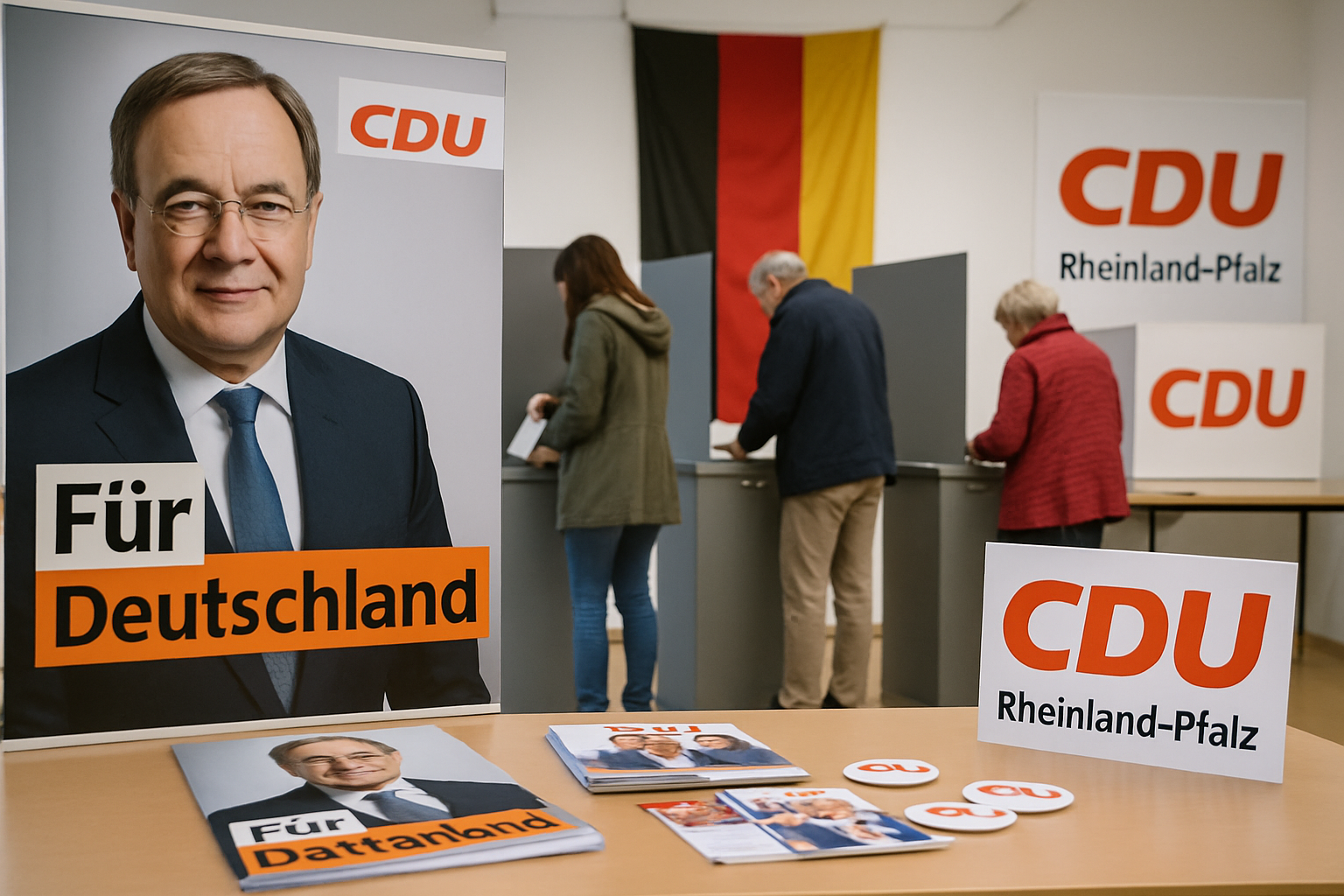
The Christian Democratic Union (CDU) has achieved a historic victory in Rhineland-Palatinate's state election on March 22, 2026, ending 35 years of Social Democratic Party (SPD) rule while the far-right Alternative for Germany (AfD) recorded its strongest-ever performance in western Germany with 20% of the vote.
According to the latest projections from ARD, CDU candidate Gordon Schnieder secured 30.5% of the vote (+2.8% from 2021), placing the party ahead of the governing SPD, which suffered its worst-ever result in the state with 27% (-8.7%). The AfD's breakthrough to 20% (+11.7%) represents the party's highest vote share in any western German state, signaling a significant political realignment in traditionally stable regions.
Power Shift After Three Decades
The result marks the first time since 1991 that the CDU has won an election in Rhineland-Palatinate, positioning Gordon Schnieder to replace SPD's Alexander Schweitzer as Minister-President. Speaking to supporters in Mainz, Schnieder declared, "The CDU is back," reflecting the party's confidence in forming the next government.
For Chancellor Friedrich Merz's CDU, this victory provides crucial momentum after the party's disappointing performance in Baden-Württemberg earlier this month, where they failed to reclaim power from the Greens. The Rhineland-Palatinate success offers validation for Merz's leadership strategy, particularly his firm stance against the AfD following his 91.2% re-election as party leader at the Stuttgart congress.
AfD's Western Breakthrough
The most striking development was the AfD's unprecedented success in western Germany. At 20% of the vote, the party nearly doubled its 2021 performance in Rhineland-Palatinate, demonstrating that far-right appeal is no longer confined to the economically struggling eastern states.
AfD candidate Jan Bollinger embraced Alice Weidel as results emerged, celebrating what represents the party's strongest performance in any western German state since its founding. The result builds on the party's 18% showing in Baden-Württemberg, suggesting a broader pattern of far-right normalization across traditionally conservative-liberal regions.
"This represents a fundamental shift in German political geography. The AfD is no longer an eastern phenomenon."
— Political Analyst, ARD
Coalition Mathematics and Democratic Isolation
Despite the AfD's strong showing, all mainstream parties have ruled out cooperation with the far-right party, maintaining Germany's democratic consensus. The CDU and SPD are likely to form a grand coalition, similar to arrangements in other German states, though the Greens could also play a kingmaker role with their 7.5% result.
The Free Democratic Party (FDP) suffered a devastating defeat, falling below the 5% threshold and losing all representation in the state parliament. This continues the FDP's struggles across Germany and raises questions about the party's future viability in an increasingly polarized political landscape.
National Implications for German Politics
The Rhineland-Palatinate result has significant implications for German federal politics. For Chancellor Merz, the victory demonstrates that his anti-extremist positioning and calls for centrist consolidation can succeed, providing political capital for upcoming state elections across Germany in 2026.
However, the AfD's breakthrough success also validates the party's strategy of "authoritarian innovation" – evolving from rural populism to competitive campaigning in prosperous regions. This represents a concerning development for democratic institutions, as it shows far-right movements can gain traction even in states with strong economic performance.
European Context and Democratic Resilience
The election results reflect broader European patterns of political realignment, with far-right parties gaining ground across the continent. The success occurs amid what observers describe as "the most challenging period for continental democracy since World War II," with 89% of Europeans demanding greater EU unity while political reality shows increasing fragmentation.
International observers are monitoring German developments closely, as the country's political stability has long served as an anchor for European democratic governance. The peaceful conduct of elections despite political tensions demonstrates institutional resilience, though the normalization of far-right support presents ongoing challenges.
Looking Ahead: Tests for German Democracy
The coalition negotiations in Rhineland-Palatinate will test Germany's capacity to maintain effective governance while isolating extremist parties. The incoming CDU-led government must address the concerns that drove voters toward the AfD – including immigration, economic anxiety, and perceived disconnect between political elites and ordinary citizens.
For the national political landscape, the results provide a template for how democratic parties can resist far-right pressure while maintaining electoral viability. The CDU's success suggests that clear anti-extremist positioning, combined with competent governance messaging, can still prevail in German politics.
However, with additional state elections scheduled across Germany throughout 2026, including in eastern states where the AfD traditionally performs even stronger, the Rhineland-Palatinate breakthrough may signal broader challenges ahead for German democratic institutions.
As Europe's largest democracy grapples with these political shifts, the international community will be watching closely to see whether Germany can maintain its role as a stabilizing force for European integration while addressing the domestic pressures that fuel political extremism.