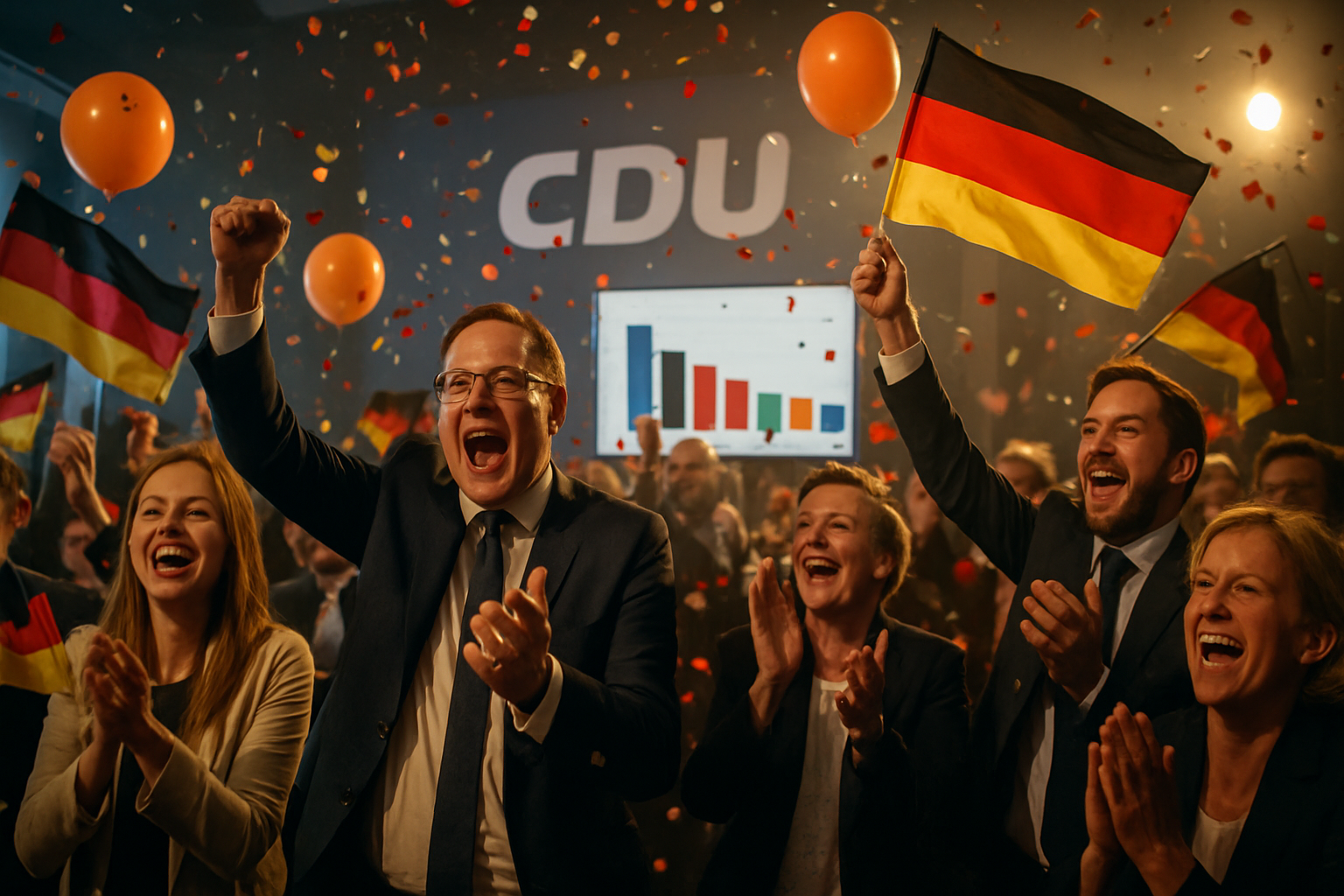
Germany's Christian Democratic Union (CDU) achieved a decisive victory in Rhineland-Palatinate's state election on Sunday, ending 35 years of Social Democratic Party (SPD) governance while the far-right Alternative for Germany (AfD) made historic gains in western Germany, capturing approximately 20% of the vote.
CDU candidate Gordon Schnieder secured victory over incumbent Minister-President Alexander Schweitzer, marking the first time since 1991 that the conservative party will lead the southwestern German state. The result represents a significant milestone for Chancellor Friedrich Merz, providing crucial momentum after the CDU's disappointing performance in Baden-Württemberg just two weeks earlier.
"The CDU is back," declared Schnieder at the party's election night celebration in Mainz, as supporters erupted in jubilation. The victory ends an era that began in 1991 when the SPD first took control of the state, establishing what many considered an unshakeable stronghold in German social democratic politics.
SPD Suffers Devastating Defeat in Former Stronghold
The defeat marks a catastrophic blow for the SPD, which has governed Rhineland-Palatinate continuously for over three decades. Schweitzer, who had been seen as a strong candidate capable of maintaining SPD dominance, conceded defeat early Sunday evening and ruled out serving in a government under CDU leadership.
The loss compounds the SPD's recent struggles, coming just weeks after the party's worst-ever performance in Baden-Württemberg. The consecutive defeats in two major states have intensified discussions about the party's national direction and leadership, with SPD chairman Lars Klingbeil acknowledging that "personnel debates" would follow.
"This is a hard setback for our party," Klingbeil said at the SPD headquarters in Berlin. "We need to reflect seriously on what went wrong and how we can reconnect with voters."
— Lars Klingbeil, SPD Chairman
The SPD's defeat in Rhineland-Palatinate is particularly significant given the party's federal responsibilities. As the junior partner in the national coalition government with the CDU, led by Chancellor Merz, the electoral losses raise questions about the party's ability to effectively advocate for its policy priorities at the federal level.
AfD Achieves Historic Western German Breakthrough
Perhaps the most striking development of the election was the AfD's unprecedented success in western Germany. The far-right party nearly doubled its previous support, reaching approximately 20% of the vote and becoming the third-largest party in the state parliament. This represents the strongest AfD performance in any western German state election to date.
The result challenges long-held assumptions about the geographic limitations of far-right appeal in Germany. While the AfD has consistently performed well in eastern German states, western regions were thought to be more resistant to populist messaging. The Rhineland-Palatinate breakthrough suggests the party has successfully adapted its strategy for more prosperous, traditionally centrist regions.
Political analysts describe this development as representing "authoritarian innovation" – the sophisticated evolution of far-right politics from rural populism to competitive campaigning in diverse constituencies. The success demonstrates the AfD's growing organizational capacity and message refinement, enabling it to compete effectively even in areas with strong democratic traditions.
Democratic Parties Maintain Isolation Strategy
Despite the AfD's historic performance, all democratic parties maintained their commitment to excluding the far-right from coalition negotiations. Both the CDU and SPD reaffirmed that cooperation with the AfD remains out of the question, preserving the democratic consensus that has characterized German politics since the party's emergence.
This stance reflects the continued strength of Germany's institutional safeguards against extremism, even as the political landscape becomes increasingly fragmented. The election demonstrates that while democratic institutions face pressure from rising populism, the fundamental commitment to democratic governance remains intact among mainstream parties.
Coalition Mathematics and Government Formation
The election results create complex coalition scenarios for forming a new state government. With the CDU emerging as the strongest party but lacking an absolute majority, Schnieder will need to negotiate partnerships to secure a governing coalition.
The most likely outcome appears to be a continuation of the "grand coalition" model, with the CDU and SPD working together despite their electoral competition. Such an arrangement would represent a role reversal from the previous government, with the CDU as the dominant partner and the SPD in a subordinate position.
Alternative coalition configurations could involve partnerships with smaller parties, though the specific arithmetic will depend on final seat distributions. The Greens, who secured approximately 7.5% of the vote, may play a kingmaker role in coalition negotiations.
Notably, both the Free Democratic Party (FDP) and the Left Party failed to clear the 5% threshold for parliamentary representation, further concentrating power among the major parties and reducing coalition options.
National Implications for German Politics
The Rhineland-Palatinate results carry significant implications for German federal politics. For Chancellor Merz, the victory provides validation of his leadership and anti-extremist positioning following his 91.2% re-election at the CDU's Stuttgart congress, where he vowed that the AfD would not "ruin our country."
The success offers the CDU crucial momentum ahead of additional state elections scheduled throughout 2026, potentially establishing a template for conservative resurgence across Germany. The party's ability to compete successfully against both social democratic incumbents and far-right challengers demonstrates its continued viability as Germany's primary center-right force.
However, the AfD's breakthrough presents ongoing challenges for all democratic parties. The result suggests that concerns about immigration, economic policies, and political establishment responsiveness continue to resonate with significant portions of the electorate, requiring sustained democratic responses beyond electoral competition.
European Context and International Observers
International observers have closely monitored the election as a bellwether for European democratic health. The results occur amid broader continental challenges to traditional party systems, including far-right advances in France, the Netherlands, and other EU member states.
The successful conduct of free and fair elections, combined with the maintenance of democratic coalition norms, demonstrates German institutional resilience. However, the AfD's growing appeal in prosperous western regions reflects patterns seen across Europe, where far-right movements have adapted their strategies for diverse constituencies.
The election serves as a test case for managing political extremism through democratic institutions rather than extra-legal measures. The preservation of democratic governance while addressing the concerns that fuel populist support remains a critical challenge for Germany and its European partners.
Economic and Social Factors
The election results reflect complex interactions between economic conditions, social change, and political preferences. Rhineland-Palatinate's relative prosperity – the state hosts significant industrial and technological sectors – suggests that economic grievances alone cannot explain the political shifts.
Instead, the results point to broader questions about political representation, cultural change, and institutional responsiveness that transcend simple economic explanations. The CDU's success in articulating a conservative vision that addresses both security concerns and economic competitiveness appears to have resonated with voters seeking stable governance.
The AfD's gains, meanwhile, reflect the party's success in broadening its appeal beyond economic dissatisfaction to encompass concerns about immigration, European integration, and national identity. This strategic evolution has enabled the party to compete in regions previously considered immune to far-right messaging.
Looking Ahead: Templates for Future Elections
The Rhineland-Palatinate election establishes important precedents for upcoming electoral contests across Germany and Europe. The CDU's victory demonstrates that center-right parties can successfully compete against both left-wing incumbents and far-right challengers through clear conservative messaging combined with democratic values.
For the SPD, the defeat necessitates fundamental reassessment of strategy, messaging, and leadership. The party's inability to maintain support in a traditional stronghold suggests deeper challenges beyond tactical adjustments, requiring comprehensive renewal to remain competitive.
The AfD's breakthrough provides the party with enhanced credibility and resources for future campaigns, while also intensifying scrutiny of its democratic commitments. The result will likely encourage far-right movements across Europe while strengthening resolve among democratic parties to maintain institutional safeguards.
As Germany faces additional state elections throughout 2026, the Rhineland-Palatinate results establish a new baseline for political competition. The successful defense of democratic institutions alongside significant political realignment provides a template for navigating populist pressure while preserving constitutional governance.
The election ultimately demonstrates both the resilience and adaptability of German democracy. While the political landscape continues evolving in response to changing public preferences, the fundamental commitment to democratic governance and institutional integrity remains strong, offering hope for continued stability amid ongoing challenges.