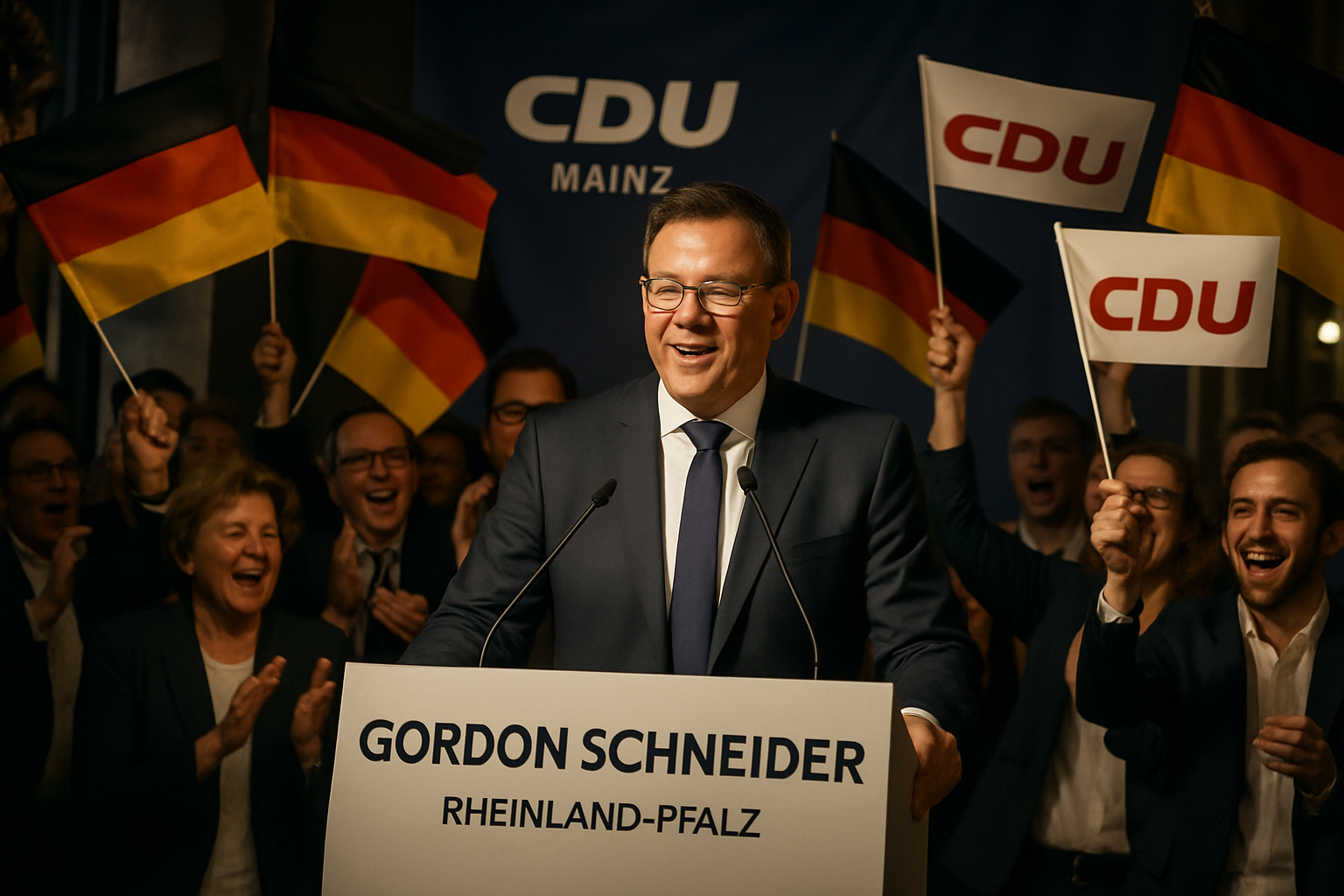
The Christian Democratic Union (CDU) has secured a decisive victory in Rhineland-Palatinate's state election, ending 35 years of Social Democratic Party (SPD) governance in a result that sends shockwaves through German politics and provides crucial momentum for Chancellor Friedrich Merz's leadership.
CDU challenger Gordon Schnieder declared "CDU is back" to jubilant supporters waving German flags and CDU banners at his victory celebration in Mainz on Sunday evening. The triumph represents a dramatic political reversal in a state that had been a traditional SPD stronghold since 1991, when the Social Democrats first took control of the southwestern German region.
Electoral Outcome and Coalition Mathematics
The election results demonstrate a fundamental realignment of German state politics, with the CDU emerging as the dominant force capable of forming the next government. Alexander Schweitzer, the SPD incumbent Minister-President, conceded defeat early in the evening and ruled out serving under a CDU-led government, marking a clean break from the previous coalition arrangement.
The most likely outcome points to a CDU-SPD grand coalition, but with dramatically reversed roles - the Christian Democrats will now serve as the senior partner while the SPD faces the prospect of junior participation after more than three decades in power. The Greens, securing approximately 7.5% of the vote, may play a crucial kingmaker role in complex coalition negotiations.
All major parties maintained their principled stance of refusing cooperation with the far-right Alternative for Germany (AfD), preserving democratic consensus despite the party's breakthrough performance. This institutional safeguard demonstrates the resilience of German democratic norms even amid significant political disruption.
AfD Reaches Historic Western Breakthrough
Perhaps the most significant development was the AfD's surge to approximately 20% support, nearly doubling their previous performance and achieving their strongest showing in any western German state. This breakthrough challenges long-held assumptions about the far-right party's appeal being limited to eastern regions and represents what political analysts describe as "authoritarian innovation" - the sophisticated evolution from rural populism to competitive campaigning across diverse constituencies.
The AfD's success in Rhineland-Palatinate mirrors broader European patterns of far-right advancement, including Marine Le Pen's National Rally gains in France and the Sweden Democrats' cooperation with mainstream parties. However, the maintenance of democratic isolation through coalition exclusion provides a template for managing extremist pressure while preserving constitutional frameworks.
National Implications for Merz Government
The victory provides Chancellor Friedrich Merz with crucial political momentum following the CDU's disappointment in Baden-Württemberg, where the party failed to reclaim power from the Greens under Cem Özdemir. The Rhineland-Palatinate success validates Merz's anti-extremist positioning, demonstrated at February's Stuttgart congress where he secured 91.2% re-election as party leader while vowing that the AfD would not "ruin our country."
The result demonstrates the CDU's capacity to compete effectively against both traditional rivals and populist challengers, providing a potential template for upcoming 2026 state elections. For Merz personally, the victory offers vindication of his leadership approach combining centrist consolidation with clear opposition to political extremism.
SPD Crisis Deepens
The defeat compounds a series of setbacks for the Social Democrats, following their loss of Baden-Württemberg and contributing to broader concerns about the party's federal coalition performance. SPD Chairman Lars Klingbeil acknowledged the result as a "hard setback" and promised upcoming "personnel debates," suggesting potential leadership changes may be considered in response to consecutive major state defeats.
The SPD's struggle in Rhineland-Palatinate, despite having the more personally popular candidate in Alexander Schweitzer, indicates deeper structural challenges beyond individual personalities. The party now faces fundamental questions about messaging and strategy as it confronts a changing political landscape where traditional working-class coalitions no longer guarantee electoral success.
According to analysis from German media, the CDU's victory was built particularly on landespolitik (state-level issues), demonstrating effective local campaigning that resonated with voter concerns about regional governance, infrastructure, and economic development. This focus on practical governance issues may have helped the party appeal to voters across traditional partisan divides.
Berlin Reacts to Political Earthquake
In Berlin, party leadership meetings are scheduled today as political organizations assess the implications of the dramatic electoral shift. SPD Fraktionschef Matthias Miersch stated that the party should avoid getting caught up in a "Personaldebatte" (personnel debate), though internal discussions about strategic direction appear inevitable given the magnitude of the defeat.
The result has prompted broader reflection about the state of German democracy and the effectiveness of mainstream parties in addressing citizen concerns about immigration, economic challenges, and political representation. The traffic light coalition in Mainz has been "krachend abgewählt" (resoundingly voted out), as described in German media, sending a clear message that voters sought change from the existing arrangement.
Democratic Resilience Under Test
Despite the electoral disruption, the Rhineland-Palatinate election demonstrated the continued strength of German democratic institutions. High voter turnout, smooth electoral operations, and the successful conduct of free and fair elections under challenging political circumstances reinforce confidence in the country's administrative competence and electoral integrity.
International observers have noted the election as a bellwether for European democratic health, given Germany's leadership role in the European Union. The successful channeling of political tensions through electoral competition while maintaining institutional safeguards provides a model for other democracies facing similar pressures from political extremism and social polarization.
Looking Forward: Coalition Negotiations and Future Elections
The coming weeks will be crucial as parties negotiate coalition arrangements in what promises to be complex discussions. The CDU's victory margin provides them with strong bargaining power, but the need to secure stable governance will require careful management of relationships with potential coalition partners.
The Rhineland-Palatinate result will undoubtedly influence the trajectory of upcoming German state elections in 2026, as parties assess the effectiveness of different campaign strategies and policy positions. The CDU's success in combining anti-extremist messaging with practical governance proposals may serve as a template for other contests.
For German politics more broadly, the election represents a significant moment in the post-Merkel era, demonstrating the continuing evolution of the country's political landscape. The result shows that despite challenges from both populist and traditional opponents, the center-right remains capable of building winning coalitions when it effectively addresses voter concerns while maintaining democratic principles.
As Gordon Schnieder prepares to form a new government in Mainz, the broader implications of this electoral earthquake will continue to resonate through German and European politics, providing lessons about democratic resilience, electoral competition, and the ongoing challenge of governing effectively in an era of political polarization and social change.