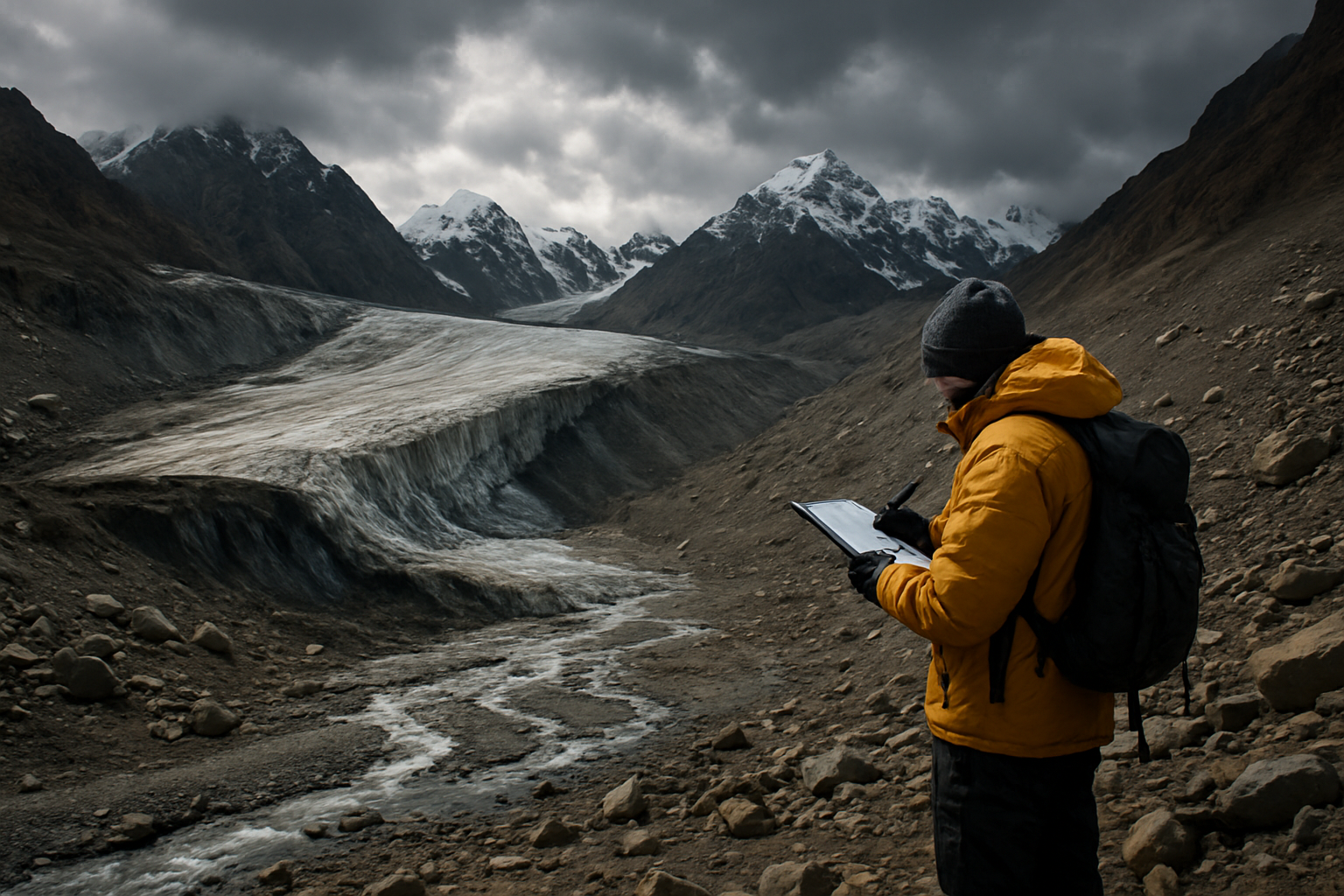
A groundbreaking documentary examining Central Asia's rapidly disappearing glaciers has sounded urgent warnings about the region's water future, as new research reveals ice loss equivalent to the area of Vienna occurring annually in some of the world's most critical mountain watersheds.
The premiere screening of "Alatau: Following the Disappearing Glaciers," a collaborative Kazakh-Kyrgyz production, took place on March 11 at the UN Plaza building in Almaty, bringing together diplomats, scientists, government officials, and environmental experts to confront the accelerating water crisis facing Central Asia. The event highlighted what scientists are calling an unprecedented threat to regional stability as glacier-fed water systems that sustain over 100 million people across the region face catastrophic decline.
Glacial Retreat Accelerates at Unprecedented Rate
The documentary's findings align with alarming new research showing that vulnerable sections of Central Asian glaciers are losing ice at unprecedented rates. A comprehensive 30-year study revealed that annual ice loss now equals the Vienna area every year, representing massive frozen water reserve reductions that have accelerated dramatically since 1996. The total ice retreat documented since that time spans 12,820 square kilometers—an area larger than Qatar.
Dr. Ainur Tuyakova, a glaciologist featured in the documentary, emphasized the regional implications: "What we're witnessing in the Tian Shan and other Central Asian ranges isn't just environmental change—it's a fundamental transformation of the water systems that form the backbone of our civilization. These glaciers feed the Amu Darya, Syr Darya, and dozens of other river systems that sustain agriculture, cities, and ecosystems across Kazakhstan, Kyrgyzstan, Uzbekistan, Tajikistan, and beyond."
Water Security Implications for 100 Million People
Central Asia's glacial systems serve as natural water towers, storing precipitation as ice during cold periods and releasing it gradually throughout the year. This natural regulation system has sustained the region's agriculture, urban centers, and ecosystems for millennia. However, the accelerating melt threatens to disrupt this delicate balance, potentially creating a future of extreme seasonal variations—devastating floods followed by prolonged droughts.
Kazakhstan has already taken steps to address the growing water crisis. The country's National Hydrogeological Service completed a nationwide inventory identifying 711 potential springs, representing the most comprehensive water resource mapping in the nation's history. This initiative, combining traditional knowledge with modern hydrogeological science, demonstrates the urgent need for alternative water sources as glacial flows become increasingly unreliable.
The implications extend far beyond national borders. Water from Central Asian glaciers flows into the Aral Sea basin, once the world's fourth-largest lake, now largely dried due to irrigation demands and climate change. The disappearing glaciers threaten to accelerate this environmental catastrophe while creating new ones downstream.
Climate Change Context: Record-Breaking Temperature Rise
The documentary's release comes as global climate records continue to shatter. January 2026 marked the hottest month in recorded history, extending a streak of 19 consecutive months with temperatures exceeding 1.5°C above pre-industrial levels. This sustained warming, which has overridden natural climate variability including La Niña cooling effects, demonstrates that human-induced climate change has fundamentally altered atmospheric systems beyond natural recovery mechanisms.
For Central Asia, this global warming translates into particularly severe impacts on high-altitude glacier systems. The region's mountain ranges, including the Tian Shan, Pamir, and Hindu Kush, are experiencing temperature increases at rates nearly double the global average. Summer temperatures that once remained below freezing at glacier elevations now regularly exceed the melting point, creating runoff patterns that were unimaginable just decades ago.
Regional Cooperation and Innovation
The collaborative nature of "Alatau: Following the Disappearing Glaciers" reflects growing regional cooperation in addressing transboundary water challenges. Kazakhstan and Kyrgyzstan, despite occasional tensions over water allocation, have recognized that glacier loss represents an existential threat requiring coordinated response rather than competition.
Kazakhstan has positioned itself as a regional leader in climate adaptation and water management innovation. The country's forthcoming Regional Ecological Summit 2026 (RES 2026), scheduled for April 22-24 with the theme "Shared Vision Sustainable Future," will bring together Central Asian leaders to develop coordinated climate action strategies. The summit represents a shift from national approaches to integrated regional planning recognizing that water systems and climate impacts transcend political boundaries.
The nation has also invested heavily in water management technology and expertise. Through partnerships with European institutions, including a dual master's degree program with Corvinus University Budapest, Kazakhstan is building world-class capacity in water diplomacy and management. Thirteen specialists completed the program in November 2025, bringing cutting-edge expertise in international water law, climate adaptation, and cooperative resource management to the region.
Technology and Traditional Knowledge Integration
The documentary highlights how effective glacier monitoring and water management requires sophisticated integration of cutting-edge technology with traditional ecological knowledge. Remote sensing, satellite tracking, and environmental monitoring provide real-time data on glacier retreat rates, snowpack changes, and water flow patterns. However, this technological capacity becomes most effective when combined with the deep understanding that mountain communities have developed over generations.
Kazakh herders and Kyrgyz mountain communities possess detailed knowledge of seasonal water patterns, traditional conservation methods, and early warning indicators for environmental change. The documentary features interviews with elderly community members who describe changes in glacier behavior, spring flow timing, and weather patterns that span decades—knowledge that proves invaluable for calibrating scientific measurements and understanding regional variations in climate impacts.
Economic and Social Implications
The economic implications of Central Asia's glacier retreat extend across multiple sectors and national boundaries. Agriculture, which employs millions across the region and generates billions in export revenue, faces fundamental challenges as water availability becomes increasingly unpredictable. Cotton production in Uzbekistan, wheat cultivation in Kazakhstan, and fruit orchards in Kyrgyzstan all depend on reliable water supplies that originate in glacial systems now under severe stress.
Urban areas face equally serious challenges. Almaty, Central Asia's largest city with over 2 million residents, depends heavily on glacial meltwater for municipal supply. Bishkek, Tashkent, and dozens of smaller cities across the region face similar vulnerabilities. The documentary features sobering projections suggesting that without adaptive management, some urban areas could face severe water shortages within the next two decades.
The energy sector also faces disruption. Central Asia's substantial hydroelectric capacity, which provides clean energy for the region and export markets, depends on consistent water flows. As glacial contributions to river systems become more erratic, hydroelectric reliability will decrease, forcing greater reliance on fossil fuels or massive investments in alternative energy infrastructure.
International Cooperation and Climate Finance
Addressing Central Asia's glacier crisis requires unprecedented international cooperation and climate finance. The scale of adaptation needed—ranging from water infrastructure modernization to agricultural system transformation—exceeds the fiscal capacity of individual nations in the region. The documentary emphasizes how climate change represents a global challenge requiring global solutions, even as its impacts fall disproportionately on developing regions.
Kazakhstan has emerged as a regional advocate for international climate finance and cooperation. The country's participation in global climate initiatives, combined with its domestic investments in renewable energy and water management, positions it to leverage international partnerships for regional benefit. The recent announcement of a 1-gigawatt wind power project with French energy giant TotalEnergies demonstrates how international cooperation can simultaneously address climate change and build adaptive capacity.
Future Scenarios and Adaptation Pathways
The documentary presents multiple scenarios for Central Asia's water future, ranging from optimistic outcomes based on rapid global climate action to catastrophic projections assuming continued warming trends. Under current trajectory, the region could lose 50-80% of its glacial ice mass by 2100, fundamentally altering the hydrology of an area larger than Western Europe.
However, the film also highlights potential adaptation pathways that could maintain water security even under challenging climate scenarios. These include massive infrastructure investments in water storage and distribution, agricultural transformation toward drought-resistant crops and water-efficient farming methods, and regional cooperation mechanisms for sharing water resources during times of scarcity.
Advanced technologies offer additional possibilities. Atmospheric water generation, desalination powered by renewable energy, and precision irrigation systems could help bridge gaps between water supply and demand. The documentary features innovations already being tested across Central Asia, including solar-powered water pumping systems and smart irrigation networks that optimize water use based on real-time soil and weather data.
Call for Immediate Action
The premiere of "Alatau: Following the Disappearing Glaciers" concluded with urgent calls for immediate action across multiple levels—from individual water conservation to international climate policy. Speakers emphasized that while the challenges are unprecedented, the tools and knowledge exist for effective responses if implemented with sufficient speed and coordination.
Dr. Bakyt Altynbek, coordinator of the film project, stressed the temporal urgency: "Every month of delay in addressing glacier loss represents water security that we can never recover. The ice that melts this summer was accumulated over centuries. Once it's gone, it cannot be replaced within any human timeframe. We must act now, not just to slow glacier retreat, but to build the infrastructure and institutions that can maintain water security as our climate continues changing."
The documentary serves as both warning and call to action, demonstrating that Central Asia's glacier crisis represents a preview of water challenges that will affect billions globally as climate change accelerates. The region's response—combining traditional knowledge with cutting-edge technology, national initiatives with international cooperation, immediate adaptation with long-term planning—may provide a model for water security in an era of environmental uncertainty.
As temperatures continue breaking records and glacier retreat accelerates, the window for effective action is rapidly narrowing. The message from Central Asia is clear: the time for incremental responses has passed, and only transformative action at unprecedented speed and scale can maintain water security for the millions who depend on these ancient ice reserves that are disappearing before our eyes.