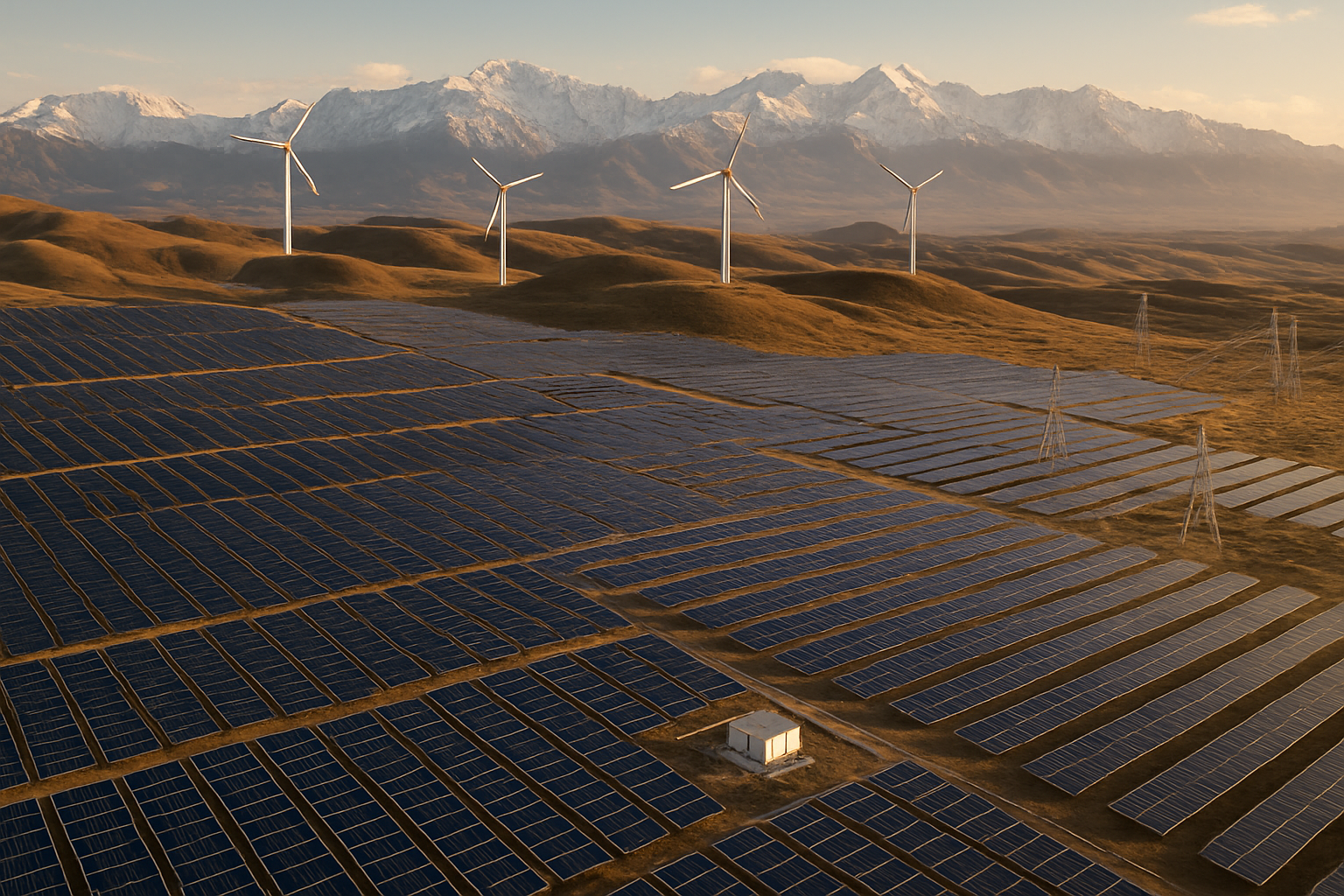
Kazakhstan's lower chamber of parliament has ratified a historic strategic partnership agreement for green energy production and transmission with Azerbaijan and Uzbekistan, while Azerbaijan pioneers the integration of solar power into critical telecommunications infrastructure, signaling Central Asia's emergence as a major player in the global renewable energy transition.
The agreement, originally signed on November 13, 2024, in Baku, was presented to Kazakhstani lawmakers by Energy Minister Yerlan Akkenzhenov on March 11, 2026, establishing the world's first transcontinental green energy corridor connecting Central Asia to European markets. This milestone comes as Azerbaijan's telecommunications company Aztelekom launched the region's inaugural solar-powered GPON (Gigabit Passive Optical Network) stations in the villages of Qarasaqqal and Mollakənd in Kurdəmir District.
Revolutionary Telecommunications Solar Integration
Azerbaijan's deployment of solar energy systems at critical telecommunications infrastructure represents a breakthrough in sustainable technology integration. The GPON Optical Line Terminal (OLT) stations now feature alternative power supply systems that ensure uninterrupted connectivity while reducing dependence on traditional grid electricity. This innovation addresses one of the most persistent challenges in rural telecommunications: reliable power supply for essential digital infrastructure.
The solar installations demonstrate Azerbaijan's commitment to positioning itself as the regional energy coordination hub recognized by the U.S. Chamber of Commerce. With current U.S.-Azerbaijan trade valued at $74.9 million annually and potential expansion from Azerbaijan's $27.2 billion in global exports, the country is strategically leveraging renewable energy to enhance its East-West energy coordinator role.
Historic Green Energy Corridor Framework
The Kazakhstan-Azerbaijan-Uzbekistan green energy partnership represents the most ambitious renewable energy cooperation framework in Central Asian history. According to historical context from previous regional initiatives, this agreement builds on Azerbaijan's extensive experience in energy infrastructure development, including bp's $3.4 billion investment in the Shah Deniz gas field and ongoing development of Black Sea green power corridors requiring the world's longest and deepest subsea cables.
Kazakhstan brings significant renewable energy potential to this partnership, with previous analysis showing the country's commitment to technological innovation through projects like the planned CIS region's first environmentally friendly automotive and aviation fuels production facility. The nation's multi-vector diplomacy approach, maintaining strategic relationships across different systems while preserving autonomy, positions it ideally for this transcontinental energy cooperation.
"Central Asia is not merely a neighbor for Azerbaijan, but a natural partner,"
— Farid Shafiyev, Chairman of the Center of Analysis of International Relations (CAIR)
Regional Energy Security Transformation
The timing of this green energy corridor is particularly significant given the global energy security challenges highlighted in our previous reporting. With natural gas prices having surged 24% in Europe and 78% in the United States, and persistent supply chain vulnerabilities where China controls 60% of production and 90% of refining capacity for lithium, cobalt, and rare earth elements, Central Asian renewable energy development offers crucial diversification.
The U.S.-EU-Japan Critical Minerals Partnership, involving 55 countries including seven African alternative suppliers, recognizes the strategic importance of diversifying critical materials supply chains. Central Asia's renewable energy projects contribute to this global effort by reducing dependence on traditional energy systems while developing domestic capabilities in clean energy technologies.
Climate Urgency and International Cooperation
These developments occur during what climate scientists have confirmed as unprecedented global warming, with January 2026 marking the 18th consecutive month exceeding 1.5°C above pre-industrial levels. The sustained warming demonstrates that human-induced climate change is fundamentally altering atmospheric systems beyond natural recovery mechanisms, making rapid renewable energy deployment essential.
Estonia's renewable energy leadership, achieving 88% renewable electricity in 2024 and operating continental Europe's largest battery storage facility serving 90,000 households, provides a template that Central Asian nations are adapting to their specific geographic and economic contexts. Similarly, Romania's advancement of a €1 billion Battery Energy Storage System with 2,500 MW capacity demonstrates the scale of infrastructure investment required for successful energy transitions.
Economic Multiplier Effects
The economic implications of Central Asia's renewable energy surge extend far beyond electricity generation. Historical analysis of similar projects shows that energy infrastructure creates significant multiplier effects through increased commerce, technical capacity building, and regional integration. The green energy corridor will generate thousands of specialized jobs across construction, maintenance, and engineering sectors while positioning Central Asia as a technology hub for sustainable energy development.
Azerbaijan's economic diversification has already achieved remarkable results, with non-oil GDP reaching 52.7% of total output as of December 2025, representing 8.6% growth in non-oil sectors. This economic transformation provides a foundation for sustainable renewable energy investment that doesn't rely solely on traditional energy exports.
Technology Integration and Innovation
Modern renewable energy projects in Central Asia incorporate sophisticated technology integration including digital monitoring, smart grid management, automated efficiency systems, and predictive maintenance capabilities. The solar-powered telecommunications infrastructure in Azerbaijan exemplifies this approach, combining renewable generation with critical communications technology to create resilient, sustainable systems.
The success of these initiatives depends on the sophisticated synthesis of cutting-edge technology with traditional energy systems and local knowledge. Kazakhstan's approach to renewable development demonstrates this integration, combining international partnerships with domestic expertise to create locally-adapted solutions that contribute to global sustainability goals.
Geopolitical and Strategic Implications
Central Asia's emergence as a renewable energy powerhouse represents a fundamental shift in global energy geopolitics. The region's strategic positioning between Europe and Asia, combined with abundant renewable energy resources and growing technical capabilities, positions these nations as crucial players in the global clean energy transition.
The February 2026 C6 conference in Baku established institutional frameworks for sustained regional cooperation, including working groups, joint investment committees, and monitoring mechanisms. This diplomatic infrastructure supports the practical implementation of renewable energy projects while maintaining the sovereignty and strategic autonomy that characterize Central Asian foreign policy approaches.
Implementation Challenges and Solutions
Despite the promising developments, significant implementation challenges remain. Financing sustainability is particularly critical for developing nations where economic pressures can override environmental considerations. Technical capacity building requires sustained investment in education, training, and institutional development. Climate change itself disrupts project timelines, requiring adaptive management capabilities for rapidly changing conditions.
Success factors identified from previous renewable energy initiatives include community ownership and engagement, transparent governance frameworks, economic viability that creates opportunities rather than imposing costs, and the integration of traditional knowledge with modern technology. The diversity of approaches across Central Asia provides resilience against single-solution dependencies while offering multiple pathways for climate adaptation.
Global Template for Renewable Energy Cooperation
The Central Asian green energy corridor provides a template for similar initiatives worldwide. The combination of transcontinental cooperation, telecommunications infrastructure integration, and strategic energy positioning demonstrates how renewable energy development can serve multiple objectives simultaneously: energy security, economic development, climate action, and international cooperation.
As the window for effective climate action continues to narrow, with ecological systems approaching critical thresholds that could trigger irreversible changes, Central Asia's proactive approach to renewable energy development offers crucial momentum for global environmental cooperation. The tools, knowledge, and cooperation frameworks exist for comprehensive renewable energy deployment, but success requires unprecedented speed and coordination.
Future Trajectory and Strategic Significance
March 2026 represents a critical juncture for global renewable energy development, with Central Asia positioning itself at the forefront of the clean energy transition. The success of the Kazakhstan-Azerbaijan-Uzbekistan green energy corridor could catalyze additional international investment and cooperation throughout the region, establishing Central Asia as a technology hub for sustainable energy development extending far beyond traditional energy exports.
The convergence of technological advancement, environmental urgency, and international cooperation creates unprecedented conditions for accelerated renewable energy deployment. Central Asia's comprehensive approach, combining immediate infrastructure needs with long-term sustainability capabilities, demonstrates how resource-rich regions can transform their energy sectors while maintaining economic growth and strategic autonomy.
The strategic significance of these developments extends beyond energy policy to encompass economic development, international relations, and climate action. As traditional energy markets face increasing volatility and environmental pressure, Central Asia's renewable energy leadership provides essential momentum for the global transition to sustainable energy systems during the critical climate action decade ahead.